



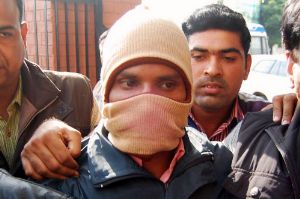
Samjhauta accused involved in 2002 Gujarat riots?

January 13, 2013

Samjhauta

New Delhi, Jan 13: The accused in the series of blasts linked to Hindu terror had also participated in the 2002 Gujarat riots that claimed over 1,600 lives. Investigations by the National Investigation Agency (NIA) have found that some of those accused in blasts such as the Samjhauta Express, Hyderabad's Mecca Masjid, Ajmer Dargah and Malegaon had gone to Gujarat during the 2002 riots on the instructions of slain RSS pracharak Sunil Joshi.

The new revelation shows that the radicalized group's tilt towards violence had begun much before they started exploding bombs in Muslim-dominated places like Malegaon and Hyderabad.

Sources said, Lokesh Sharma, who has been arrested in connection with the Samjhauta Express and 2006 Malegaon blasts, has revealed during interrogations that following the burning of 59 kar sevaks in a train near Godhra in February, 2002, by Muslim fundamentalists, there was lot of pent-up anger among right-wing Hindu groups even in Madhya Pradesh. As the riots broke out in Gujarat, Joshi asked Lokesh to head to Gujarat and participate in the riots, sources said.

"Lokesh has said that he duly followed the orders and also killed several people during the riots as part of a mob," said an official privy to the interrogation. Lokesh, however, is not aware if Joshi himself or others in the group also took part in the riots.

NIA, however, suspects that if Joshi had sent Lokesh, he could have asked others close to him to carry out a similar task. Other accused in NIA's custody, however, have not revealed any information as yet on this. Rajender Chaudhary, Manohar Singh, Dhan Singh and Lokesh Sharma are in NIA custody in connection with several blasts.

"Initially, however, there actions were not well organized or coordinated and most acted independently. Although, their extreme radicalization had begun after the 1992 Babri Masjid demolition," said the official.

However, the first recorded anti-minority crime against the group members traces back to 2001, when they had shot a nun in the face from a running bike on Ujjain-Dewas road in MP. This was followed by participation in Gujarat riots, and then lobbing a grenade at a mosque in Jammu in 2004 that led to death of two persons and 15 others getting injured.

It was in 2004 that the group first got organized under the leadership of Pragya Singh Thakur, who had called the accused to Ujjain Kumbh Mela and discussed carrying out coordinated attacks on minority religious places and gatherings. What followed was a series of attacks and blasts ranging from 2005 bid on the life of acquitted accused in 2001 Parliament attack case SAR Geelani in Delhi, blasts in Malegaon in 2006, Samjhauta Express, Ajmer Dargah and Mecca Masjid in 2007, and again in Malegaon in 2008.

Comments

Add new comment

  • Coastaldigest.com reserves the right to delete or block any comments.
  • Coastaldigset.com is not responsible for its readers’ comments.
  • Comments that are abusive, incendiary or irrelevant are strictly prohibited.
  • Please use a genuine email ID and provide your name to avoid reject.
News Network
January 22,2020

Jan 22: India's ranking in the latest global Democracy Index has dropped 10 places to the 51st spot out of 167 owing to violent protests and threats to civil liberties challenging freedoms across the country.

Prime Minister Narendra Modi's government has been criticized by rights groups and western governments after shutting off the internet and mobile phone networks and detaining opposition politicians in Kashmir.

Modi’s government has also responded harshly to ongoing protests against a controversial, religion-based citizenship law. Muslims have said their neighborhoods have been targeted, while the central government has attempted to ban protests and urged TV news channels not to broadcast “anti-national” content. Some leaders in Modi’s ruling party called for “revenge” against protesters. India’s score in 2019 was its worst ranking since the EIU’s records began in 2006, and has fallen gradually since Modi was elected in 2014.

The Economist Intelligence Unit’s 2019 Democracy Index, which provides an annual comparative analysis of political systems across 165 countries and two territories, said the past year was the bleakest for democracies since the research firm began compiling the list in 2006.

“The 2019 result is even worse than that recorded in 2010, in the wake of the global economic and financial crisis,” the research group said in releasing the report on Wednesday.

The average global score slipped to 5.44 out of a possible 10 -- from 5.48 in 2018 -- driven mainly by “sharp regressions” in Latin America, Sub-Saharan Africa, the Middle East and North Africa. Apart from coup-prone Thailand, which improved its score after holding an election last year, there were also notable declines in Asia after a tumultuous period of protests and new measures restricting freedom across the region’s democracies.

Asia Declines

Hong Kong, meanwhile, fell three places to rank 75th out of 167 as more than seven months of violent and disruptive protests rocked the Asian financial hub. An aggressive police response early in the unrest, when protests were mostly peaceful, led to a “marked decline in confidence in government -- the main factor behind the decline in the territory’s score in our 2019 index,” the group said.

In Singapore, which ranked alongside Hong Kong at 75th, a new “fake news” law led to a deteriorating score on civil liberties.

“The government claims that the law was enacted simply to prevent the dissemination of false news, but it threatens freedom of expression in Singapore, as it can be used to curtail political debate and silence critics of the government,” EIU analysts said.

China’s score fell to just 2.26 in the EIU’s ranking, placing it near the bottom of the list at 153, as discrimination against minorities, repression and surveillance of the population intensified. Still, in China “the majority of the population is unconvinced that democracy would benefit the economy, and support for democratic ideals is absent,” the EIU said.

Comments

Add new comment

  • Coastaldigest.com reserves the right to delete or block any comments.
  • Coastaldigset.com is not responsible for its readers’ comments.
  • Comments that are abusive, incendiary or irrelevant are strictly prohibited.
  • Please use a genuine email ID and provide your name to avoid reject.
News Network
May 14,2020

London, May 14: Fugitive liquor baron Vijay Mallya on Thursday urged the Central government to accept his offer to repay 100 per cent of his loan dues and close the case against him.

While congratulating the Centre for introducing Rs 20 lakh crore relief package to boost the economy amid the coronavirus lockdown, Mallya, lamented that his repeated attempts to pay back his dues have been ignored by the Indian government.

"Congratulations to the Government for a Covid 19 relief package. They can print as much currency as they want BUT should a small contributor like me who offers 100% payback of State-owned Bank loans be constantly ignored? Please take my money unconditionally and close," he tweeted.

Earlier this month, Mallya had sought permission to appeal against a ruling ordering his extradition to India in Britain's highest court the UK Supreme Court.

The application comes two weeks after the High Court in London - the UK's second-highest court - dismissed Mallya's appeal against a lower court ruling that he be sent to India to face charges of defrauding a consortium of Indian banks of more than Rs 9,000 crores relating to the collapse of Kingfisher Airlines in 2012.

Comments

Add new comment

  • Coastaldigest.com reserves the right to delete or block any comments.
  • Coastaldigset.com is not responsible for its readers’ comments.
  • Comments that are abusive, incendiary or irrelevant are strictly prohibited.
  • Please use a genuine email ID and provide your name to avoid reject.
News Network
February 9,2020

New Delhi, Feb 9: Calling India a "long-standing friend", Sri Lankan Prime Minister Mahinda Rajapaksa on Saturday thanked Prime Minister Narendra Modi for visiting his country in the aftermath of last year's Easter Sunday terror attacks and outlined that New Delhi has always helped Colombo in its fight against terrorism.

In a joint press briefing with PM Modi, Mahinda Rajapaksa said he hopes that India will continue to help Sri Lanka fight terrorism.

Mahinda Rajapaksa expressed his gratitude to PM Modi for the neighbourhood first policy and the priority India gives to Sri Lanka.

"We had agreed that our cooperation is multifaceted and priority is given to a number of areas including security, economy, culture and social sectors. Part of our discussions centered on cooperation with regard to the security of the two countries. India has always assisted Sri Lanka to enhance our capacity, capabilities in intelligence and counter-terrorism. We look forward to getting continued support in this regard," he said.

"I thank the Prime Minister for visiting Sri Lanka in the aftermath of the Easter Sunday terror attacks that provided us with immense strength to come to terms with the tragedy. We also appreciate Prime Minister Modi's $400 million line of credit to enhance the economy of Sri Lanka and another $50 million line of credit for fighting terrorism," he added.

The Sri Lankan president urged PM Modi to consider further assistance to expand housing projectS all over Sri Lanka to benefit people from rural areas.

"The Prime Minister and I discussed how Sri Lanka and India can work together in the field of economy. India is among the world's fastest growing economies. I discussed with PM Modi how Sri Lanka could benefit from certain economic sectors where India is in a strong position," he said.

Concluding his statement, Mahinda Rajapaksa said, "India is our closest neighbour and a long-standing friend. The close historical links...provided a solid foundation to our ties."

Comments

Add new comment

  • Coastaldigest.com reserves the right to delete or block any comments.
  • Coastaldigset.com is not responsible for its readers’ comments.
  • Comments that are abusive, incendiary or irrelevant are strictly prohibited.
  • Please use a genuine email ID and provide your name to avoid reject.