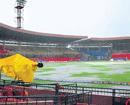
Fire erupts at Chinnaswamy stadium

February 16, 2013

stadiumBangalore, Feb 16: A minor fire broke out this morning at Chinnaswamy stadium where the Indian cricket team began their three-day training camp ahead of their Test series against Australia but the incident did not disrupt the practice session of Mahendra Singh Dhoni and his men.

The fire broke out at the Members Stand when a white cloth placed as a temporary sightscreen caught fire as a consequence of routine maintenance work which involved a bit of welding, Karnataka State Cricket Academy Secretary Javagal Srinath said in a statement.

Srinath, a former India pacer, said in less than a couple of minutes, the in-house fire safety equipment was used to douse the fire and bring the situation under control.

The Indian players were undergoing their practice session at the ground at that time in preparation of their Test series against Australia beginning in Chennai from February 22.

"Practice wasn't affected in any way with a new sight screen deployed immediately afterwards," Srinath said.

Comments

Add new comment

  • Coastaldigest.com reserves the right to delete or block any comments.
  • Coastaldigset.com is not responsible for its readers’ comments.
  • Comments that are abusive, incendiary or irrelevant are strictly prohibited.
  • Please use a genuine email ID and provide your name to avoid reject.
News Network
April 23,2020

Washington, Apr 23: Air pollution over northern India has plummeted to a 20-year-low for this time of the year, according to satellite data published by US space agency National Aeronautics and Space Administration (NASA).
The US space agency's satellite sensors observed aerosol levels at a 20-year low post the countrywide lockdown, implemented to slow the spread of the novel coronavirus.

"We knew we would see changes in atmospheric composition in many places during the lockdown," said Pawan Gupta, a Universities Space Research Association (USRA) scientist at NASA''s Marshall Space Flight Center. "But I have never seen aerosol values so low in the Indo-Gangetic Plain at this time of year," added Mr Gupta.

Acting Assistant Secretary of State for South and Central Asia Alice G Wells tweeted, "These images from NASA were taken each spring starting in 2016 and show a 20-year low in airborne particle levels over India. When India and the world are ready to work and travel again, let's not forget that collaborative action can result in cleaner air."

The data published with maps show aerosol optical depth (AOD) in 2020 compared to the average for 2016-2019. Aerosol optical depth is a measure of how light is absorbed or reflected by airborne particles as it travels through the atmosphere.

If aerosols are concentrated near the surface, an optical depth of 1 or above indicates very hazy conditions. An optical depth, or thickness, of less than 0.1 over the entire atmospheric vertical column is considered "clean." The data were retrieved by the Moderate Resolution Imaging Spectroradiometer (MODIS) on NASA's Terra satellite.

In the first few days of the lockdown, it was difficult to observe a change in the pollution signature. "We saw an aerosol decrease in the first week of the shutdown, but that was due to a combination of rain and the lockdown," said Mr Gupta.

Around March 27, heavy rain poured over vast areas of northern India and helped clear the air of aerosols. Aerosol concentrations usually increase again after such heavy precipitation.

"After the rainfall, I was really impressed that aerosol levels did not go up and return to normal. We saw a gradual decrease and things have been staying at the level we might expect without anthropogenic emissions," Mr Gupta said.

On March 25, the Indian government placed its 1.3 billion citizens under a strict lockdown to reduce the spread of COVID-19. The countrywide mandate decreased activity at factories and severely reduced car, bus, truck and airplane traffic. Every year, aerosols from anthropogenic (human-made) sources contribute to unhealthy levels of air pollution in many Indian cities.

Aerosols are tiny solid and liquid particles suspended in the air that reduce visibility and can damage the human lungs and heart.

In southern India though, the story is a little hazier. Satellite data show aerosol levels have not yet decreased to the same extent. In fact, levels seem to be slightly higher than in the past four years. The reasons are unclear but could be related to recent weather patterns, agricultural fires, winds or other factors.

"This a model scientific experiment," Robert Levy, program leader for NASA's MODIS aerosol products, said about the lockdown and its effects on pollution.

"We have a unique opportunity to learn how the atmosphere reacts to sharp and sudden reductions in emissions from certain sectors. This can help us separate how natural and human sources of aerosols affect the atmosphere," Mr Levy added.


Comments

Add new comment

  • Coastaldigest.com reserves the right to delete or block any comments.
  • Coastaldigset.com is not responsible for its readers’ comments.
  • Comments that are abusive, incendiary or irrelevant are strictly prohibited.
  • Please use a genuine email ID and provide your name to avoid reject.
News Network
January 27,2020

Jan 27: The Andhra Pradesh Cabinet passed a resolution on Monday setting in motion the process for abolishing the state Legislative Council.

A similar resolution will now be adopted in the Legislative Assembly and sent to the Centre for necessary follow-up action.

With just nine members, the ruling YSR Congress is in minority in the 58-member Legislative Council. The opposition Telugu Desam Party (TDP) has an upper hand with 28 members and the ruling party could get a majority in the House only in 2021 when a number of opposition members will retire at the end of their six-year term.

The move by the Andhra Pradesh cabinet came after the Y S Jaganmohan Reddy government last week failed to pass in the Upper House of the state legislature two crucial Bills related to its plan of having three capitals for the state.

Andhra Pradesh Legislative Council Chairman M A Sharrif on January 22 referred to a select committee the two bills -- AP Decentralisation and Inclusive Development of All Regions Bill, 2020, and the AP Capital Region Development Authority (CRDA) Act (Repeal) Bill -- for deeper examination.

The chairman had said that he was using his discretionary powers under Rule 154 while referring the Bills to the select panel in line with the demand of the TDP.

Following this, the chief minister had told the Assembly, "We need to seriously think whether we need to have such a House which appears to be functioning with only political motives. It is not mandatory to have the Council, which is our own creation, and it is only for our convenience."

"So let us discuss the issue further on Monday and take a decision on whether or not to continue the Council," he had said.

In fact, the YSRC had on December 17 first threatened to abolish the Council when it became clear that the TDP was bent on blocking two Bills related to creation of a separate Commission for SCs and conversion of all government schools into English medium.

As the Legislature was adjourned sine dine on December 17, no further action was taken. But last week, the issue cropped up again as the TDP remained firm on its stand on opposing the three-capitals plan.

The YSRC managed to get two TDP members to its side, but the government failed to get the three capitals Bills passed in the Council.

"What will be the meaning of governance if the House of Elders does not allow good decisions to be taken in the interest of people and block enactment of laws? We need to seriously think about it… Whether we should have such a House or do away with it," the chief minister had said in the Assembly.

Comments

Add new comment

  • Coastaldigest.com reserves the right to delete or block any comments.
  • Coastaldigset.com is not responsible for its readers’ comments.
  • Comments that are abusive, incendiary or irrelevant are strictly prohibited.
  • Please use a genuine email ID and provide your name to avoid reject.
Agencies
July 20,2020

New Delhi, Jul 20: Reiterating that China has still occupied India's territory, Congress leader Rahul Gandhi on Monday attacked Prime Minister Narendra Modi saying that he has fabricated a fake strongman image to come to power which has now become India's biggest weakness as he has to protect the idea of 'Chhapan Inch'.

Taking to Twitter, the Congress leader posted a video message and wrote, "PM fabricated a fake strongman image to come to power. It was his biggest strength. It is now India's biggest weakness."

In the video message, speaking on "China's Strategic Game Plan" the Congress leader said: "What is China's strategic and tactical game plan? It is simply not a border issue. The worry I have is that the Chinese are sitting in our territory today. Chinese don't do anything without thinking about it strategically."

"In their mind, they have mapped out the world and they are trying to shape the world. That's the scale of what they are doing. That's what Gwadar is, that is what belt and road is. It is a restructuring of the planet. So when you are thinking about the Chinese you have to understand that that is the level at which they are thinking," he added.

Now at the tactical level, they're trying to improve their position. Whether it is Galwan, whether it's Demchok or whether it is Pangong Lake. The idea is to position themselves, he said.

"They are disturbed by our highway they want to make our highway redundant and if they are thinking larger scale, they want to do something with Pakistan in Kashmir. So it is not simply a border issue. It is a border issue designed to put pressure on the Prime Minister of India," the Congress leader said.

"And they are thinking of putting pressure in a very particular way. And what they are doing, is that they are attacking his image. They understand that it in order for Mr Narendra Modi to be an effective politician; in order for Mr Narendra Modi to survive as a politician, he has to protect the idea of--Chhapan Inch. And this the real idea the Chinese are attacking. They are basically telling Mr Narendra Modi that if you do not do what we say, we will destroy the idea of Mr Narendra Modi as a strong leader," he added.

Gandhi continued saying, now the question is, how will PM Narendra Modi react. Will he take them on? Will he take on the challenge and say absolutely not, I'm the Prime Minister of India. I do not care about my image I'm going to take you on. Or will he succumb to them?

"The worry I have so far is that the Prime Minister has succumbed. The worry I have is, the Chinese are sitting in our territory today and the Prime Minister has said publicly they are not, which to me tells me that is worried about his image and defending his image," said Gandhi.

"And if he allows the Chinese to understand that they can manipulate him because of his image, the Indian Prime Minister will no longer be worth anything for India," he added.

Comments

Add new comment

  • Coastaldigest.com reserves the right to delete or block any comments.
  • Coastaldigset.com is not responsible for its readers’ comments.
  • Comments that are abusive, incendiary or irrelevant are strictly prohibited.
  • Please use a genuine email ID and provide your name to avoid reject.