



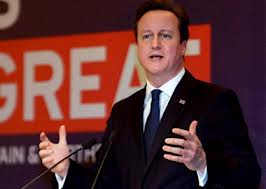
Same-day visa for Indian biz, no cap on students: Cameron

February 19, 2013

visa_for_Indian

Mumbai, Feb 19: In a measure to attract more Indian businessmen and students, British Prime Minister David Cameron on Monday announced a same-day visa service for investors and no limit on the number of students from the country.

“We have the biggest visa operations anywhere in the world right here in India. I announce that we are going to introduce for businesses a ‘same-day visa’ service to those who want to come and invest in our country,” Cameron said at a business meeting held in the Taj Mahal Palace Hotel here.

Cameron said he wanted UK companies to help India develop new cities and districts along a 600 mile (equivalent of 1,000 km) corridor between Mumbai and Bangalore, generating investment projects worth up to $25 billion.

“With me I’ve got architects, planners and finance experts who can work out the complete solution. It would unleash India’s potential along the 1,000 km corridor from Mumbai to Bangalore, transforming lives and putting British businesses in prime position to secure valuable commercial deals,” said Cameron in an interaction with the staff of Hindustan Unilever, the Indian unit of Anglo-Dutch FMCG major Unilever.

Cameron is on a 3-day visit to India with the largest trade delegation taken abroad by a British PM to date, saying he wanted UK firms to work with both the Indian and British governments to develop nine districts to link India’s financial capital Mumbai with its tech hub Bangalore.

He said India should open up its markets to allow foreign direct investment in hitherto closed sectors. Cameron is gung ho over the Mumbai-Bangalore corridor project while forecasts from his office showed that 5.8 per cent of India’s population growth would be in the corridor, contributing 11.8 per cent of the country’s gross domestic product growth by 2020.

Cameron’s office said British and Indian officials had been working with business representatives from the two countries on the Mumbai-Bangalore project since last year and had produced an initial assessment of its scale and potential.

Accordingly, the first phase of the project would involve investment in physical infrastructure, such as transport networks, telecommunications and power generation.

Later construction would concentrate on social infrastructure such as welfare and education. India has pushed the building of giant development “corridors” to accelerate the growth of its manufacturing base, which has lagged behind its IT and services industry.

The government has also planned to build 24 new industrial cities along a 1,483 km (920 mile) railway line between New Delhi and Mumbai with Japanese funding, but the project has progressed slowly.

Meanwhile, the UK government would be willing to co-fund a feasibility study, on a match funding basis, with the Indian government costing up to 1 million pounds ($1.55 million). By 2030, if realised, the project could generate close to half a million jobs, while indirect jobs could bring the total in the region to two million, Cameron's office said.

“Our initial scoping work suggests that accommodating the 3-4 million people attracted to each of the new cities would require close to 1 million new homes, up to 120 schools, 10 colleges and hospitals,” the office said. Meeting with corporate India this evening here, Cameron announced same-day visa services and said there would be no limit on the number of students from here studying in Britain and also no cap on the length of time they can stay and work in graduate-level jobs after they qualify in his country.

He made a similar announcement with regard to businessmen visas saying: “....we are going to introduce for businesses a same-day visa service for those who want to come to our country and invest...”

Cameron will fly to Delhi tomorrow for talks with Prime Minister Manmohan Singh on a range of issues.

Comments

Add new comment

  • Coastaldigest.com reserves the right to delete or block any comments.
  • Coastaldigset.com is not responsible for its readers’ comments.
  • Comments that are abusive, incendiary or irrelevant are strictly prohibited.
  • Please use a genuine email ID and provide your name to avoid reject.
News Network
February 29,2020

New Delhi, Feb 29: Former Union Minister M J Akbar told a Delhi court on Friday that journalist Priya Ramani had defamed him by calling him with adjectives such as 'media's biggest predator' in the wake of #MeToo movement in 2018 that harmed his reputation.

M J Akbar made the allegations before Additional Chief Metropolitan Magistrate Vishal Pahuja through his lawyer during the final hearing of a private criminal defamation complaint filed by him against Priya Ramani. Akbar resigned as Union minister on October 17, 2018.

Ramani in 2018 accused Akbar of sexual misconduct around 20 years ago when he was a journalist.

Senior advocate Geeta Luthra, appearing for Akbar, said that the allegations were intentional and malafide.

“When you call someone media's biggest predator, it is per se defamatory. Calling a person with such adjectives is on the face of it defamatory. In the eyes of the people, Akbar's reputation was harmed... The per se effect was lowering of my (Akbar) reputation in the eyes of the right thinking members of the society,” she told the court.

She said there was no due process in the allegations. “It has a cascading effect. Embarrassing questions were asked. I (Akbar) am a person of greatest integrity... There was no due process in the allegations. You cannot just make allegation and let that person suffer,” she added.

Luthra said that if there was any grievance, it had to be raised then and there before the appropriate authority.

“We need to realise the effect has what we say or what we do. It's not like she went to any authority or raised any grievance. Opportunity was there, rights were there but to attack so person behind their back on social media...knowing that his whole life will be adversely affected? It's not right,” she said.

M J Akbar has denied all the allegations of sexual harassment against the women who came forward during #MeToo campaign against him.

Akbar had earlier told the court that the allegations made in an article in the 'Vogue' and the subsequent tweets were defamatory on the face of it as the complainant had deposed them to be false and imaginary and that an “immediate damage” was caused to him due to the “false” allegations by Priya Ramani.

Ramani had earlier told the court that her “disclosure” of alleged sexual harassment by Akbar has come at “a great personal cost” and she had “nothing to gain” from it.

She had said her move would empower women to speak up and make them understand their rights at workplace.

Several women came up with accounts of the alleged sexual harassment by M J Akbar him while they were working as journalists under him.

He has termed the allegations “false, fabricated and deeply distressing” and said he was taking appropriate legal action against them.

Comments

Add new comment

  • Coastaldigest.com reserves the right to delete or block any comments.
  • Coastaldigset.com is not responsible for its readers’ comments.
  • Comments that are abusive, incendiary or irrelevant are strictly prohibited.
  • Please use a genuine email ID and provide your name to avoid reject.
News Network
May 24,2020

New Delhi, May 24: The Indian economy is likely to slip into recession in the third quarter of this fiscal as loss in income and jobs and cautiousness among consumers will delay recovery in consumer demand even after the pandemic, says a report.

According to Dun & Bradstreet's latest Economic Observer, the country's economic recovery will depend on the efficacy and duration of implementation of the government's stimulus package.

"The multiplier effect of the stimulus measures on the economy will depend on three key aspects i.e. the time taken for effecting the withdrawal of the lockdown, the efficacy of implementation and duration of execution of the measures announced," Dun & Bradstreet India Chief Economist Arun Singh said.

The report noted that the government's larger-than-expected stimulus package is likely to re-start economic activities.

Besides, measures taken by the Reserve Bank of India like reducing the repo rate by a further 40 basis points to 4 per cent, extending the moratorium period by three months and facilitating working capital financing will also help stimulate the momentum.

Singh said while the measures announced by the government are "positive", most of them have been directed towards strengthening the supply side of the economy, and "it is to be noted that supply needs to be matched with demand", he said.

Besides, "in the absence of cash-in-hand benefits under the government's stimulus package, demand for goods and services is expected to remain depressed", he added.

He further said the loss in income and employment opportunities, and cautiousness among consumers, will lead to a delayed recovery in consumer demand, even after the pandemic. As debt and bad loan levels increase, the banking sector might face challenges.

The report further noted that even as the monetary stimulus is expected to inject liquidity and stimulate demand for a wider section of the economy, the channelisation of funds from the financial institutions will be subjected to several constraints.

The foremost concern being increase in risk averseness, as the balance sheets of firms, households, and banks/NBFCs have weakened considerably and low demand for funds by firms as production activities have been on a standstill during the lockdown period, Singh said.

India has been under lockdown since March 25 to contain the spread of the coronavirus, resulting in supply disruptions and demand compression.

Prime Minister Narendra Modi imposed a nationwide lockdown to control the spread of coronavirus on March 25. It has been extended thrice, with some relaxations. The fourth phase of the lockdown is set to expire on May 31. 

Comments

Add new comment

  • Coastaldigest.com reserves the right to delete or block any comments.
  • Coastaldigset.com is not responsible for its readers’ comments.
  • Comments that are abusive, incendiary or irrelevant are strictly prohibited.
  • Please use a genuine email ID and provide your name to avoid reject.
News Network
April 29,2020

New Delhi, Apr 29: India's tally of COVID-19 cases has reached 31,332, said the Union Ministry of Health and Family Welfare on Wednesday. With 73 more deaths reported, the number of deaths due to coronavirus in the country breached the 1,000 mark and stood at 1,007.

The tally is inclusive of 22,629 active coronavirus cases, 7,695 patients who have been cured/discharged and one patient migrated.

According to the Ministry, Maharashtra has the most number of COVID-19 cases with 9,318 cases of which, 1,388 patients have been cured/discharged while 400 patients have succumbed to the virus.

Gujarat has the second-highest number of positive cases in the country with 3744 cases including 434 patients cured/discharged and 181 deaths.

Delhi's tally stands at 3314 cases of which, 1078 patients have recovered while 54 patients have succumbed to the virus.

Madhya Pradesh has a total of 2387 positive cases including 377 patients recovered/discharged and 120 fatalities.

Meanwhile, Goa (seven cases; all seven recovered), Arunachal Pradesh (one case; now recovered), Manipur (two cases; both recovered), Tripura (two cases; both recovered) have reported no new cases of COVID-19.

Comments

Add new comment

  • Coastaldigest.com reserves the right to delete or block any comments.
  • Coastaldigset.com is not responsible for its readers’ comments.
  • Comments that are abusive, incendiary or irrelevant are strictly prohibited.
  • Please use a genuine email ID and provide your name to avoid reject.