



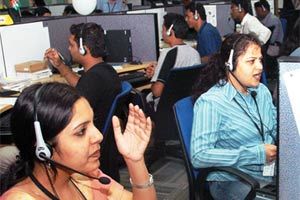
India lost 10% of BPO business in 5 years

February 27, 2013

BPO

New Delhi, Feb 27: India has lost about 10 per cent share of the global BPO market in the last five years to destinations like China, the Philippines and Brazil, raising concerns for the USD 20-billion Indian BPO industry.

The pre-budget Economic Survey 2012-13, which was tabled in Parliament today, said India faces stiff competition from several emerging countries in the BPO sector.

It called for information campaigns by the industry to dispel the myths and fears about outsourcing in the developed economies.

Countries like Malaysia, China and the Philippines in Asia; Egypt and Morocco in North Africa; Brazil, Mexico, Chile and Columbia in Latin America; and Poland and Ireland in Europe are emerging as attractive destinations for voice contracts, posing a significant threat to Indian firms, it said.

"According to Nasscom, in the last five years, India has lost about 10 per cent market share to the rest of the world in the world BPO space, most of which is in the voice contract segment," it said.

According to industry body Nasscom, in FY13, IT services would account for USD 50 billion, while Business Process Management (BPM or BPO) and Engineering services would contribute USD 20 billion and USD 10 billion, respectively.

In terms of competition, though China faces challenges like language proficiency, it is making large investments in the mission mode to increase English proficiency.

"Thus, (China) may eventually emerge as a threat to India," it added.

The Philippines, which is the second largest destination for outsourcing, is also a serious competitor having developed both the hardware and software segments of IT.

Outsourcing has become a national issue in many developed countries like the US and the UK, who are supporting the local BPO industry through various means.

"In such a situation, the Indian BPO industry needs to gear up to address the challenges. Information campaigns to dispel the myths and fears about outsourcing needs to be undertaken by the industry in the developed economies," it said.

In the overall IT and IT-enabled services space, new competitors like China, Israel and the Philippines have emerged in recent years.

Between 2005 and 2011, the annual average growth of IT-ITeS services was 69 per cent in the Philippines, 28 per cent in Sri Lanka, 59 per cent in Ukraine, 27 per cent in the Russian Federation, 37 per cent in Argentina and 35 per cent in Costa Rica.

"Even if in some cases the export values are relatively low, the average annual growth of computer services in these economies is well above the average of the top exporters," it said.

Comments

Add new comment

  • Coastaldigest.com reserves the right to delete or block any comments.
  • Coastaldigset.com is not responsible for its readers’ comments.
  • Comments that are abusive, incendiary or irrelevant are strictly prohibited.
  • Please use a genuine email ID and provide your name to avoid reject.
News Network
February 19,2020

New Delhi, Feb 19: India will switch to the world's cleanest petrol and diesel from April 1 as it leapfrogs straight to Euro-VI emission compliant fuels from Euro-IV grades now - a feat achieved in just three years and not seen in any of the large economies around the globe.

India will join the select league of nations using petrol and diesel containing just 10 parts per million of sulphur as it looks to cut vehicular emissions that are said to be one of the reasons for the choking pollution in major cities.

Sanjiv Singh, Chairman of Indian Oil Corp (IOC) - the firm that controls roughly half of the country's fuel market, said almost all refineries began producing ultra-low sulphur BS-VI (equivalent to Euro-VI grade) petrol and diesel by the end of 2019 and oil companies have now undertaken the tedious task of replacing every drop of fuel in the country with the new one.

"We are absolutely on track for supplying BS-VI fuel from April 1. Almost all refineries have begun supplying BS-VI fuel and the same has reached storage depots across the country," he said.

From storage depots, the fuel has started travelling to petrol pumps and in the next few weeks all of them will only have BS-VI grade petrol and diesel, he said. "We are 100 per cent confident that fuel that will flow from nozzles at all the petrol pumps in the country on April 1 will be BS-VI emission compliant fuel."

India adopted Euro-III equivalent (or Bharat Stage-III) fuel with a sulphur content of 350 ppm in 2010 and then took seven years to move to BS-IV that had a sulphur content of 50 ppm. From BS-IV to BS-VI it took just three years.

"It was a conscious decision to leapfrog to BS-VI as first upgrading to BS-V and then shifting to BS-VI would have prolonged the journey to 4 to 6 years. Besides, oil refineries, as well as automobile manufacturers, would have had to make investments twice - first to producing BS-V grade fuel and engines and then BS-VI ones," he said.

State-owned oil refineries spent about Rs 35,000 crore to upgrade plants that could produce ultra-low sulphur fuel. This investment is on top of Rs 60,000 crore they spent on refinery upgrades in the previous switchovers.

BS-VI has a sulphur content of just 10 ppm and emission standards are as good as CNG.

Originally, Delhi and its adjoining towns were to have BS-VI fuel supplies by April 2019 and the rest of the country was to get same supplies from April 2020.

But oil marketing companies switched over to supply of BS-VI grade fuels in the national capital territory of Delhi on April 1, 2018.

The supply of BS-VI fuels was further extended to four contiguous districts of Rajasthan and eight of Uttar Pradesh in the National Capital Region (NCR) on April 1, 2019, together with the city of Agra.

BS-VI grade fuels were made available in 7 districts of Haryana from October 1, 2019.

Singh said the new fuel will result in a reduction in NOx in BS-VI compliant vehicles by 25 per cent in petrol cars and by 70 per cent in diesel cars.

The switchover, he said, is a tedious task as every drop of old, higher-sulphur content fuel has to be flushed out in depots, pipelines and tanks before being replaced by BS-VI.

"We are confident of disruption-free switchover to BS-VI supplies across the country," he said. "What we will be supplying is the best quality available anywhere in the world. You don't have any better fuel that is supplied in any part of the world. Perhaps our BS-VI fuel will be better than equivalent fuel in some parts of the US and Europe."

India adopted a fuel upgradation programme in the early 1990s. Low lead gasoline (petrol) was introduced in 1994 in Delhi, Mumbai, Kolkata and Chennai. On February 1, 2000, unleaded gasoline was mandated nationwide.

Similarly, BS-2000 (Euro-I equivalent, BS-1) vehicle emission norms were introduced for new vehicles from April 2000. BS-II (Euro-II equivalent) emission norms for new cars were introduced in Delhi from 2000 and extended to the other metro cities in 2001.

Benzene limits have been reduced progressively from 5 per cent in 2000 to 1 per cent nationwide. Lead content in gasoline was removed in phases and only unleaded gasoline is being produced and sold from February 1, 2000.

The octane number of gasoline signifies the improved performance of the engine. Loss in octane number due to phasing out of lead was made up by installing new facilities in the refinery and changes in refinery operation. RON (Research Octane Number) of gasoline for BS-2000 spec was increased to 88. This has over time been increased to 91.

Singh said sulphur reduction will reduce Particulate Matter (PM) emissions even in the in-use older generation diesel vehicles.

Comments

Add new comment

  • Coastaldigest.com reserves the right to delete or block any comments.
  • Coastaldigset.com is not responsible for its readers’ comments.
  • Comments that are abusive, incendiary or irrelevant are strictly prohibited.
  • Please use a genuine email ID and provide your name to avoid reject.
Agencies
May 17,2020

New Delhi, May 17: Following the COVID-19-induced economic disruptions, up to 135 million jobs could be lost and 120 million people might be pushed back into poverty in India, all of which will have a hit on consumer income, spending and savings, says a report.

According to a new report by international management consulting firm Arthur D Little, the worst of COVID-19's impact will be felt by India's most vulnerable in terms of job loss, poverty increase and reduced per-capita income, which in turn will result in a steep decline in the Gross Domestic Product (GDP).

"Given the continued rise of COVID-19 cases, we believe that a W-shaped recovery is the most likely scenario for India. This implies a GDP contraction of 10.8 per cent in FY 2020-21 and GDP growth of 0.8 per cent in FY 2021-22," the report said.

India's COVID-19 tally has crossed 90,000 and the nationwide death toll has touched nearly 2,800 so far.

The report titled "India: Surmounting the economic challenges posed by COVID-19: A 10-point programme to revive and power India's post-COVID economy" said the 'collateral damage' of the forecasted GDP slowdown, will be felt most acutely in employment, poverty alleviation, per-capita income and overall nominal GDP.

"Unemployment may rise to 35 per cent from 7.6 per cent resulting in 136 million jobs lost and a total of 174 million unemployed. Poverty alleviation will receive a set-back, significantly changing the fortunes of many, putting 120 million people into poverty and 40 million into abject poverty," the report said.

"India is headed towards a W-shaped economic recovery with a potential GDP contraction of 10.8 per cent in FY21. An opportunity loss of USD 1 trillion is staring India in its face," said Barnik Chitran Maitra, lead author of the report and Managing Partner & CEO of Arthur D Little, India and South Asia.

Maitra further said "for its USD 5 trillion vision, a radical economic approach is needed, centred on an immediate stimulus and structural reforms. The Prime Minister's visionary 'Atma Nirbhar Bharat Abhiyan' is a good start to this new approach."

The report lauded the steps taken by the government and the Reserve Bank of India, but said a far more assertive approach may be required given the magnitude of the adverse economic output.

The report suggested a 10-point programme to accelerate the recovery which include strengthening the 'safety net' significantly for the most vulnerable, enable survival of small and medium businesses, restarting the rural economy and providing targeted assistance to at-risk sectors.

It further said the government should launch "Make in India 2.0" to capture global opportunities, build 'Modern India', accelerate Digital India and Innovation, strengthen global investment corridors with the US, UAE, Saudi Arabia, Japan and the UK, debottleneck land and labour and transform banking and financial markets in a bid to secure a sustainable economic future for 1.3 billion Indians. 

Comments

Add new comment

  • Coastaldigest.com reserves the right to delete or block any comments.
  • Coastaldigset.com is not responsible for its readers’ comments.
  • Comments that are abusive, incendiary or irrelevant are strictly prohibited.
  • Please use a genuine email ID and provide your name to avoid reject.
News Network
May 23,2020

New Delhi, May 23: India witnessed the biggest ever spike of 6,654 positive cases in the last 24 hours, taking the total number of COVID-19 cases to 1,25,101, according to the Union Ministry of Health and Family Welfare.

As many as 137 deaths have been reported in the last 24 hours, taking the death toll to 3,720.
Out of the total number of cases, 69,597 are active and 51,784 have been cured/discharged or have migrated.

Maharashtra continues to remain the worst-affected state with 44,582 COVID-19 cases. It is followed by Tamil Nadu (14,753), Gujarat (13,268), and Delhi (12,319).

The nationwide lockdown imposed as a precautionary measure to contain the spread of COVID-19 has been extended till May 31.

Comments

Add new comment

  • Coastaldigest.com reserves the right to delete or block any comments.
  • Coastaldigset.com is not responsible for its readers’ comments.
  • Comments that are abusive, incendiary or irrelevant are strictly prohibited.
  • Please use a genuine email ID and provide your name to avoid reject.