


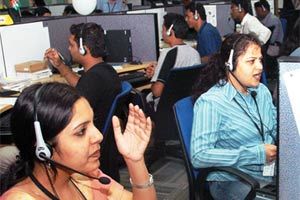
India lost 10% of BPO business in 5 years

February 27, 2013

BPO

New Delhi, Feb 27: India has lost about 10 per cent share of the global BPO market in the last five years to destinations like China, the Philippines and Brazil, raising concerns for the USD 20-billion Indian BPO industry.

The pre-budget Economic Survey 2012-13, which was tabled in Parliament today, said India faces stiff competition from several emerging countries in the BPO sector.

It called for information campaigns by the industry to dispel the myths and fears about outsourcing in the developed economies.

Countries like Malaysia, China and the Philippines in Asia; Egypt and Morocco in North Africa; Brazil, Mexico, Chile and Columbia in Latin America; and Poland and Ireland in Europe are emerging as attractive destinations for voice contracts, posing a significant threat to Indian firms, it said.

"According to Nasscom, in the last five years, India has lost about 10 per cent market share to the rest of the world in the world BPO space, most of which is in the voice contract segment," it said.

According to industry body Nasscom, in FY13, IT services would account for USD 50 billion, while Business Process Management (BPM or BPO) and Engineering services would contribute USD 20 billion and USD 10 billion, respectively.

In terms of competition, though China faces challenges like language proficiency, it is making large investments in the mission mode to increase English proficiency.

"Thus, (China) may eventually emerge as a threat to India," it added.

The Philippines, which is the second largest destination for outsourcing, is also a serious competitor having developed both the hardware and software segments of IT.

Outsourcing has become a national issue in many developed countries like the US and the UK, who are supporting the local BPO industry through various means.

"In such a situation, the Indian BPO industry needs to gear up to address the challenges. Information campaigns to dispel the myths and fears about outsourcing needs to be undertaken by the industry in the developed economies," it said.

In the overall IT and IT-enabled services space, new competitors like China, Israel and the Philippines have emerged in recent years.

Between 2005 and 2011, the annual average growth of IT-ITeS services was 69 per cent in the Philippines, 28 per cent in Sri Lanka, 59 per cent in Ukraine, 27 per cent in the Russian Federation, 37 per cent in Argentina and 35 per cent in Costa Rica.

"Even if in some cases the export values are relatively low, the average annual growth of computer services in these economies is well above the average of the top exporters," it said.

Comments

Add new comment

  • Coastaldigest.com reserves the right to delete or block any comments.
  • Coastaldigset.com is not responsible for its readers’ comments.
  • Comments that are abusive, incendiary or irrelevant are strictly prohibited.
  • Please use a genuine email ID and provide your name to avoid reject.
News Network
February 29,2020

New Delhi, Feb 29: Former Union Minister M J Akbar told a Delhi court on Friday that journalist Priya Ramani had defamed him by calling him with adjectives such as 'media's biggest predator' in the wake of #MeToo movement in 2018 that harmed his reputation.

M J Akbar made the allegations before Additional Chief Metropolitan Magistrate Vishal Pahuja through his lawyer during the final hearing of a private criminal defamation complaint filed by him against Priya Ramani. Akbar resigned as Union minister on October 17, 2018.

Ramani in 2018 accused Akbar of sexual misconduct around 20 years ago when he was a journalist.

Senior advocate Geeta Luthra, appearing for Akbar, said that the allegations were intentional and malafide.

“When you call someone media's biggest predator, it is per se defamatory. Calling a person with such adjectives is on the face of it defamatory. In the eyes of the people, Akbar's reputation was harmed... The per se effect was lowering of my (Akbar) reputation in the eyes of the right thinking members of the society,” she told the court.

She said there was no due process in the allegations. “It has a cascading effect. Embarrassing questions were asked. I (Akbar) am a person of greatest integrity... There was no due process in the allegations. You cannot just make allegation and let that person suffer,” she added.

Luthra said that if there was any grievance, it had to be raised then and there before the appropriate authority.

“We need to realise the effect has what we say or what we do. It's not like she went to any authority or raised any grievance. Opportunity was there, rights were there but to attack so person behind their back on social media...knowing that his whole life will be adversely affected? It's not right,” she said.

M J Akbar has denied all the allegations of sexual harassment against the women who came forward during #MeToo campaign against him.

Akbar had earlier told the court that the allegations made in an article in the 'Vogue' and the subsequent tweets were defamatory on the face of it as the complainant had deposed them to be false and imaginary and that an “immediate damage” was caused to him due to the “false” allegations by Priya Ramani.

Ramani had earlier told the court that her “disclosure” of alleged sexual harassment by Akbar has come at “a great personal cost” and she had “nothing to gain” from it.

She had said her move would empower women to speak up and make them understand their rights at workplace.

Several women came up with accounts of the alleged sexual harassment by M J Akbar him while they were working as journalists under him.

He has termed the allegations “false, fabricated and deeply distressing” and said he was taking appropriate legal action against them.

Comments

Add new comment

  • Coastaldigest.com reserves the right to delete or block any comments.
  • Coastaldigset.com is not responsible for its readers’ comments.
  • Comments that are abusive, incendiary or irrelevant are strictly prohibited.
  • Please use a genuine email ID and provide your name to avoid reject.
News Network
May 23,2020

New Delhi, May 23: On the occasion of Jumat-ul-Vida, the last Friday of the ongoing holy month of Ramzan, a select group of people offered namaz at Delhi's Jama Masjid ahead of Eid-ul-Fitr, while adhering to social distancing following relaxations in the fourth phase of the COVID-19 lockdown.

"A large number of people wanted to offer prayers today but we told them they should do so from their homes. Only the staff of the mosque and a few members of the family offered prayers here," Shahi Imam of Jama Masjid said.

The coronavirus pandemic has also marred the excitement of Eid for the vegetable and fruit vendors in neighbouring Daryaganj.

The fourth phase of nation-wide lockdown extended till May 31, began from Monday in which markets and shops were allowed to open. However, due to persisting fear of COVID-19, the sale of products is yet to pick pace.

Unlike each year, the market lacks the sheen this Eid with no bustle and people cautious about venturing out.

Salim, who has been selling cheese and curd in the market for the last 35 years, told ANI, "I have never seen such an Eid. There is an atmosphere of fear in the minds of people."

Another fruit seller Haseen Malik said that "During the month of Ramadan, most people relish fruits such as musk melon, sweet lemon and watermelon so there is some demand for it. But there is no excitement for Eid this year. The sale has been at an all-time low because of the lockdown."

In the wake of the festival and to ensure social distancing, Delhi Police has made elaborate security arrangements. 

Comments

Add new comment

  • Coastaldigest.com reserves the right to delete or block any comments.
  • Coastaldigset.com is not responsible for its readers’ comments.
  • Comments that are abusive, incendiary or irrelevant are strictly prohibited.
  • Please use a genuine email ID and provide your name to avoid reject.
News Network
June 13,2020

New Delhi, Jun 13: About 56 per cent of children were found to have no access to smartphones which have emerged as essential tools for online learning during the coronavirus-induced lockdown, according to a new study that surveyed 42,831 students at various school levels.

The study ''Scenario amidst COVID 19 - Onground Situations and Possible Solutions'' was conducted by child rights NGO Smile Foundation with an aim of analysing the access to technology.

The findings of the study showed that 43.99 per cent of surveyed children have access to smartphones and another 43.99 per cent of students have access to basic phones while 12.02 per cent do not have access to either smartphones or basic phones.

A total of 56.01 per cent children were found to have no access to smartphones, the study said.

"Concerning television, it was noted that while 68.99 per cent have access to TV, a major chunk of 31.01 per cent does not. Hence suggesting that using smartphone interventions for enhancing learning outcomes is not the only solution," it said.

At the primary level of education (class 1 to 5) 19,576 children were surveyed while at upper primary level (class 6 to 8) 12,277 children were surveyed. At secondary level of education (class 9 to 10) 5,537 children were surveyed and at higher secondary level (class 11 to 12) 3,216 children were surveyed.

The survey based on which the study was conducted used two approaches - over the telephone wherein the NGO reached out to the children whose database it already had -- students enrolled in various education centres of the NGO -- and second was through community mobilization wherein community workers went door to door to get answers.

The survey was conducted in 23 states, including Delhi, Gujarat, Maharashtra, Karnataka, Tamil Nadu, West Bengal, Andhra Pradesh, Telangana, Uttar Pradesh, Haryana, over a period of 12 days from April 16 to April 28.

The lockdown induced by the COVID-19 pandemic in March prompted schools and colleges to move to the virtual world for teaching and learning activities. However, many experts say the digital divide in the country may turn online classes into an operational nightmare.

As per official statistics, there are over 35 crore students in the country. However, it is not clear as to how many of them have access to digital devices and Internet.

Santanu Mishra, co-founder and executive trustee, Smile Foundation, said the findings clearly show that the digital divide is a real challenge, and multiple approaches need to be implemented to cater to all across the nation.

"As an exercise before we start any programme, we do a baseline study to understand the on-ground challenges so that our programmes can bring in real work and real change. With the onset of the pandemic, following indefinite school closures, it is more important than ever to understand the situation and how can we ensure that children are given quality education. Through this, we understand that customized modules need to be built in accordance with the channel of communication," he said.  

Comments

Add new comment

  • Coastaldigest.com reserves the right to delete or block any comments.
  • Coastaldigset.com is not responsible for its readers’ comments.
  • Comments that are abusive, incendiary or irrelevant are strictly prohibited.
  • Please use a genuine email ID and provide your name to avoid reject.