



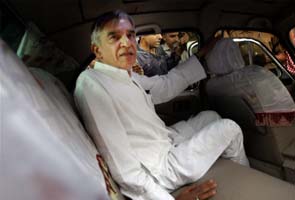
Pawan Kumar Bansal and Ashwani Kumar resign, BJP sharpens attack on delayed action

May 11, 2013

Pawan_Kumar_BansalNew Delhi, May 11: Law Minister Ashwani Kumar and Railway Minister Pawan Kumar Bansal have been asked to put in their papers, a decision that came on Friday evening, after Congress President Sonia Gandhi conveyed to Prime Minister Manmohan Singh that their continuation would further muddy the image of the party and the government.

As indicated by ET in a report on May 10, the Congress leadership axed the two ministers in a move seemingly aimed at dispelling the impression of shielding the embattled ministers and savouring the much needed political bounce from the party's election victory in Karnataka. Both Kumar, who faces the charge of brazenly intervening in the CBI's investigation into the coalfield allocation scandal, and Bansal, who is embroiled in a cash-for-jobs scam, appeared to run out of the prime minister's stout backing after the Congress president forced his hand. Gandhi's intervention came two days after the government chose to end Parliament's budget session ahead of schedule amid the demand of the Opposition to sack the two ministers before debating important bills such as the one on food security. The government had refused to give in to the demand even as the budget session turned out to be least productive ever due to the gridlock.

The party brass can now use the vacancy at the railway ministry to appease Karnataka leader Mallikarjun Kharge, who lost out to Siddaramaiah in the election to the post of chief ministership earlier on Friday, a senior Congress leader told ET. Kharge is currently handling the labour portfolio at the Centre.

The main opposition, Bharatiya Janata Party, sharpened its attack on the government, saying if Bansal and Kumar had resigned earlier, Parliament's time would not have been wasted. BJP spokesman Shahnawaz Hussain questioned the prime minister for allowing the two ministers "to continue for so long despite the SC rap on one and the CBI tightening its noose around other".

Hussain said the government should have heeded the advice of BJP's Sushma Swaraj. "The leader of opposition Sushma Swaraj had said that both ministers should resign and then Parliament can run. But two days before the session was to end, it was adjourned sine die. The Congress must have thought it would get some respite but the BJP will continue its fight outside Parliament," Hussain said.

The PM was believed to have had reservation on dropping the law minister in particular because while Bansal faced charges of financial impropriety, Kumar faced the rap in an exercise that also involved the

Prime Minister's Office and the coal ministry. Recent reports have alleged that Bansal presided over a ministry riddled with corruption. The CBI's investigations into the case have been pointing to the involvement of the minister's kin as well as officials in fixing important appointments.

On May 3, the CBI had arrested railway board member Mahesh Kumar for allegedly paying Rs 90 lakh as bribe for a posting in the Railway Board. The negotiations were allegedly done through the minister's nephew, Vijay Singla.

Comments

Add new comment

  • Coastaldigest.com reserves the right to delete or block any comments.
  • Coastaldigset.com is not responsible for its readers’ comments.
  • Comments that are abusive, incendiary or irrelevant are strictly prohibited.
  • Please use a genuine email ID and provide your name to avoid reject.
News Network
January 10,2020

Mumbai, Jan 10: India’s oil demand growth is set to overtake China by mid-2020s, priming the country for more refinery investment but making it more vulnerable to supply disruption in the Middle East, the International Energy Agency (IEA) said on Friday.

India’s oil demand is expected to reach 6 million barrels per day (bpd) by 2024 from 4.4 million bpd in 2017, but its domestic production is expected to rise only marginally, making the country more reliant on crude imports and more vulnerable to supply disruption in the Middle East, the agency said.

China’s demand growth is likely to be slightly lower than that of India by the mid-2020s, as per IEA’s China estimates given in November, but the gap would slowly become bigger thereafter.

“Indian economy is and will become even more exposed to risks of supply disruptions, geopolitical uncertainties and the volatility of oil prices,” the IEA said in a report on India’s energy policies.

Brent crude prices topped USD 70 a barrel on rising geopolitical tensions in the Middle East, putting pressure on emerging markets such as India. Like the rest of Asia, India is highly dependent on Middle East oil supplies with Iraq being its largest crude supplier.

India, which ranks No 3 in terms of global oil consumption after China and the United States, ships in over 80 per cent of its oil needs, of which 65 per cent is from the Middle East through the Strait of Hormuz, the IEA said.

The IEA, which coordinates release of strategic petroleum reserves (SPR) among developed countries in times of emergency, said it is important for India to expand its reserves.

REFINERY INVESTMENTS

India is the world’s fourth largest oil refiner and a net exporter of refined fuel, mainly gasoline and diesel.

India has drawn plans to lift its refining capacity to about 8 million bpd by 2025 from the current about 5 million bpd.

The IEA, however, forecasts India’s refining capacity to rise to 5.7 million bpd by 2024.

This would make “India a very attractive market for refinery investment,” IEA said.

Drawn to India’s higher fuel demand potential, global oil majors like Saudi Aramco, BP, Abu Dhabi National Oil Co and Total are looking at investing in India’s oil sector.

Saudi Aramco and ADNOC aim to own a 50 per cent stake in a planned 1.2-million bpd refinery in western Maharashtra state, for which land is yet to be acquired.

Comments

Add new comment

  • Coastaldigest.com reserves the right to delete or block any comments.
  • Coastaldigset.com is not responsible for its readers’ comments.
  • Comments that are abusive, incendiary or irrelevant are strictly prohibited.
  • Please use a genuine email ID and provide your name to avoid reject.
News Network
June 7,2020

Bhopal, June 7: In a shocking incident of medical cruelty, an 80-year-old man was tied to a hospital bed in Madhya Pradesh after he allegedly failed to make payment of fees for his treatment. The incident took place at the City Hospital in Shajapur.  

The hospital, however, claimed that he was having convulsions and as a result had his hands and legs tied so that he could not hurt himself.

The man’s family members have accused the hospital authorities of resorting to the heinous act after they failed to pay a fee of Rs 11,000 for his treatment at the. 

“We had deposited a bill of Rs 5,000 at the time of admission but when the treatment took a few more days, we did not have the money to pay the bill,” his daughter told the channel.

The hospital, however, maintained that the man was shackled because he was suffering from an electrolyte imbalance. “He was having convulsions because of electrolyte imbalance,” an unidentified doctor said. “We tied him so that he could not hurt himself.” 
The doctor claimed the hospital had waived off the man’s bill on “humanitarian grounds”.

Chief Minister Shivraj Singh Chouhan took cognizance of the matter and promised strict action against the hospital authorities. 

The Shajapur administration has also ordered an inquiry and has sent a police team to the hospital for investigation, the district collector told media persons.

Comments

Add new comment

  • Coastaldigest.com reserves the right to delete or block any comments.
  • Coastaldigset.com is not responsible for its readers’ comments.
  • Comments that are abusive, incendiary or irrelevant are strictly prohibited.
  • Please use a genuine email ID and provide your name to avoid reject.
News Network
May 4,2020

New Delhi, May 4: The country's manufacturing sector activity witnessed unprecedented contraction in April amid national lockdown restrictions, following which new business orders collapsed at a record pace and firms sharply reduced their staff numbers, a monthly survey said on Monday.

The headline seasonally adjusted IHS Markit India Manufacturing Purchasing Managers' Index (PMI) fell to 27.4 in April, from 51.8 in March, reflecting the sharpest deterioration in business conditions across the sector since data collection began over 15 years ago.
The index slipped into contraction mode, after remaining in the growth territory for 32 consecutive months.

In PMI parlance, a print above 50 means expansion, while a score below that denotes contraction.

Amid widespread business closures, demand conditions were severely hampered in April. New orders fell for the first time in two-and-a-half years and at the sharpest rate in the survey's history, far outpacing that seen during the global financial crisis, the survey said.

"After making it through March relatively unscathed, the Indian manufacturing sector felt the full force of the coronavirus pandemic in April," said Eliot Kerr, Economist at IHS Markit.
Panellists attributed lower production to temporary factory closures that were triggered by restrictive measures to limit the spread of COVID-19.

Export orders also witnessed a sharp decline. Following the first reduction since October 2017 during March, foreign sales fell at a quicker rate in April. "In fact, the rate of decline accelerated to the fastest since the series began over 15 years ago," the survey said.

On the employment front, deteriorating demand conditions saw manufacturers drastically cut back staff numbers in April. The reduction in employment was the quickest in the survey's history.

"In the latest survey period, record contractions in output, new orders and employment pointed to a severe deterioration in demand conditions.
“Meanwhile, there was evidence of unprecedented supply-side disruption, with input delivery times lengthening to the greatest extent since data collection began in March 2005," Kerr said.

On the prices front, both input costs and output prices were lowered markedly as suppliers and manufacturers themselves offered discounts in an attempt to secure orders.

Going ahead, sentiment regarding the 12-month outlook for production ticked up from March's recent low on hopes that demand will rebound once the COVID-19 threat has diminished and lockdown restrictions eased.

"There was a hint of positivity when looking at firms' 12-month outlooks, with sentiment towards future activity rebounding from March's record low. That said, the degree of optimism remained well below the historical average," Kerr said.

In India, the death toll due to COVID-19 rose to 1,373 and the number of cases climbed to 42,533 as on Monday, according to the health ministry.

Meanwhile, the coronavirus-induced lockdown has been extended beyond May 4, for another two weeks in the country.

Comments

Add new comment

  • Coastaldigest.com reserves the right to delete or block any comments.
  • Coastaldigset.com is not responsible for its readers’ comments.
  • Comments that are abusive, incendiary or irrelevant are strictly prohibited.
  • Please use a genuine email ID and provide your name to avoid reject.