Telangana region observes bandh

June 15, 2013
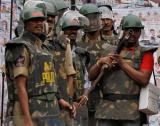
telangana_copyHyderabad, Jun 15: A day-long bandh began this morning in Telangana region of Andhra Pradesh in response to a call given by TRS, which accused the Congress Government of resorting to repressive measures to put down the statehood rally.

Initial reports reaching here from the region indicate the Road Transport Corporation (RTC) bus services were partially affected as protesters staged dharnas in front of depots in Telangana districts, including Hyderabad.

A RTC spokesperson said they were in touch with police officials and will operate services as per their advice.

Most of the educational institutions in the city remained closed. Commercial establishments, malls, cinema theatres were also shut.

The bandh call was given a day after pro-Telangana organisations, including political parties, organised a "Chalo Assembly" rally to press for statehood to the region.

TRS President K Chandrasekhar Rao gave the bandh call to protest against the Congress Government's "repressive measures" to deal with the march for Telangana yesterday.

CPI, a strong supporter of separate Telangana state, however, is not supporting the bandh and described the TRS decision as unilateral.

The Telangana Joint Action Committee (JAC), which comprises TRS, BJP and pro-Telangana organisations, said the bandh is being observed in the entire region.

South Central Railway, which cancelled MMTS (local) trains in Hyderabad yesterday following "Chalo Assembly" stir, resumed services today.

A SCR spokesperson said there has been no cancellation or rescheduling of train services.

Comments

Add new comment

  • Coastaldigest.com reserves the right to delete or block any comments.
  • Coastaldigset.com is not responsible for its readers’ comments.
  • Comments that are abusive, incendiary or irrelevant are strictly prohibited.
  • Please use a genuine email ID and provide your name to avoid reject.
Agencies
May 26,2020

New Delhi, May 26: As India ranked 10th in the global infection list, overtaking Iran, which was an early hotspot of coronavirus, India's top medical body has said the human trials of COVID-19 vaccine may begin at least in six months.

Dr. Rajni Kant, Director Regional Medical Research Centre and Head at the Indian Council of Medical Research (ICMR) said, "The virus strain isolated at the National Institute of Virology (NIV) laboratory in Pune will be used to develop the vaccine, and this strain has been successfully transferred to the Bharat Biotech International Ltd. (BBIL). It is expected that the human trials of the vaccine will begin in at least six months."

Queried on the focus areas as India inches closer to 1.4 lakh COVID-19 cases, Kant said we should not get anxious about the rapid increase in numbers, especially in the past week, which saw 5,000 Covid-19 cases daily, instead focus on protecting the most vulnerable group.

"We should not fear from increasing Covid-19 cases. The elderly and people with comorbidities need protection. This is the highly vulnerable group, and we need to deploy resources and develop strategies to keep the mortality rate as low as possible in this group," said Kant.

Initially, it was assumed that the country would require thousands of ventilators, but last week, the health ministry said only 0.45 per cent of COVID-19 cases need ventilator support.

Kant insisted the focus should be on five per cent to 10 per cent serious patients. "We are testing more than one lakh daily and our case fatality rate is already one of the lowest in the world. In absence of vaccine, people should follow social distancing guidelines," he added

On the significance of the recovery rate, Kant said the increasing recovery rate of the COVID-19 patients, which is at 41 per cent, is a bright spot in India's fight against deadly viral infection.

Queried on large scale COVID-19 cases in Mumbai, Delhi and Ahmedabad, Kant said the population density in these regions is very high, which proves to be the just right environment for the viral infection.

He insisted on developing robust cluster management strategies in the hard-hit coronavirus spots, and the movement of people should be curtailed in these areas.

"Currently, a lot of people are moving around easily and avoiding social distancing norms. The first phase of the lockdown was very effective, but now things have changed," added Kant.

Comments

Add new comment

  • Coastaldigest.com reserves the right to delete or block any comments.
  • Coastaldigset.com is not responsible for its readers’ comments.
  • Comments that are abusive, incendiary or irrelevant are strictly prohibited.
  • Please use a genuine email ID and provide your name to avoid reject.
Agencies
February 17,2020

New Delhi, Feb 17: The Supreme Court said on Monday that people have a fundamental right to protest against a law but the blocking of public roads is a matter of concern and there has to be a balancing factor.

Hearing pleas over the road blocks due to the ongoing protests at Shaheen Bagh against the Citizenship Amendment Act (CAA), a bench comprising Justices S K Kaul and K M Joseph said its concern is about what will happen if people start protesting on roads.

Democracy works on expressing views but there are lines and boundaries for it, the bench said.

It asked senior advocate Sanjay Hegde and advocate Sadhana Ramachandran to talk to Shaheen Bagh protestors and persuade them to move to an alternative site where no public place is blocked.

The matter has been posted for next hearing on February 24.

People have a fundamental right to protest but the thing which is troubling us is the blocking of public roads, the bench said.

Solicitor General Tushar Mehta said Shaheen Bagh protestors should not be given a message that every institution is on its knees trying to persuade them on this issue.

The apex court said that if nothing works, we will leave it to the authorities to deal with the situation.

Protestors have made their made their point and the protests have gone on for quite some time, it said.

Restrictions have been imposed on the Kalindi Kunj-Shaheen Bagh stretch and the Okhla underpass, which were closed on December 15 last year due to the protests against CAA and Register of Citizens.

The top court had earlier said the anti-CAA protesters at Delhi's Shaheen Bagh cannot block public roads and create inconvenience for others.

The apex court was hearing an appeal filed by advocate Amit Sahni, who had approached the Delhi high court seeking directions to the Delhi Police to ensure smooth traffic flow on the Kalindi Kunj-Shaheen Bagh stretch, which was blocked by anti-CAA protesters on December 15.

While dealing with Sahni's plea, the high court had asked local authorities to deal with the situation keeping in mind law and order.

Separately, former BJP MLA Nand Kishore Garg has filed a petition in the apex court seeking directions to the authorities to remove the protestors from Shaheen Bagh.

One of the pleas has sought laying down of comprehensive and exhaustive guidelines relating to outright restrictions for holding protests or agitations leading to obstruction of public place.

In his plea, Garg has said that law enforcement machinery was being "held hostage to the whims and fancies of the protesters" who have blocked vehicular and pedestrian movement from the road connecting Delhi to Noida.

State has the duty to protect fundamental rights of citizen who were continuously being harassed by the blockage of arterial road, it said.

"It is disappointing that the state machinery is muted and a silent spectator to hooliganism and vandalism of the protesters who are threatening the existential efficacy of the democracy and the rule of law and had already taken the law and order situation in their own hand," the plea had said.

In his appeal, Sahni had sought supervision of the situation in Shaheen Bagh, where several women are sitting on protest, by a retired Supreme Court judge or a sitting judge of the Delhi High Court.

Sahni has said in his plea that protests in Shaheen Bagh has inspired similar demonstrations in other cities and to allow it to continue would set a wrong precedent.

Comments

Add new comment

  • Coastaldigest.com reserves the right to delete or block any comments.
  • Coastaldigset.com is not responsible for its readers’ comments.
  • Comments that are abusive, incendiary or irrelevant are strictly prohibited.
  • Please use a genuine email ID and provide your name to avoid reject.
News Network
February 24,2020

New Delhi, Feb 24: They hail from vastly different backgrounds — Donald Trump is the son of a property tycoon while Narendra Modi is a descendant of a poor tea-seller.

Yet the two teetotallers, loved by right-wing nationalists in their home countries, share striking similarities that have seen them forge a close personal bond, analysts say.

Ahead of the American leader's first official visit to India, which begins in Modi's home state of Gujarat on Monday, the world's biggest democracy has gone out of its way to showcase the chemistry between them.

In Gujarat's capital Ahmedabad, large billboards with the words "two dynamic personalities, one momentous occasion" and "two strong nations, one great friendship" have gone up across the city.

"There's a lot that Trump and Modi share in common, and not surprisingly these convergences have translated into a warm chemistry between the two," Michael Kugelman of the Washington-based Wilson Center said.

"Personality politics are a major part of international diplomacy today. The idea of closed-door dialogue between top leaders has often taken a backseat to very public and spectacle-laden summitry."

Since assuming the top political office in their respective countries — Modi in 2014 and Trump in 2017 — the two men have been regularly compared to each other.

Trump, 73, and Modi, 69, both command crowds of adoring flag-waving supporters at rallies. A virtual cult of personality has emerged around them, with their faces and names at the centre of their political parties' campaigns.

A focus of Trump's administration has been his crackdown on migrants, including a travel ban that affects several Muslim-majority nations, among others, while critics charge that Modi has sought to differentiate Muslims from other immigrants through a contentious citizenship law that has sparked protests.

Both promote their countries' nationalist and trade protectionist movements — Trump with his "America First" clarion call and Modi with his "Make in India" mantra.

And while they head the world's largest democracies, critics have described the pair as part of a global club of strongmen that includes Russia's Vladimir Putin and Brazil's Jair Bolsonaro.

"There are many qualities that Trump and Modi share — a love for political grandstanding and an unshakable conviction that they can achieve the best solutions or deals," former Indian diplomat Rakesh Sood said.

Modi and Trump have sought to use their friendship to forge closer bonds between the two nations, even as they grapple with ongoing tensions over trade and defence.

Despite sharing many similarities in style and substance, analysts say there are some notable differences between the pair.

Modi is an insider who rose through the ranks of the Bharatiya Janata Party after starting out as a cadre in Rashtriya Swayamsevak Sangh.

Trump is a businessman and a political outsider who has in some sense taken over the Republican Party.

"Modi is a more conventional leader than is Trump in that he hasn't sought to revolutionise the office he holds in the way that Trump has," said Kugelman, a longtime observer of South Asian politics.

He added that genuine personal connections between leaders of both countries have helped to grow the partnership.

"George Bush and Manmohan Singh, Barack Obama and Singh, Obama and Modi, now Modi and Trump — there has been a strong chemistry in all these pairings that has clearly helped the relationship move forward," he added.

Trump has also stood by the Indian leader during controversial decisions, including his revocation of autonomy for Kashmir and his order for jets to enter Pakistani territory following a suicide bombing.

Analysts said the leaders would use the visit to bolster their image with voters.

A mega "Namaste Trump" rally in Ahmedabad on Monday will be modelled after the "Howdy, Modi" Houston extravaganza last year when the Indian leader visited the US and the two leaders appeared before tens of thousands of Indian-Americans at a football stadium.

"The success of this visit... will have a positive impact on his (Trump's) re-election campaign and the people of Indian origin who are voters in the US — a majority of them are from Gujarat," former Indian diplomat Surendra Kumar said.

"On the Indian side, the fact that Prime Minister Modi... (shares) such warmth, bonhomie and informality with the most powerful man on Earth adds to his stature... as well as with hardcore supporters."


Comments

Add new comment

  • Coastaldigest.com reserves the right to delete or block any comments.
  • Coastaldigset.com is not responsible for its readers’ comments.
  • Comments that are abusive, incendiary or irrelevant are strictly prohibited.
  • Please use a genuine email ID and provide your name to avoid reject.