



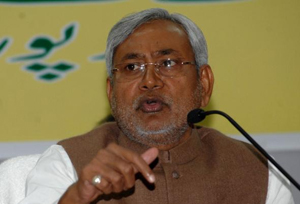
BJP releases Nitish Kumar’s 2003 speech praising Modi

June 17, 2013

Nitish_Kumar_speachNew Delhi, Jun 17: The bitter falling out between BJP and JD(U) was evident with the saffron party releasing Bihar chief minister Nitish Kumar's 2003 speech in which he praised Gujarat CM Narendra Modi as a leader with a future outside the state.

The BJP move to embarrass Kumar - who has made opposition to Modi a cornerstone of his "secular" politics - is intended to argue that the Bihar CM was not always opposed to the saffron strongman.

As the speech delivered at the inauguration of a railway project is well after the 2002 riots, the BJP's intent is obvious. "I am certain that Narendrabhai will not be confined to Gujarat for long and the country will get the benefit of his services," Kumar is quoted as saying.

JD(U) sources were, however, quick to argue that the BJP move smacked of its desperation after the breakup of the alliance and amounted to trying to shoot a messenger who bears bad news. "This won't take away from the fact that Modi is a deeply divisive and polarizing leader," a senior JD(U) leader said.

Meanwhile, BJP president Rajnath Singh said he was "saddened" by the "unfortunate" walking out of JD(U) from NDA and maintained that it would weaken the fight against Congress.

However, Singh also got a taste of continuing rumblings in BJP with veteran leader L K Advani reported to have brought up Modi's elevation as head of the party's campaign committee as a reason for the breakup of the alliance with JD(U).

Advani and leader of opposition in Lok Sabha Sushma Swaraj see the end of the alliance as a highly unfortunate development although the mood of other leaders, including those from Bihar, has turned more aggressive. "The breakup of NDA is sad and unfortunate," Swaraj said on Twitter.

Rajnath, however, had a different take on the events and said, "We always treated JD(U) as a younger brother and our relationship of 17 years was not a political but an emotional one. It was never made under pressure."

Singh was speaking at a programme organised by the BJP's youth wing. "When a coalition is formed, it is based on trust and mutual understanding. When that goes, it is really sad. We can be betrayed but we will never betray," he said.

He said if Modi was being considered communal because of the 2002 post-Godhra riots, there have been thousands of riots in 24 years of Congress rule since independence.

Singh pointed out that in 2000, BJP was a bigger party than JD(U) in Bihar as it had 60 seats while JD(U) won only "36-37 seats". But still, BJP chose a JD(U) leader to become chief minister, he said.

He warned JD(U) that a party which does not care for the feelings of the people in a democratic country cannot survive for long.

Comments

Add new comment

  • Coastaldigest.com reserves the right to delete or block any comments.
  • Coastaldigset.com is not responsible for its readers’ comments.
  • Comments that are abusive, incendiary or irrelevant are strictly prohibited.
  • Please use a genuine email ID and provide your name to avoid reject.
News Network
April 1,2020

Thiruvananthapuram, Apr 1: A day after the Kerala Government issued orders to provide special alcohol passes on doctor's prescription to tipplers, who exhibit withdrawal symptoms, the Excise Department received 40 applications from across the state.

Speaking to ANI, a Senior Excise Official said, "Around 40 people approached us with doctor's prescriptions to get liquor passes across the State. We will forward it to Beverages Corporation and they will conduct home delivery of liquor."

Ernakulam topped the list with eight applications, while Kottayam Excise Office received four and Thiruvananthapuram office received three applications.

"As per the notification we received, a maximum of three litre of alcohol can be provided in a week for a person. For availing liquor again they will have to submit fresh application for the liquor pass," the official added.

An order in this regard was issued by the government on Monday night which outlines the necessary steps to be taken by a person with withdrawal symptoms to purchase alcohol.

As per the order, any individual with a prescription from a government doctor or a doctor from a Taluk hospital or government hospital, where the doctor mentions the patient's "Alcohol Withdrawal Symptoms" can submit the prescription for alcohol to the nearest Excise Range office.

A form also has been provided which should be duly filled to get the liquor pass. The Excise Department after the scrutiny may allow the person to buy Indian Made Foreign Liquor (IMFL) from the beverages corporation.

However, the Kerala Government Medical Officers Association (KGMOA) came out against the order, saying that doctors affiliated with the organisation will not give a prescription for liquor. Further, in a statement issued they said they are observing a 'black day' on Wednesday in protest against the government move.

The Indian Medical Association (IMA) also had termed the direction by the Kerala government 'unscientific' and said doctors had no legal obligation to prescribe alcohol.

After the liquor ban was enforced in view of the lockdown, Kerala has witnessed a number of suicide cases allegedly connected with withdrawal symptoms.

Announcing the decision Kerala Chief Minister Pinarayi Vijayan had also mentioned that the government was issuing such a direction following reports of people developing suicidal tendencies due to the unavailability of alcohol.

Comments

Add new comment

  • Coastaldigest.com reserves the right to delete or block any comments.
  • Coastaldigset.com is not responsible for its readers’ comments.
  • Comments that are abusive, incendiary or irrelevant are strictly prohibited.
  • Please use a genuine email ID and provide your name to avoid reject.
Agencies
January 9,2020

The World Bank says that a lack of credit and drop in private consumption have led to a gloomy growth outlook for India with a steep cut in growth rate for the current fiscal year and only a modest gain projected for the next year.

India's growth rate is forecast to be only 5 per cent for the current fiscal year, weighed down by a growth of only 4.5 per cent in the July-September quarter, according to the 2020 Global Economic Prospects report released on Wednesday.

"In India, [economic] activity was constrained by insufficient credit availability, as well as by subdued private consumption," the Bank said.

The growth rate is forecast by the Bank to pick up to 5.8 per cent in the next fiscal year and to 6.1 per cent in 2021-22.

India's growth rate was 6.8 per cent in 2018-19.

The 5 per cent growth rate projection for the current financial year is a sharp cut of 2.5 per cent from the 7.5 per cent forecast made by the Bank in January last year, toppling it from the rank of the world's fastest growing economy.

India's performance follows a global trend of lowered growth weighed down by developed economies.

The report estimated world economic growth rate to be only 2.4 per cent last year and forecast it to edge up 0.1 per cent to 2.5 per cent in the current year.

Even with the lower growth rate of 5 per cent in the current fiscal year and 5.8 per cent forecast for the next, India holds the second rank among large economies, behind only China with an estimated growth rate of 6.1 per cent for 2019 and 5.9 per cent this year.

The report blamed "weak confidence, liquidity issues in the financial sector" and "weakness in credit from non-bank financial companies" for India's slowdown.

The Bank predicated India's recovery to 5.8 per cent in the coming financial year for India but "on the monetary policy stance remaining accommodative" and the assumption that "the stimulative fiscal and structural measures already taken will begin to pay off."

It also warned that sharper-than-expected slowdown in major external markets such as United States and Europe, would affect South Asia through trade, financial, and confidence channels, especially for countries with strong trade links to these economies."

The Bank said that the growth of advanced economies was 1.6 per cent last year and "is anticipated to slip to 1.4 per cent in 2020 in part due to continued softness in manufacturing."

In contrast the growth of emerging market and developing countries is expected to accelerate from 3.5 per cent last year to 4.1 per cent this year, the report said.

In South Asia, Bangladesh is estimated to have the highest growth rate of 7.2 per cent in the current fiscal year, although down from 8.1 per cent last fiscal year.

But its higher regional growth rates are coming off a lower base with a per capital gross domestic product of $1,698 compared to $2,010 for India.

Bangladesh is expected to grow by 7.3 per cent in the next financial year.

Pakistan's growth rate is estimated at only 2.4 per cent in the current fiscal year and is projected to rise to 3 per cent in the next, according to the Bank.

The Bank blamed monetary tightening in Pakistan for a sharp deceleration in fixed investment and a considerable softening in private consumption for the fall in growth rate from 3.3 per cent in the 2018-19 fiscal year.

Sri Lanka's growth rate was estimated to be 2.7 per cent last year and forecast to grow to 3.3 per cent this year.

Nepal grew by an estimated 6.4 per cent in the current fiscal year and will rise to 6.5 per cent in the next.

Comments

Add new comment

  • Coastaldigest.com reserves the right to delete or block any comments.
  • Coastaldigset.com is not responsible for its readers’ comments.
  • Comments that are abusive, incendiary or irrelevant are strictly prohibited.
  • Please use a genuine email ID and provide your name to avoid reject.
News Network
May 4,2020

New Delhi, May 4: The country's manufacturing sector activity witnessed unprecedented contraction in April amid national lockdown restrictions, following which new business orders collapsed at a record pace and firms sharply reduced their staff numbers, a monthly survey said on Monday.

The headline seasonally adjusted IHS Markit India Manufacturing Purchasing Managers' Index (PMI) fell to 27.4 in April, from 51.8 in March, reflecting the sharpest deterioration in business conditions across the sector since data collection began over 15 years ago.
The index slipped into contraction mode, after remaining in the growth territory for 32 consecutive months.

In PMI parlance, a print above 50 means expansion, while a score below that denotes contraction.

Amid widespread business closures, demand conditions were severely hampered in April. New orders fell for the first time in two-and-a-half years and at the sharpest rate in the survey's history, far outpacing that seen during the global financial crisis, the survey said.

"After making it through March relatively unscathed, the Indian manufacturing sector felt the full force of the coronavirus pandemic in April," said Eliot Kerr, Economist at IHS Markit.
Panellists attributed lower production to temporary factory closures that were triggered by restrictive measures to limit the spread of COVID-19.

Export orders also witnessed a sharp decline. Following the first reduction since October 2017 during March, foreign sales fell at a quicker rate in April. "In fact, the rate of decline accelerated to the fastest since the series began over 15 years ago," the survey said.

On the employment front, deteriorating demand conditions saw manufacturers drastically cut back staff numbers in April. The reduction in employment was the quickest in the survey's history.

"In the latest survey period, record contractions in output, new orders and employment pointed to a severe deterioration in demand conditions.
“Meanwhile, there was evidence of unprecedented supply-side disruption, with input delivery times lengthening to the greatest extent since data collection began in March 2005," Kerr said.

On the prices front, both input costs and output prices were lowered markedly as suppliers and manufacturers themselves offered discounts in an attempt to secure orders.

Going ahead, sentiment regarding the 12-month outlook for production ticked up from March's recent low on hopes that demand will rebound once the COVID-19 threat has diminished and lockdown restrictions eased.

"There was a hint of positivity when looking at firms' 12-month outlooks, with sentiment towards future activity rebounding from March's record low. That said, the degree of optimism remained well below the historical average," Kerr said.

In India, the death toll due to COVID-19 rose to 1,373 and the number of cases climbed to 42,533 as on Monday, according to the health ministry.

Meanwhile, the coronavirus-induced lockdown has been extended beyond May 4, for another two weeks in the country.

Comments

Add new comment

  • Coastaldigest.com reserves the right to delete or block any comments.
  • Coastaldigset.com is not responsible for its readers’ comments.
  • Comments that are abusive, incendiary or irrelevant are strictly prohibited.
  • Please use a genuine email ID and provide your name to avoid reject.