



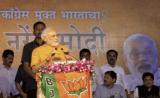
Cong hiding behind 'burqa' of secularism: Modi

July 14, 2013

modi

Pune, Jul 14: Amid uproar over his remarks on 2002 riots, Gujarat Chief Minister Narendra Modi today charged Congress with wearing the "burqa (veil) of secularism" and "hiding in a bunker" each time it is confronted with a crisis.

Addressing a public meeting here, Modi also attacked Congress Vice-President Rahul Gandhi on the issue of his party's "failure" to eradicate poverty and alleged that it was raising the bogey of "threat to secularism" to throttle people's aspirations.

"Look minutely, whenever Congress is faced with a challenge- whether is corruption, price rise, directives from the Supreme Court, or a minister being jailed, or the rape of girls or an atmosphere of insecurity- they do not answer the people. The moment there is a crisis, they wear the 'burqa' (veil) of secularism and hide in a bunker," Modi said.

BJP has often charged the Congress with engaging in minority appeasement for votebank politics.

Modi said Congress follows this act by insisting that one should not talk about poverty or corruption or price rise at this juncture as "secularism is in danger". He charged that Congress has done this for decades.

The BJP leader said Congress will not be able to throttle the aspirations and hopes of the people in the name of secularism any longer.

"Congress will no longer be able to keep the poor hungry, or the young unemployed or distance itself when a girl is raped. Now this medicine will not work," Modi said.

Though Modi attacked Prime Minister Manmohan Singh for failing to check the fall of the rupee despite being an expert on economics, he was more scathing on Rahul Gandhi.

Without naming Gandhi, Modi said the "heir" spends nights in the homes of the poor and shows this to the media and foreigners as "remnants of the past" when 35 years back Congress had given the slogan of removing poverty.

Modi said there is no limit to the corruption in the UPA government. "They have not left anything- air (spectrum), land, water," he said.

He charged that the Congress has made it impossible for the poor to have two meals a day but feels "serving a legal paper"- alluding to the Food Security Ordinance- will fill their stomachs.

The BJP leader criticised the government for taking the Ordinance route on this issue.

"The Parliament session is due in a few days. Government should have taken Parliament into confidence, have a healthy debate, remove its shortcomings and then passed a good Food Security Act. Why bring an Ordinance? Because they (Congress) have no trust in their UPA allies," Modi said.

He maintained that Congress did not wish to take the support of its allies on the Food Bill as they would also get credit for it.

"This is an insult of Parliament, of UPA allies and of the whole democratic process," he alleged.

Alleging that the Congress-led "government in Delhi" has "taken for granted" the people of this country, Modi said the root cause of problems being faced by the people is the dynastic politics of the ruling party in the last 60 years.

"Congress party feels that doing anything to win polls- be it appeasing this group or the other by giving them doles and doing votebank politics- is enough then they live a life of luxury for the next five years," he said.

Attacking the Congress-led government on the state of the economy and the devaluation of the Rupee, Modi said at the time of independence both the Rupee and the dollar had the same value.

He wondered why the Rupee is getting devalued when the currency of countries like Pakistan, Bangladesh, Nepal, Sri Lanka and Maldives has not fallen.

The Rupee is losing its power as the people in Delhi are busy in making and looting money that they are not concerned," Modi said.

Comments

Add new comment

  • Coastaldigest.com reserves the right to delete or block any comments.
  • Coastaldigset.com is not responsible for its readers’ comments.
  • Comments that are abusive, incendiary or irrelevant are strictly prohibited.
  • Please use a genuine email ID and provide your name to avoid reject.
Agencies
August 2,2020

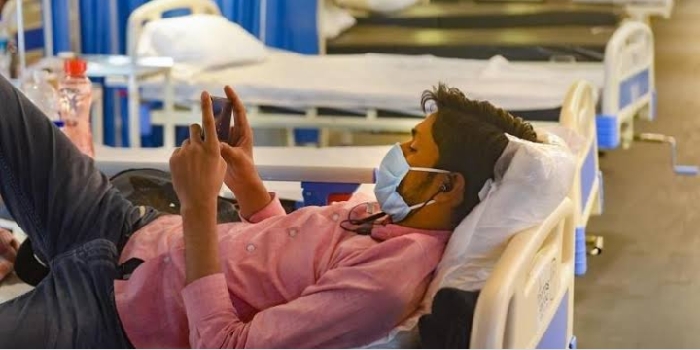
New Delhi, Aug 2: The Centre has written to all states and Union Territories stating that smartphones and tablet devices should be allowed for hospitalised Covid-19 patients so that they can interact with family and friends through video conferencing, which would provide them psychological support.

Though mobile phones are allowed in hospital wards, the missive was issued following some representation from the kin of patients alleging otherwise.

Director-General of Health Services (DGHS) in the Health Ministry Dr Rajiv Garg in the letter to the principal secretaries of health and medical education of states and Union territories said appropriate protocols for disinfecting devices and allotting timeslots can be developed by the hospital concerned to facilitate contact between patients and their family.

He underlined that administrative and medical teams should be responsive to the psychological needs of patients admitted in Covid-19 wards and ICUs of various hospitals.

"Social connection can calm down patients and also reinforce the psychological support given by the treating team. Please instruct all concerned that they should allow smartphones and tablet devices in patient areas so that the patient can video conference with their family and friends," stated the letter issued on July 29.

"Though mobile phones are allowed in the wards to enable a patient stay in touch with his or her family, we received representations from the patient families from some states stating mobile phones are not being allowed by hospital administrations because of which they were not being able to stay in contact with the patient," said Dr Garg.

Comments

Add new comment

  • Coastaldigest.com reserves the right to delete or block any comments.
  • Coastaldigset.com is not responsible for its readers’ comments.
  • Comments that are abusive, incendiary or irrelevant are strictly prohibited.
  • Please use a genuine email ID and provide your name to avoid reject.
Agencies
January 20,2020

New Delhi, Jan 20: The BJP has got a brand new President in the form of JP Nadda. At around 2.30 pm, the announcement was made, bringing an end to the Amit Shah era in BJP. The party's Working President Jagat Prakash Nadda won unopposed, sparking celebrations outside the BJP headquarters here on Monday. 

Amit Shah himself was among the people who proposed Nadda's name along with Nitin Gadkari and Rajnath Singh. Soon after his annointment, BJP election returning officer Radha Mohan Singh told the media, "I announce JP Nadda as the new BJP President." Shah was also seen hugging Nadda.

The nomination process for the post of the BJP President began at 10 am and went on till 12.30 pm. For the next hour, the filed nomination paper, which was just one, was examined. Party members waitied till 2.30 pm for the candidate to withdraw if he wished to. It was after this that Nadda was declared as the man who would step into the shoes of Amit Shah.

Many in the BJP believe that although Nadda is the BJP chief now, Shah would still make all macro-level decisions like pre poll alliances or top organisational appointments. Nadda would be in charge of monitoring the day-to-day needs of the organisation. BJP sources say that Amit Shah himself wanted an arrangement like this one and personally wanted Nadda to take over. as he helped Shah formulate legislations like Triple Talaq and Citizenship Amendment Act.

The party constitution mandates completion of election of at least 50 per cent of state Presidents for the election of national President to happen. In the last few days, the BJP has completed the election of a slew of state Presidents like in West Bengal, Nagaland among others.

The process of election of the national BJP President is quite elaborate and has been described in detail in the party constitution, which says that the national president shall be elected by an electoral college, comprising members of the national council and the state councils.

"Any 20 members of the electoral college of a state can jointly propose the name of a person, who has been an active member for four terms and has 15 years of membership, for the post of national president. Such joint proposal should come from not less than five states where elections have been completed for the national council. The consent of the candidate is necessary," it says.

Who is JP Nadda?

Jagat Prakash Nadda, 59, who has his roots in the Rashtriya Swayamsevak Sangh (RSS) and its affiliates, was appointed the Bharatiya Janata Party (BJP) national President on Monday, replacing his 'mentor' and Union Home Minister Amit Shah.

Former environment, health and law minister from Himachal Pradesh, which has just four of the Lok Sabha's 543 seats, Nadda has tried to carve out his own space in national politics with his low profile and astute organisational skills, believe his party leaders.

He rose through the ranks from the Akhil Bharatiya Vidyarthi Parishad (ABVP), the student wing of the RSS, from where he has managed to build inroads from university to the state politics.

Nadda has been active on the national political scene since 2010 when he was picked by then BJP chief Nitin Gadkari to join his new team. He was made the party's national general secretary.

Born on December 2, 1960, Nadda did his graduation from Patna and holds a post-graduate degree in political science and Bachelor of Legislative Law (LL.B) from Himachal Pradesh University in Shimla.

Starting his political career as a student leader of the ABVP in 1978, Nadda had also worked both with Gadkari and Shah even in the party's youth wing -- the Bharatiya Yuva Morcha -- from 1991 to 1994.

His wife Mallika Nadda, who teaches history at the Himachal Pradesh University and is currently posted in university's campus in Delhi, was an ABVP activist too, and its national general secretary from 1988 to 1999.

In the previous BJP government (2007-12) in the state, Nadda was forced to resign as Forest Minister in 2010 owing to differences between him and then chief minister Prem Kumar Dhumal.

He was elected to the Rajya Sabha in 2012.

Nadda won his first Assembly election from Bilaspur (Sadar) in Himachal in 1993. In 1998, he again won from that seat and became the state Health Minister.

He lost the Assembly elections in 2003, but again won in 2007 and was appointed the Forest Minister in the Himachal Pradesh.

Nadda, as a forest minister, was the brain behind opening forest police stations to check forest crimes, launching community-driven plantation, setting up forest ponds and the massive plantation of deodars to boost the depleting green cover of the 'Queen of Hills', as Shimla was fondly called by the British.

A close confidant of Prime Minister Narendra Modi, Nadda was among those who were mentioned as likely aspirants to the BJP top post after Rajnath Singh was inducted into the Central government as the Home Minister in 2014.

Later, Nadda was inducted into the union cabinet in its first expansion in 2014 as the Health Minister.

Hailing Nadda's appointment, Chief Minister Jai Ram Thakur told IANS it is a proud moment that a leader belonging to a small state in the national politics is today the leader of the country's biggest national party.

His father N.L. Nadda, who was a Vice-Chancellor of the Ranchi University, resides in Bilaspur town.

Comments

Add new comment

  • Coastaldigest.com reserves the right to delete or block any comments.
  • Coastaldigset.com is not responsible for its readers’ comments.
  • Comments that are abusive, incendiary or irrelevant are strictly prohibited.
  • Please use a genuine email ID and provide your name to avoid reject.
News Network
February 27,2020

New Delhi, Feb 27: An Indian Air Force aircraft on Thursday evacuated 76 Indians and 36 foreign nationals from the coronavirus-hit Chinese city of Wuhan.

The C-17 Globemaster III transport aircraft was sent to Wuhan on Wednesday and it carried 15 tonnes of medical supplies for coronavirus-affected people in China.

On its return, the aircraft brought back 112 people, including 23 citizens from Bangladesh, six from China, two each from Myanmar and the Maldives and one each from South Africa, the US and Madagascar.

Earlier, India had evacuated around 650 Indians from Wuhan in two Air India flights.

“In all 723 Indian nationals and 43 foreign nationals have been evacuated from Wuhan, China, in these three flights,” the Ministry of External Affairs (MEA) said.

On the medical supplies delivered by India to China, the MEA said they would help augment the country’s efforts to control the coronavirus outbreak which had been declared as a public health emergency by the World Health Organisation.

“The assistance is also a mark of friendship and solidarity from the people of India towards the people of China as the two countries also celebrate 70th anniversary of establishment of diplomatic relations this year,” it said.

Comments

Add new comment

  • Coastaldigest.com reserves the right to delete or block any comments.
  • Coastaldigset.com is not responsible for its readers’ comments.
  • Comments that are abusive, incendiary or irrelevant are strictly prohibited.
  • Please use a genuine email ID and provide your name to avoid reject.