



Cong hiding behind 'burqa' of secularism: Modi

July 14, 2013

modi

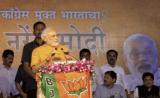
Pune, Jul 14: Amid uproar over his remarks on 2002 riots, Gujarat Chief Minister Narendra Modi today charged Congress with wearing the "burqa (veil) of secularism" and "hiding in a bunker" each time it is confronted with a crisis.

Addressing a public meeting here, Modi also attacked Congress Vice-President Rahul Gandhi on the issue of his party's "failure" to eradicate poverty and alleged that it was raising the bogey of "threat to secularism" to throttle people's aspirations.

"Look minutely, whenever Congress is faced with a challenge- whether is corruption, price rise, directives from the Supreme Court, or a minister being jailed, or the rape of girls or an atmosphere of insecurity- they do not answer the people. The moment there is a crisis, they wear the 'burqa' (veil) of secularism and hide in a bunker," Modi said.

BJP has often charged the Congress with engaging in minority appeasement for votebank politics.

Modi said Congress follows this act by insisting that one should not talk about poverty or corruption or price rise at this juncture as "secularism is in danger". He charged that Congress has done this for decades.

The BJP leader said Congress will not be able to throttle the aspirations and hopes of the people in the name of secularism any longer.

"Congress will no longer be able to keep the poor hungry, or the young unemployed or distance itself when a girl is raped. Now this medicine will not work," Modi said.

Though Modi attacked Prime Minister Manmohan Singh for failing to check the fall of the rupee despite being an expert on economics, he was more scathing on Rahul Gandhi.

Without naming Gandhi, Modi said the "heir" spends nights in the homes of the poor and shows this to the media and foreigners as "remnants of the past" when 35 years back Congress had given the slogan of removing poverty.

Modi said there is no limit to the corruption in the UPA government. "They have not left anything- air (spectrum), land, water," he said.

He charged that the Congress has made it impossible for the poor to have two meals a day but feels "serving a legal paper"- alluding to the Food Security Ordinance- will fill their stomachs.

The BJP leader criticised the government for taking the Ordinance route on this issue.

"The Parliament session is due in a few days. Government should have taken Parliament into confidence, have a healthy debate, remove its shortcomings and then passed a good Food Security Act. Why bring an Ordinance? Because they (Congress) have no trust in their UPA allies," Modi said.

He maintained that Congress did not wish to take the support of its allies on the Food Bill as they would also get credit for it.

"This is an insult of Parliament, of UPA allies and of the whole democratic process," he alleged.

Alleging that the Congress-led "government in Delhi" has "taken for granted" the people of this country, Modi said the root cause of problems being faced by the people is the dynastic politics of the ruling party in the last 60 years.

"Congress party feels that doing anything to win polls- be it appeasing this group or the other by giving them doles and doing votebank politics- is enough then they live a life of luxury for the next five years," he said.

Attacking the Congress-led government on the state of the economy and the devaluation of the Rupee, Modi said at the time of independence both the Rupee and the dollar had the same value.

He wondered why the Rupee is getting devalued when the currency of countries like Pakistan, Bangladesh, Nepal, Sri Lanka and Maldives has not fallen.

The Rupee is losing its power as the people in Delhi are busy in making and looting money that they are not concerned," Modi said.

Comments

Add new comment

  • Coastaldigest.com reserves the right to delete or block any comments.
  • Coastaldigset.com is not responsible for its readers’ comments.
  • Comments that are abusive, incendiary or irrelevant are strictly prohibited.
  • Please use a genuine email ID and provide your name to avoid reject.
News Network
January 24,2020

Jan 24: India’s economy appears to be shaking off a slump, as activity in the services and manufacturing sectors expanded for a second straight month in December.

The needle on a gauge measuring so-called animal spirits signaled the economy may be taking a turn for the better, as five of the eight high-frequency indicators tracked by Bloomberg News came in stronger last month. The dial was last at the current position in August.

“Animal spirits” is a term coined by British economist John Maynard Keynes to refer to investors’ confidence in taking action, and the gauge uses the three-month weighted average to smooth out volatility in the single-month numbers.

The nascent recovery would need a helping hand, with expectations building that Finance Minister Nirmala Sitharaman will provide some stimulus when she presents the budget Feb. 1. Official forecasts show the economy is set to expand at 5% in the year ending March 2020 -- the weakest pace in more than a decade.

Here are the details of the dashboard:

Business Activity

The dominant services index rose to the highest level in five months in December as improving new work orders helped boost activity. The seasonally adjusted Markit India Services PMI index climbed to 53.3 from 52.7 in November, helping post a strong end to the calendar year.

India’s manufacturing PMI also rose -- to 52.7 from 51.2 a month ago -- boosted by the fastest increase in new orders since July. A reading above 50 means expansion while anything below that signals contraction.

The uptick in business confidence was accompanied by a rise in inflationary pressures, the survey showed. That trend may keep monetary policy makers from resuming interest-rate cuts anytime soon, leaving most of the heavy-lifting to boost growth with the government.

“The relative stability in macro indicators over the past two months suggests that the worst is behind, but the recovery is likely to be prolonged,” said Teresa John, an economist at Nirmal Bang Equities Pvt. in Mumbai. “Still, sluggish growth and rising inflation indicate that India may well remain in stagflation for most of 2020.”

Exports

Exports remained a laggard, falling 1.8% in December from a year ago. The drag was mainly because of a fall in export of engineering goods, which constitute a third of India’s non-oil exports.

Capital goods imports continued to contract and was lower by 16.5% year-on-year in December after a 22% drop in November. This was the seventh consecutive month of continuous decline, underscoring the weakness in the capex cycle, according to IDFC First Bank.

Consumer Activity

Weakness in demand for passenger vehicles persisted, with local sales falling 1.2% in December from a year ago, according to the Society of Indian Automobile Manufacturers. That capped the worst yearly passenger vehicle sales on record. A Nielsen study on demand for fast-moving consumer goods showed volume growth dropped to 3.5% in the last quarter of 2019 from 3.9% in the same period of 2018.

Funding conditions held out hope, showing considerable improvement in December, according to the Citi India Financial Conditions Index. Credit growth remained tardy though, with demand for loans rising at a slower 7.1% pace from a year ago compared with a nearly 8% growth in November.

Industrial Activity

Industrial output rose for the first time in four months in November. The pick up was broad-based, led by mining, manufacturing and electricity. Mining and manufacturing, in particular, posted a second month of sequential growth. Production of consumer goods also rose after a few months of contraction.

The index of eight core infrastructure industries, which feeds into the index of industrial production, however, declined 1.5% in November from a year ago -- the fourth straight month of contraction. That was on account of shrinking production of electricity, steel, coal, natural gas and crude oil. Both the core sector and industrial output numbers are reported with a one-month lag.

Comments

Add new comment

  • Coastaldigest.com reserves the right to delete or block any comments.
  • Coastaldigset.com is not responsible for its readers’ comments.
  • Comments that are abusive, incendiary or irrelevant are strictly prohibited.
  • Please use a genuine email ID and provide your name to avoid reject.
Agencies
August 9,2020

Pathanamthitta, Aug 9 : An orange alert has been issued in Kerala's Pathanamthitta district as the water level in Pamba dam is now flowing at 983.05 metres and it is likely to reach 983.50 metres within an hour.

A red alert will be declared at 984.5 metres and dam will open when the water level reaches 985 metres.

"The water level in Pamba dam is 983.05 metres now and is likely to reach 983.50 metres within an hour. So, the second alert- orange alert has been issued. A red alert will be declared at 984.5 metres and dam will open when it reaches 985 metres," said Pathanamthitta District Collector.

Meanwhile, a portion of the Shiva Temple in Aluva continues to remain submerged. However, the water level in the Periyar River is receding gradually and more part of the temple is above the water level now. 

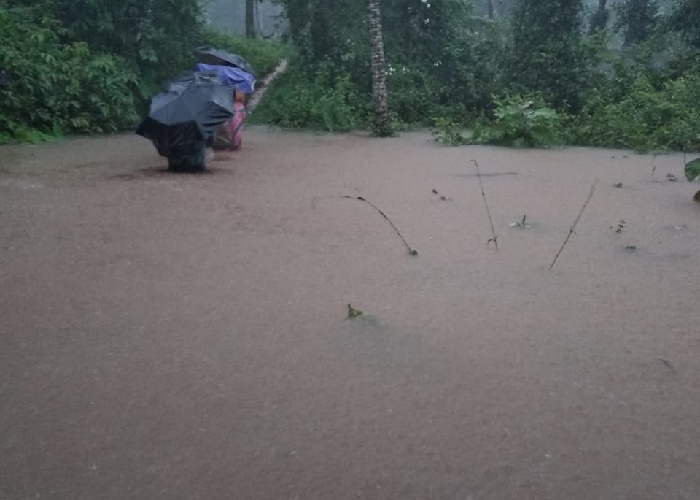
As Kerala has been receiving heavy rain for the past few days, severe waterlogging affects traffic movement at Mannuthy bypass in Thrissur on Saturday.

On Friday, the India Meteorological Department (IMD) had issued a red alert in Kozhikode district. It had also predicted rainfall in different parts of the state.

Due to heavy downpour, a massive landslide had occurred in Idukki district recently. The death toll in Idukki landslide has risen to 26, Kerala Chief Minister Pinarayi Vijayan said on Saturday.

The Chief Minister said that monsoon fury continues to be severe in the state.

Comments

Add new comment

  • Coastaldigest.com reserves the right to delete or block any comments.
  • Coastaldigset.com is not responsible for its readers’ comments.
  • Comments that are abusive, incendiary or irrelevant are strictly prohibited.
  • Please use a genuine email ID and provide your name to avoid reject.
News Network
June 12,2020

Jun 12: There have been complaints of non-availability of beds or denial of treatment to coronavirus patients in the national capital despite nearly 70 per cent of beds in five designated hospitals run by the Delhi government lying vacant, with experts attributing it to people''s aversion towards state-run facilities.

As per the latest information shared on the Delhi Corona app on Thursday afternoon, more than 3,000 beds are lying vacant in these five dedicated COVID-19 hospitals that have a total capacity of 4,344 beds.

However, almost all beds at several big private hospitals are shown to be occupied.

Families of many COVID-19 patients, confirmed or suspected, have alleged in the past few weeks that they have been denied admission at many facilities or have not been able to get a bed for their kin.

Medical and public health experts feel it may be because of the image associated with government hospitals, related to infrastructure and hygiene conditions, and perhaps shortage of staff.

According to the latest data available on Delhi Corona app on Thursday afternoon, a total of 9,444 beds are available in private facilities and hospitals run by the central and Delhi governments. Out of these, 4,371 are vacant.

The app shows that beds are available at Delhi government-run hospitals dedicated for COVID-19 treatment such as LNJP Hospital (1,219), GTB Hospital (1,314), Rajiv Gandhi Super Speciality Hospital or RGSSH (242).

However, almost all beds at several big private hospitals are shown to be occupied.

At LNJP Hospital, there are a total of 2,000 beds, out of these 781 are occupied. GTB Hospital has total 1,500 beds, only 186 of which are occupied. Even at RGSSH, 258 of the 500 beds are occupied.

Beds are available at other dedicated COVID-19 facilities in the national capital too, according to the app. Deep Chand Bandhu Hospital has 94 unoccupied beds out of a total 176 and Satyawadi Raja Harishchandra Hospital has 145 vacant beds out of a total 168.

This makes a total of 4,344 COVID-19 beds at these five dedicated Delhi government hospitals, out of which 3,014 or 69.38 per cent are vacant.

A senior doctor at the RGSSH said, "We are only admitting very serious COVID-19 patients in the hospital. Those with mild symptoms, or asymptomatic ones, are either being home quarantined or being sent to COVID Care Centres. Our beds are on stand-by also to accommodate serious patients in case there is a sudden rush."

Delhi Heath Minster Satyendar Jain had recently said that some private hospitals could have been denying admission, but the Delhi government-run hospitals have not denied beds to any needy COVID-19 patient.

He had also said that main private hospitals are almost full to their capacity in terms of number of COVID-19 beds.

According to the app, at prominent private hospitals like Indraprastha Apollo, Max Hospital in Shalimar Bagh, Fortis Hospital in Shalimar Bagh, BL Kapur Hospital are fully occupied.

Max Hospital in Saket has a total of 200 beds for COVID-19 patients, and only one is vacant.

On June 9, the Delhi government had directed 22 private hospitals in the national capital to dedicate a total of 2,015 extra beds for treatment of coronavirus patients, revising its earlier allocation limit of 20 per cent.

Lawyer and public heath activist Ashok Agarwal said infrastructure and hygiene are two main factors, and people still want to "avoid government facilities".

"I know of cases, where people were willing to be on waiting list of private hospitals but did not go to a government hospital, even though beds were available," he said.

Even those who went to a government hospital for COVID-19 treatment, complained of "dirty toilets, and these being used by multiple patients", Agarwal said.

"Also, as the cases erupted successively over the months, many people got scared and were in two minds to go to a government hospital, as admitted patients were making allegations in videos and on social media about lack of proper services. Besides, there is shortage of medical staff at various facilities, and each patient needs to be attended to," he argued.

Delhi government hospitals and private facilities were directed to prominently display information about the availability of beds on a flex board at their main gates.

Delhi Lt Governor Anil Baijal on Wednesday ordered Delhi hospitals to display the availability of COVID and non-COVID beds, charges for rooms or beds along with contact details on a LED board outside the hospital.

Max Hospital sources said they were already displaying the status of beds on LED screens near their reception area even before the government order.

A spokesperson from Fortis Hospital said, "We are in the process of arranging to put up the displays as per the prescribed format."

Delhi recorded 1,501 fresh coronavirus cases on Wednesday, taking the COVID-19 tally in the city to over 32,000, and the death toll due to the disease mounted to 984, authorities said.

Comments

Add new comment

  • Coastaldigest.com reserves the right to delete or block any comments.
  • Coastaldigset.com is not responsible for its readers’ comments.
  • Comments that are abusive, incendiary or irrelevant are strictly prohibited.
  • Please use a genuine email ID and provide your name to avoid reject.