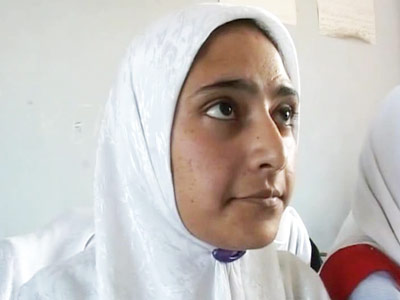
Kashmiri girl gets US scholarship, denied passport because her uncle was a militant

August 5, 2013

US_scholarshipBudgam/Jammu and Kashmir, Aug 5: She was offered a scholarship by the US, but orphaned Kashmiri teenager Sufaira has been denied a passport by her own country - just because her uncle was a militant even before she was born.

15-year-old Sufaira Jan, who stays in an orphanage in Budgam, was to have left for the US in the first week of August, after winning a one-year scholarship under the India-US Youth Exchange Study programme.

She cleared four exams and an interview in the US embassy in Delhi in March to get an invitation from America, becoming an inspiration for the entire orphanage.

But reality hit hard when she applied for a passport in April, this year. The Jammu and Kashmir state government did not give her a clearance, based on the state CID's (Criminal Investigation Department) records on her uncle, a former militant who surrendered in 1995.

"The government doesn't understand that if my uncle was a militant in the past, and is now surrendered and lives a normal life, what is my fault? I am not a militant," Sufaira told NDTV.

Though she should have been on her way to the US by now, Sufaira still has her fingers crossed. "I really want to go to America - I cleared all the exams successfully. Even my friends are praying for me"

Jammu and Kashmir Chief Minister Omar Abdullah's response should encourage her.

As NDTV highlighted Sufaira's story, chief minister tweeted: "Needless to say she will NOT be denied a passport because of her uncle's past. All such pending cases of previous denials are being cleared."

Comments

Add new comment

  • Coastaldigest.com reserves the right to delete or block any comments.
  • Coastaldigset.com is not responsible for its readers’ comments.
  • Comments that are abusive, incendiary or irrelevant are strictly prohibited.
  • Please use a genuine email ID and provide your name to avoid reject.
News Network
April 16,2020

United Nations, Apr 16: WHO chief Tedros Adhanom Ghebreyesus has welcomed the world health body's cooperation with India to leverage strategies that helped the country win its war against polio into the response to COVID-19 outbreak, saying such joint efforts will help defeat the pandemic.

The World Health Organization (WHO) has said it will work with India's Ministry of Health and Family Welfare to leverage the strategies that helped the country eradicate polio to fight the pandemic.

Migrants who returned to UP and Bihar were hurriedly housed in schools and panchayat buildings, which were turned into quarantine centres. However, unhygienic conditions and people running away have proved to be a problem

The WHO's national polio surveillance network will be engaged to strengthen COVID-19 surveillance and its field staff will continue to support immunization and elimination of tuberculosis and other diseases.

“Great news: @MoHFW_INDIA & @WHOSEARO initiated a systematic engagement of @WHO's national polio surveillance network, and other field staff, for India's #COVID19 response, tapping into the best practices & resources that helped win its war against polio,” the WHO director-general tweeted, referring to India's Ministry of Health and Family Welfare and World Health Organization Regional Office for South-East Asia.

According to the Johns Hopkins University data, over 2 million people are infected by the virus and more than 136,000 people have died of the disease globally.

Ghebreyesus expressed gratitude to Health and Family Welfare Minister Harsh Vardhan “for his leadership and collaboration” with WHO. “Through these joint efforts we can defeat the #coronavirus and save lives. Together!”

India eliminated polio in 2014.
According to a WHO press release, Vardhan said in New Delhi that “time and again the Government of India and WHO together have shown our ability, competence and prowess to the whole world. With our combined meticulous work, done with full sincerity and dedication, we were able to get rid of polio.”

“All of you in the field – IDSP (Integrated Disease Surveillance Project), state rapid response teams and WHO - are our ‘surveillance corona warriors'. With your joint efforts we can defeat the coronavirus and save lives,” Vardhan added.

WHO South-East Asia Regional Director Poonam Khetrapal Singh said the National Polio Surveillance Project (WHO-NPSP) played a critical role in strengthening surveillance for polio that generated useful, timely and accurate data to guide policies, strategies and interventions until transmission of the poliovirus was interrupted in the country,” adding that the other WHO field staff involved with elimination of tuberculosis and neglected tropical diseases and hypertension control initiative were also significant resources.

Singh added that “it is now time to use all your experience, knowledge and skills, with the same rigor and discipline that you showed while monitoring polio activities, to support districts with surveillance, contact tracing and containment activities.”

The WHO release said strengths of the NPSP team – surveillance, data management, monitoring and supervision, and responding to local situations and challenges – will be utilized to supplement efforts of National Centre for Disease Control, IDSP and Indian Council of Medical Research to strengthen COVID-19 surveillance.

The NPSP team will also support in sharing information and best practices and help states and districts calibrate their response based on transmission scenarios and local capacities.

The WHO field staff will continue to support immunization and surveillance and elimination of Tuberculosis and Neglected Tropical Diseases, Singh said, adding, “disease outbreaks can negatively impact progress in a range of areas, from maternal and child mortality to vaccine-preventable diseases and other treatable conditions. India had been making stupendous progress in these areas and we cannot afford for India's remarkable progress to be set back or reversed.”


Comments

Add new comment

  • Coastaldigest.com reserves the right to delete or block any comments.
  • Coastaldigset.com is not responsible for its readers’ comments.
  • Comments that are abusive, incendiary or irrelevant are strictly prohibited.
  • Please use a genuine email ID and provide your name to avoid reject.
Agencies
January 25,2020

Thiruvananthapuram, Jan 25: Kerala Chief Minister Pinarayi Vijayan on Friday asked the state's MPs to take up the matter of deaths of eight Keralites at a resort in Nepal early this week, with the Centre to pursue the matter with the neighbouring country's government.

He was speaking to the MPs at the customary meeting that the Chief Minister has with all MPs ahead of every session of the parliament.

"The demand has come from the families of the victims for a fair probe on what happened and adequate compensation. For this, you (MPs) should take it up with the Centre. A probe has to be done by the Nepal authorities and the Centre should pursue this with them," Pinarayi reportedly stated. 

"We (the state government) have already taken the issue with the Centre and will now send a detailed letter on the need for a fair probe by the Nepal authorities," he added.

The eight dead include Praveen Krishnan Nair, who worked in the UAE and was on a short vacation here, when the tragedy struck the family. His wife Saranya, a second year M.Pharma student, and their three children, were also killed.

On Friday morning, it was a goodbye that Thiruvananthapuram has perhaps not seen before, as hundreds of people, many of them strangers, came to pay last respects to the five members of the Nair family.

The family of Praveen Nair decided to bury the bodies of the three children and cremate the bodies of Praveen and Saranya. It was also decided to bury the ashes of the couple alongside their three children in the compound of their house.

The second family hailed from Kozhikode and the bodies of Ranjith, an IT professional, his wife, who works in a cooperative bank and their younger child, who slept in the same room as that of Praveen, arrived at the Kozhikode airport on Friday morning.

State Transport Minister A.K. Saseendran and many others were there to receive the bodies, which were first taken to Ranjith's new home that is almost complete.

From there it was taken to a hall for all to pay their last respects and then to the family home of Ranjith where the cremation took place.

Watching everything happening was Ranjith's elder son, seven-year-old Madhav, who escaped that night in Nepal as he was sleeping in another room.

Madhav had arrived from Delhi on Thursday and was unaware of the tragedy as he was busy moving around in a new bicycle, which his relatives had bought to keep him busy.

Comments

Add new comment

  • Coastaldigest.com reserves the right to delete or block any comments.
  • Coastaldigset.com is not responsible for its readers’ comments.
  • Comments that are abusive, incendiary or irrelevant are strictly prohibited.
  • Please use a genuine email ID and provide your name to avoid reject.
News Network
January 28,2020

New Delhi, Jan 28: Kolkata Metro Rail Corp expects to complete its East-West project, which runs partly under the city’s iconic Hooghly river, by March 2022 after a delay of several years doubled costs.

The authority is awaiting a final installment of Rs 20 crore ($2.8 million) over the next two years from the Indian Railway Board, said Manas Sarkar, managing director at KMRC. A soft loan of Rs 4,160 crore from Japan International Cooperation Agency helps fund 48.5% of the project.

India’s oldest metro, which started in 1984 with a North-South service, was due to expand by 2014 but faced problems including squatters on the planned route. These issues have contributed to the total project cost rising to about Rs 8,600 crore for some 17 kilometers from Rs 4,900 crore for 14 km.

“About 40% of total transport demand will be tackled by these two metro services,” Sarkar said in an interview at his office in Kolkata. “It will be a relief for environmental pollution and the city should be much more decongested.”

The new line is expected to carry about 900,000 people daily, -- roughly 20% of the city’s population -- and will take less than a minute to cross a 520-meter underwater tunnel. Depending on the time of day, it takes some 20 minutes to use the ferry and anywhere upward of an hour to cross the Howrah bridge.

KMRC will repay the JICA loan over 30 years after an initial six-year moratorium. The interest rate is between 1.2% to 1.6%. The East-West metro project is 74% owned by the railway ministry and 26% by the ministry of housing and urban affairs.

“We don’t anticipate any further cost escalation now,” Sarkar said.

Comments

Add new comment

  • Coastaldigest.com reserves the right to delete or block any comments.
  • Coastaldigset.com is not responsible for its readers’ comments.
  • Comments that are abusive, incendiary or irrelevant are strictly prohibited.
  • Please use a genuine email ID and provide your name to avoid reject.