



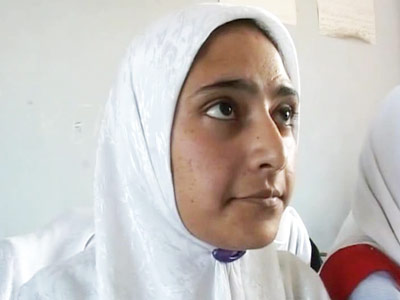
Kashmiri girl gets US scholarship, denied passport because her uncle was a militant

August 5, 2013

US_scholarshipBudgam/Jammu and Kashmir, Aug 5: She was offered a scholarship by the US, but orphaned Kashmiri teenager Sufaira has been denied a passport by her own country - just because her uncle was a militant even before she was born.

15-year-old Sufaira Jan, who stays in an orphanage in Budgam, was to have left for the US in the first week of August, after winning a one-year scholarship under the India-US Youth Exchange Study programme.

She cleared four exams and an interview in the US embassy in Delhi in March to get an invitation from America, becoming an inspiration for the entire orphanage.

But reality hit hard when she applied for a passport in April, this year. The Jammu and Kashmir state government did not give her a clearance, based on the state CID's (Criminal Investigation Department) records on her uncle, a former militant who surrendered in 1995.

"The government doesn't understand that if my uncle was a militant in the past, and is now surrendered and lives a normal life, what is my fault? I am not a militant," Sufaira told NDTV.

Though she should have been on her way to the US by now, Sufaira still has her fingers crossed. "I really want to go to America - I cleared all the exams successfully. Even my friends are praying for me"

Jammu and Kashmir Chief Minister Omar Abdullah's response should encourage her.

As NDTV highlighted Sufaira's story, chief minister tweeted: "Needless to say she will NOT be denied a passport because of her uncle's past. All such pending cases of previous denials are being cleared."

Comments

Add new comment

  • Coastaldigest.com reserves the right to delete or block any comments.
  • Coastaldigset.com is not responsible for its readers’ comments.
  • Comments that are abusive, incendiary or irrelevant are strictly prohibited.
  • Please use a genuine email ID and provide your name to avoid reject.
News Network
March 27,2020

Mumbai, Mar 27: The Reserve Bank of India (RBI) on Friday lowered the key repo rate by 75 basis points to 4.4 per cent in a bid to arrest the economic slowdown amid coronavirus (COVID-19) outbreak.
The reverse repo rate now stands at 4 per cent, down by 90 basis points, said RBI Governor Shaktikanta Das adding this has been done to make it unattractive for banks to passively deposit funds with the central bank and instead lend it to the productive sectors.
The six-member monetary policy committee (MPC) met on March 24, 25 and 27 and voted 4:2 in favour of the repo rate reduction. The MPC also decided to continue with the accommodative stance as long as it is necessary to revive growth and mitigate the impact of COVID-19 on the economy while ensuring that inflation remains within the target.
"The need of the hour is to shield the economy from the pandemic," said Das. "We need to mitigate the impact of coronavirus, revive economic growth and provide financial stability."
Repo rate is the rate at which a country's central bank lends money to commercial banks, and the reverse repo rate is the rate at which it borrows from them.
The RBI Governor further said that the economic growth and inflation projection will be highly contingent depending on the duration, spread and intensity of the pandemic.
"Global economic activity has come to a near standstill as COVID-19 related lockdowns and social distancing are imposed across a widening swathe of affected countries. Expectations of a shallow recovery in 2020 from 2019's decade low in global growth have been dashed," said Das.
"The outlook is now heavily contingent upon the intensity, spread and duration of the pandemic. There is a rising probability that large parts of the global economy will slip into recession," he said.
However, the RBI has injected liquidity of Rs 2.8 lakh crore via various instruments equal to 1.4 per cent of GDP. "Along with today's measures, liquidity measures equal to 3.2 per cent of GDP. The RBI will take continuous measures to ensure liquidity in the system."
The RBI governor has said that all banking institutions can offer a three-month moratorium on all loans for a period of three months. The RBI has also allowed banks to restructure the working capital cycle for companies without worrying that these will have to be classified as a non-performing asset (NPA).
The three-month moratorium will permit banks to avoid a large onset of NPAs during the 21-day lockdown and keep their books healthy.
Das said banks and other financial institutions should do all they can to keep credit flowing to economic agents facing financial stress on account of the isolation that the virus has imposed.
"Market participants should work with regulators like the RBI and the Securities and Exchange Board of India (SEBI) to ensure the orderly functioning of markets in their role of price discovery and financial intermediation," he said.

Comments

Add new comment

  • Coastaldigest.com reserves the right to delete or block any comments.
  • Coastaldigset.com is not responsible for its readers’ comments.
  • Comments that are abusive, incendiary or irrelevant are strictly prohibited.
  • Please use a genuine email ID and provide your name to avoid reject.
News Network
June 13,2020

New Delhi, Jun 13: Veteran Urdu poet Anand Mohan Zutshi 'Gulzar' Dehlvi passed away on Friday afternoon, five days after he recovered from COVID-19.

He died at his Noida home, and was a month shy of turning 94.

"His corona test came negative on June 7 and we brought him home. Today he had lunch and at around 2.30pm he passed away," his son Anoop Zutshi told PTI.

"He was quite old, and the infection had left him very weak. So doctors are thinking it was possible a cardiac arrest," he added.

A freedom fighter and a premier 'inquilabi' poet, Dehlvi was admitted to a private hospital on June 1 after testing positive for coronavirus.

Born in old Delhi's Gali Kashmeerian in 1926, he was also the editor of 'Science ki Duniya', the first Urdu science magazine published by the Government of India in 1975.

Remembering her fond memories of Dehlvi, historian-writer Rana Safvi recalled seeing the poet at most 'mushairas' in Delhi.

"I cannot express how big a loss it is. We used to see him at every 'mushaira' in Delhi. It's a big loss to Delhi and the world of poetry," Safvi said.

She also took to Twitter to express her condolences.

"Sad to hear about Gulzar Dehlvi saheb's demise. He was the quintessential Dilli waala. May he rest in peace," she tweeted.

According to Delhi-based poet and lawyer Saif Mahmood, Dehlvi was "the presiding bard of Delhi", following in the footsteps of iconic poets like Mirza Ghalib, and Mir Taqi Mir.

His death is the "end of an era", he said.

"No one knew the nooks and crannies of Mir and Ghalib's Delhi like him. Gulzar saheb claimed that his father, Allama Pandit Tribhuvan Nath Zutshi 'Zaar Dehlvi', was a disciple of the renowned poet Daagh Dehlvi," he said, while reminiscing his meeting with Dehlvi three years back.

The poet had recited a still unpublished 'sher' (couplet) then, Mahmood said, which seems more relevant now in the aftermath of his demise.

"Mere baad aane waalon, meri baat yaad rakhna/ mere naqsh-e-pa se behtar, koi raasta nahin hai". (Those who come after, remember what I say/ there’s no better way than to follow my footprints).

"He was a true exemplar of not just the Urdu language but also of the Urdu culture. In fact he was a living and breathing form of Urdu tehzeeb," Mahmood said.

Comments

Add new comment

  • Coastaldigest.com reserves the right to delete or block any comments.
  • Coastaldigset.com is not responsible for its readers’ comments.
  • Comments that are abusive, incendiary or irrelevant are strictly prohibited.
  • Please use a genuine email ID and provide your name to avoid reject.
News Network
January 7,2020

New Delhi, Jan 7: The Delhi Police has filed an FIR against JNUSU president Aishe Ghosh and 19 others for allegedly attacking security guards and vandalising the server room of the Jawaharlal Nehru University (JNU) on January 4.

The police registered the FIR on January 5.

In the complaint filed by the JNU administration, the University alleged that the accused were involved in physical violence and pushed the women guards, verbally abused them and threatened them of dire consequences if they opened the lock of university's communication and information (CIS) office.

"They illegally trespassed the University property with the criminal intention to damage the public property. They damaged servers and made it dysfunctional. They also damaged fiber optic power supplies and broke the biometric systems inside the room," the University officials alleged.

This incident allegedly occurred a day before Aishe Ghosh, other JNU students and teachers were attacked by a masked mob inside the campus.

Comments

Add new comment

  • Coastaldigest.com reserves the right to delete or block any comments.
  • Coastaldigset.com is not responsible for its readers’ comments.
  • Comments that are abusive, incendiary or irrelevant are strictly prohibited.
  • Please use a genuine email ID and provide your name to avoid reject.