



Indian stock market slips below trillion-dollar mark, rupee at record low

August 6, 2013

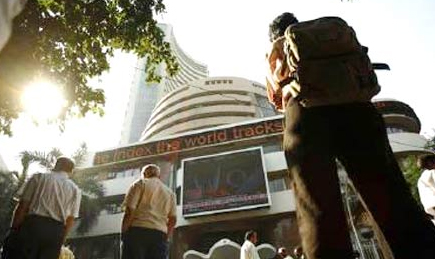
Indian_stockMumbai, Aug 6: Indian stock market slipped below the trillion-dollar level in terms of total valuation of all listed companies on Tuesday morning, as downward pressure continued on rupee and share prices.

Rupee touched its all-time low level of Rs 61.51 against the US dollar in early trade and the stock market also lost further ground with a fall of over one per cent in the benchmark Sensex.

As a result, the total market capitalisation of all listed stocks in the country fell to nearly USD 992 billion (close to Rs 60.9 lakh crore), pushing India out of the elite global league of markets having a trillion-dollar valuation.

The BSE benchmark Sensex tumbled by more than 200 points in the late morning trade on fresh selling mainly in realty, metal, consumer durable, banking and captial goods sectors.

Indian stock market has been holding to the trillion-dollar level by a wafer-thin margin for last few days amid continuing weakness in stocks and rupee values.

At the end of Monday's trade, the total valuation of all listed stocks in India stood at Rs 61,55,448.63 crore (USD 1.011 trillion), while it had touched a low of USD 1.004 trillion last week.

With India out of this league, only 13 stock markets across the world currently enjoy a trillion-dollar status, led by the US (an estimated USD 20 trillion).

Other members of this elite club are - UK, Japan, China, Canada, Hong Kong, Germany, France, Switzerland, Australia, South Korea, Nordic region and Brazil.

While markets like Russia, Spain and South Africa have moved out of this club after enjoying a trillion-dollar status in the past, at least three more markets -- Brazil, South Korea and Nordic region markets -- are maintaining this level with small margins.

India had first entered the trillion-dollar club in June 2007, but moved out in September 2008, amid a global slowdown. It again got back into this elite league in May 2009 and had largely remained there since then, except for some brief periods.

Rather than the fall in share values, the rupee weakness has been the greater force behind the dollar-valuation plunge in the recent months.

Since the beginning of the current fiscal in April 2013, though the rupee valuation of Indian stock market has fallen by only about 4 per cent (from Rs 63.88 lakh crore to Rs 60.90 crore), but its dollar valuation has plunged by about 18 per cent (from USD 1,209 billion to USD 992 billion).

Rupee has depreciated by over 12 per cent during this period.

Comments

Add new comment

  • Coastaldigest.com reserves the right to delete or block any comments.
  • Coastaldigset.com is not responsible for its readers’ comments.
  • Comments that are abusive, incendiary or irrelevant are strictly prohibited.
  • Please use a genuine email ID and provide your name to avoid reject.
News Network
May 18,2020

New Delhi, May 18: With the highest-ever spike of 5,242 new cases in last 24 hours, the total number of positive COVID-19 cases in India reached 96,169 on Monday, according to the Ministry of Health and Family Welfare.

With 157 deaths reported in the last 24 hours, the death toll has risen to 3,029, as per the latest update by the ministry.

Out of the total number of cases, 36,824 have been cured/discharged/migrated.

This comes a day after the nationwide lockdown, imposed as a precautionary measure to contain the spread of COVID-19, was extended till May 31.

Maharashtra remains the worst-affected state due to the virus with 33,053 cases, including 1,198 deaths. It is followed by Gujarat (11,379), Tamil Nadu (11,224) and Delhi (10,054).

Comments

Add new comment

  • Coastaldigest.com reserves the right to delete or block any comments.
  • Coastaldigset.com is not responsible for its readers’ comments.
  • Comments that are abusive, incendiary or irrelevant are strictly prohibited.
  • Please use a genuine email ID and provide your name to avoid reject.
Agencies
March 25,2020

New Delhi, Mar 25: The Indian Rail Catering and Tourism Corporation (IRCTC) on Wednesday appealed to the people not to cancel their e-tickets on their own in case of trains being cancelled by the national transporter due to nation-wide lockdown to help curb the spread of novel coronavirus pandemic.

Clearing the doubts of the railway passengers, IRCTC spokesperson Siddharth Singh said, "Doubts have been raised regarding cancellation of e-tickets subsequent to the halting of railway passenger trains.

"It may be submitted that for trains cancelled by the railways in its complete run, refund on e-tickets is full and automatic. In this case, no cancellation exercise is required to be done on the part of the user," he said.

The IRCTC official said that if user cancels his e-ticket in situations of train cancellations, there are chances he may get "less refund". "Hence passengers are advised not to cancel e-tickets on their own for those trains which have been cancelled by the railways," he said.

He also said that the refund amount will be credited to the user account used for booking e-tickets automatically and no charges will be deducted by the railways in case of train cancellation.

His remarks came as the national transporter announced the suspension of the passenger, mail and express services from March 23 till March 31. However, the railways extended the suspension of services till April 14 in the wake of the three week lockdown announced by Prime Minister Narendra Modi from March 25 during his second special address to the nation on Tuesday night.

The railways has cancelled over 13,600 passengers trains across the country in a bid to combat the spread of novel coronavirus. Only freight trains are running to ensure the supply of essential services. About 9,000 freight trains are transporting essential items every day across the country.

On Wednesday, India recorded 562 cases of COVID-19 with 10 deaths.

Comments

Add new comment

  • Coastaldigest.com reserves the right to delete or block any comments.
  • Coastaldigset.com is not responsible for its readers’ comments.
  • Comments that are abusive, incendiary or irrelevant are strictly prohibited.
  • Please use a genuine email ID and provide your name to avoid reject.
News Network
May 21,2020

Bengaluru, May 21: The COVID-19-induced lockdown saw a spurt in crybercrimes in India with Kerala recording the highest number during the period, according to an analysis of IT security solutions provider K7 Computing.

The report analyses various cyberattacks within India during the pandemic and reveals that threat actors targeted the States with COVID-19-themed attacks aimed at exploiting user trust.

The sudden surge in the frequency of attacks witnessed from February 2020 to mid-April 2020 indicates that scamsters across the world were exploiting the widespread panic around coronavirus at both the individual and corporate level, the company said in a statement.

These attacks aimed to compromise computers and mobile devices to gain access to users confidential data, banking details and cryptocurrency accounts.

The key threats seen during this period ranged from phishing attacks to rogue apps disguised as COVID-19 information apps that targeted users sensitive data.

Phishing attacks were noticed more in Tier-II and Tier-III cities while the metros fared better.

Smaller cities saw over 250 attacks being blocked per 10,000 users.

Users from Ghaziabad and Lucknow seem to have faced almost six and four times the number of attacks, respectively, as Bengaluru users.

In Kerala, regions like Kottayam, Kannur, Kollam, and Kochi saw the highest hits with 462, 374, 236, and 147 attacks respectively, while the state as a whole saw around 2,000 attacks during the period, the highest thus far in the country.

This was followed by Punjab with 207 attacks and Tamil Nadu at 184 attacks, the statement said.

A majority of the recorded attacks were phishing attacks with sophisticated campaigns that could easily snare even the most educated users, it said.

These attacks were aimed at heightening users fears and creating a sense of urgency to take action.

The report noted phishing attacks where scamsters posed as representatives of the United States Department of the Treasury, the World Health Organisation, and the Centres for Disease Control and Prevention.

Users were encouraged to visit links that would automatically download malware on the host computer such as the Agent Tesla keylogger or Lokibot information-stealing malware, infamous banking Trojans such as Trickbot or Zeus Sphinx, and even disastrous ransomware.

Other attacks included infected COVID-19 Android apps like CoronaSafetyMask that scam users with promises of masks for an upfront payment; the spyware app Project Spy; and seemingly genuine apps that are infected with dangerous malware like banking Trojans such as Ginp, Anubis and Cerberus, it was stated.

Comments

Add new comment

  • Coastaldigest.com reserves the right to delete or block any comments.
  • Coastaldigset.com is not responsible for its readers’ comments.
  • Comments that are abusive, incendiary or irrelevant are strictly prohibited.
  • Please use a genuine email ID and provide your name to avoid reject.