



Indian stock market slips below trillion-dollar mark, rupee at record low

August 6, 2013

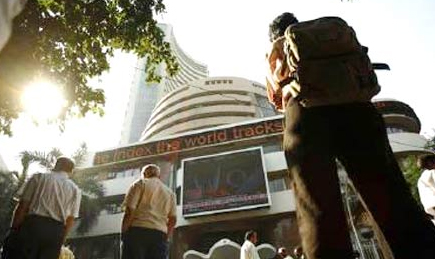
Indian_stockMumbai, Aug 6: Indian stock market slipped below the trillion-dollar level in terms of total valuation of all listed companies on Tuesday morning, as downward pressure continued on rupee and share prices.

Rupee touched its all-time low level of Rs 61.51 against the US dollar in early trade and the stock market also lost further ground with a fall of over one per cent in the benchmark Sensex.

As a result, the total market capitalisation of all listed stocks in the country fell to nearly USD 992 billion (close to Rs 60.9 lakh crore), pushing India out of the elite global league of markets having a trillion-dollar valuation.

The BSE benchmark Sensex tumbled by more than 200 points in the late morning trade on fresh selling mainly in realty, metal, consumer durable, banking and captial goods sectors.

Indian stock market has been holding to the trillion-dollar level by a wafer-thin margin for last few days amid continuing weakness in stocks and rupee values.

At the end of Monday's trade, the total valuation of all listed stocks in India stood at Rs 61,55,448.63 crore (USD 1.011 trillion), while it had touched a low of USD 1.004 trillion last week.

With India out of this league, only 13 stock markets across the world currently enjoy a trillion-dollar status, led by the US (an estimated USD 20 trillion).

Other members of this elite club are - UK, Japan, China, Canada, Hong Kong, Germany, France, Switzerland, Australia, South Korea, Nordic region and Brazil.

While markets like Russia, Spain and South Africa have moved out of this club after enjoying a trillion-dollar status in the past, at least three more markets -- Brazil, South Korea and Nordic region markets -- are maintaining this level with small margins.

India had first entered the trillion-dollar club in June 2007, but moved out in September 2008, amid a global slowdown. It again got back into this elite league in May 2009 and had largely remained there since then, except for some brief periods.

Rather than the fall in share values, the rupee weakness has been the greater force behind the dollar-valuation plunge in the recent months.

Since the beginning of the current fiscal in April 2013, though the rupee valuation of Indian stock market has fallen by only about 4 per cent (from Rs 63.88 lakh crore to Rs 60.90 crore), but its dollar valuation has plunged by about 18 per cent (from USD 1,209 billion to USD 992 billion).

Rupee has depreciated by over 12 per cent during this period.

Comments

Add new comment

  • Coastaldigest.com reserves the right to delete or block any comments.
  • Coastaldigset.com is not responsible for its readers’ comments.
  • Comments that are abusive, incendiary or irrelevant are strictly prohibited.
  • Please use a genuine email ID and provide your name to avoid reject.
Agencies
June 15,2020

New Delhi, Jun 15: Average temperature of India experienced a rise of 0.7 degree Celsius, along with decline in rainfall, significant increase in frequency of very severe cyclonic storms and droughts in over a decade due to human activities, the Ministry of Earth Sciences in its research report said.

The contentions were made in a report issued by the ministry on the impact of climate change. It will be published by Union Minister Harsh Vardhan on June 19.

According to the report, "Since the middle of the twentieth century, India witnessed rise in temperature; decrease in monsoon; rise in extreme temperature and rainfall, droughts, and sea levels; and increase intensity of severe cyclones.

The report, prepared by researchers of the Centre for Climate Change Research, a cell under The Ministry's Indian Institute of Tropical Meteorology, Pune, further stated that there is compelling scientific evidence that human activities have influenced these changes in regional climate.

India's average temperature has risen by around 0.7 degrees Celsius during 1901-2018, it said, adding that the rise is largely on account of GHG-induced warming and partially offset by forcing due to anthropogenic aerosols.

It states that the average temperature over India is projected to rise by 4.4 degrees Celsius, while the intensity of heat waves is likely to increase by 3-4 times by the end of the century.

In the 30-year period between 1986 and 2015, temperatures of the warmest day and the coldest night of the year have risen by about 0.63 degrees Celsius and 0.4 degree Celsius.

According to the report, by the end of the century, the temperatures of the warmest day and the coldest night are projected to rise by approximately 4.7 degrees Celsius and 5.5 degrees Celsius, respectively.

Alarmingly, sea surface temperature of the tropical Indian Ocean has also risen by one degrees Celsius on average during 1951-2015.

"The frequency of very severe cyclonic storms during the post-monsoon season has increased significantly (+1 event per decade) during the last two decades (2000-2018)," it added.

This came in the backdrop of Cyclone 'Amphan' and 'Nisarga' which made landfalls on May 20 and June 3 and killed several people, flattened villages, and destroyed farms.

"This is the first-ever climate change assessment report for India. This report will be very useful for policy makers, researchers, social scientists, economists, and students," said M. Rajeevan, secretary, the Ministry of Earth Sciences.

Besides this, the report also highlighted various other unnerving data on climate change in the country. Both the frequency and extent of droughts have increased significantly during 1951-2016.

The overall decrease of seasonal "summer monsoon rainfall" during the last 6-7 decades has led to an increased propensity for droughts over India.

"In particular, areas over central India, southwest coast, southern peninsula and north-eastern India have experienced more than 2 droughts per decade, on average, during this period. The area affected by drought has also increased by 1.3 per cent per decade over the same period."

The Hindu Kush Himalayas (HKH) also experienced a temperature rise of about 1.3 degree Celsius during 1951-2014.

Several areas of the Himalayas have experienced a declining trend in snowfall and also retreat of glaciers in recent decades. By the end of the twenty-first century, its annual mean surface temperature is projected to increase by about 5.2 degree Celsius.

The summer monsoon precipitation from June to September over India has also declined by around 6 per cent from 1951 to 2015, with notable decreases over the Indo-Gangetic Plains and the Western Ghats, the report further states.

Comments

Add new comment

  • Coastaldigest.com reserves the right to delete or block any comments.
  • Coastaldigset.com is not responsible for its readers’ comments.
  • Comments that are abusive, incendiary or irrelevant are strictly prohibited.
  • Please use a genuine email ID and provide your name to avoid reject.
News Network
May 4,2020

New Delhi, May 4: Rebutting the Congress' criticism, the BJP said on Monday that the railways has subsidised 85 per cent of ticket fare for special trains being run for migrant workers and the state governments have to pay the remaining 15 per cent.

The ruling party also accused the Congress of promoting indiscriminate movement of people which, it said, would lead to "faster spread" of coronavirus infection "just like we saw in Italy", and asked if this is what Sonia Gandhi wants.

The counter-charge from BJP leaders, including its spokesperson Sambit Patra and information technology department in-charge Amit Malviya, came after Congress president Sonia Gandhi hit out at the central government for making migrants pay for their train fare and asked her party's state units to pick the tab.

Congress leader Rahul Gandhi also took a swipe at the railways, saying, on one hand, it is seeking ticket fare from people stranded in various states while on the other it is donating Rs 151 crore to the PM-CARES Fund.

Responding to him, Patra said, "Rahul Gandhi ji, I have attached guidelines of MHA which clearly state that 'No tickets to be sold at any station'. Railways has subsidised 85% & state govt to pay 15%. The state govt can pay for the tickets (Madhya Pradesh's BJP govt is paying). Ask Cong state govts to follow suit," Patra tweeted.

The BJP leader further clarified that for each 'Shramik Express', special trains being run for migrants to take them back to their native places during the lockdown, about 1,200 tickets to the destination are handed by the railways to the state government concerned.

State governments are supposed to clear the ticket price and hand over the tickets to workers, he said.

He said the BJP government in Madhya Pradesh is doing so and asked Rahul Gandhi to tell the Congress-ruled states to follow suit.

Hitting out at Sonia Gandhi, Malviya tweeted, "Congress is obviously upset at how well India has handled Covid. They would have ideally wanted a lot more people to suffer and die. Promoting indiscriminate movement of people would lead to faster spread of infection, just like we saw in Italy. Is this what Sonia Gandhi wants?"

BJP MP Subramanian Swamy claimed that migrant workers returning home will not have to pay money as the rail travel will be free from now onwards.

"Talked to Piyush Goyal office. Govt will pay 85% and State Govt 15%. Migrant labour will go free. Ministry will clarify with an official statement," he tweeted.

BJP Congress Coronavirus COVID-19 Coronavirus lockdown Italy Sonia Gandhi Rahul Gandhi Sambit Patra Amit Malviya Subramanian Swamy Piyush Goyal

Comments

Add new comment

  • Coastaldigest.com reserves the right to delete or block any comments.
  • Coastaldigset.com is not responsible for its readers’ comments.
  • Comments that are abusive, incendiary or irrelevant are strictly prohibited.
  • Please use a genuine email ID and provide your name to avoid reject.
Agencies
July 31,2020

Thiruvananthapuram, Jul 31: People offered Eid-al-Adha namaz while ensuring social distancing norms at mosques in Thiruvananthapuram and Mallapuram on Friday.

Kerala Chief Minister Pinarayi Vijayan had on Thursday announced that the Eid-al-Adha prayers can be offered in mosques of the state on Friday with a limited number of people due to the COVID-19 pandemic.

Kerala is celebrating the festival of Eid-al-Adha on Friday.

Eid al-Adha or Bakrid, also known as "Sacrifice Feast" is marked by sacrificing an animal, usually a sheep or a goat to prove their devotion and love for Allah. Post the sacrifice, devotees distribute the offering to family, friends, neighbours and especially to the poor and the needy. 

Comments

Add new comment

  • Coastaldigest.com reserves the right to delete or block any comments.
  • Coastaldigset.com is not responsible for its readers’ comments.
  • Comments that are abusive, incendiary or irrelevant are strictly prohibited.
  • Please use a genuine email ID and provide your name to avoid reject.