



New Delhi, Aug 15: In an apparent attack on BJP leader and Gujarat Chief Minister Narendra Modi, Prime Minister Manmohan Singh today warned that "narrow and sectarian ideologies" would "weaken" the democracy and the country and they should be prevented from growing.
"There can be no place for narrow and sectarian ideologies in a modern, progressive and secular country.
Such ideologies divide our society and weaken our democracy. We should prevent them from growing," he said in his 10th consecutive speech on the Independence Day from the Red Fort.
In his 30-minute speech, Mr Singh did not make any direct reference to Mr Modi but apparently was referring to him indirectly.
The Prime Minister said there was a "need to strengthen those traditions of our country which teach us to promote tolerance and respect for thought processes different from ours."
"I would appeal to all political parties, all sections of our society and the public at large to work in this direction," he said.
Mr Singh said despite some worrisome communal incidents in 2012 and this year, "the last 9 years have been good for communal harmony".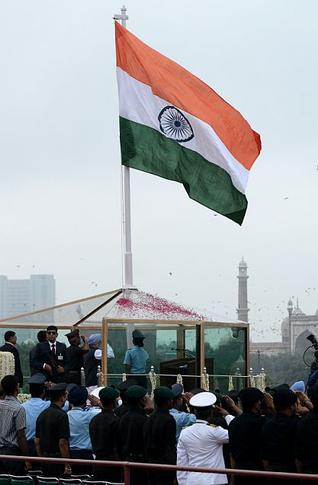
Full text of PM's I-Day speech
Following is the text of Prime Minister Manmohan Singh's speech on Independence Day:
My dear fellow citizens, Brothers, sisters and dear children, I greet you all on this Independence Day.
Today is certainly a day of joy for us. But on this celebration of independence we also feel pain in our hearts that our brothers and sisters in Uttarakhand had to face devastation about two months back. Our deepest sympathies are with all the families that suffered loss of life or property. I want to assure the people of Uttarakhand today that the whole country stands with them in this moment of crisis. Our government is working with all the resources at its command to rehabilitate those whose houses have been destroyed and rebuild damaged infrastructure.
Our army, paramilitary forces and numerous officers and staff of the Central and State governments worked in difficult conditions in partnership with the common people to perform an outstanding task in providing relief to those who were stranded. We especially pay homage to the officers and men of the Air Force, ITBP and NDRF who sacrificed their lives to save others.
We are also deeply pained that we lost the submarine, INS Sindurakshak in an accident yesterday. Eighteen brave sailors are feared to have lost their lives. The accident is all the more painful because the Navy had recently achieved two major successes in the form of its first nuclear submarine, INS Arihant and the aircraft carrier, INS Vikrant.
We pay homage to the brave hearts we have lost. We also congratulate the Navy on its successes.
Brothers and Sisters,
We achieved independence in 1947 under the leadership of Mahatma Gandhi. If we look at our subsequent journey, we would find that our country has seen major changes every ten years.
In the decade beginning 1950, India took its first steps as a democratic republic under the leadership of Pandit Jawahar Lal Nehru. We established institutions like the Atomic Energy Commission, Planning Commission and Election Commission, which went on to make a major contribution to the processes of nation building in later years. The first general elections were conducted and a beginning was made towards the formulation of the First Five Year Plan for socio-economic development of the country.
In the sixties, Pandit Nehru set up new industries and factories, implemented new irrigation projects and opened new universities. By laying emphasis on the role of science and technology in nation building he started the work of transforming this ancient country into a modern nation.
In the seventies, Indiraji boosted our confidence as a nation. During this period, we launched our first satellite in space. The Green Revolution enabled us to be self sufficient in food grains for the first time.
In the next decade, Rajiv Gandhi ji set into motion the process of technological and economic modernisation. The foundation for the progress we later made in the area of information technology was laid during this period. The importance of Panchayati Raj Institutions was emphasized and this later resulted in amendments to our Constitutions for strengthening and empowering these institutions.
In the year 1991, under the leadership of Shri Narsimha Rao, we successfully negotiated a major economic crisis and embraced reforms for strengthening our economy. These reforms were opposed by many political parties at that time.
But the reforms were in national interest and were therefore continued by all governments that came to power subsequently. Since then, the reform process has continually moved forward.
I believe that the last decade has also been a decade of major changes in the history of our nation. In no other decade has our economic development increased as much as in this decade. Democratic forces have been strengthened and many sections of our society have joined the mainstream of development for the first time.
The common man has been given new rights which have led to his social and economic empowerment.
Brothers and Sisters,
The first UPA government came to power in May 2004. Ever since, we have worked with sincerity and honesty to build a progressive and modern India.
We have envisioned a prosperous India. An India which has got rid of centuries old burden of poverty, hunger and disease. Where the light of education has driven away the darkness of ignorance and superstition.
Where there is social equality and all citizens enjoy equal economic opportunity. Where no section of the society faces injustice and exploitation.
We have dreamt of an India where the youth get employment opportunities that enable them to contribute to the noble endeavour of nation building.
We have strived for India's voice to be heard loud and clear at the international level. We have strived to build a nation that is looked at with respect and honour by the whole world.
We have taken many measures to realise these dreams. But the journey is long and a large distance still remains to be travelled.
Brothers and Sisters,
We have recently issued an Ordinance towards a Food Security law. The Food Security Bill is now before Parliament and we hope it will be passed shortly. This law will benefit 75 per cent of our rural population and half of our urban population. Under the law, about 81 crore Indians would be entitled to receive rice at 3 Rupees per kg, wheat at 2 Rupees per kg and coarse grains at 1 Rupee per kg. This is the largest effort of its kind in the whole world.
We have been able to implement this law only because of the hard work of our farmers. Our food-grain production reached a record level of 25.9 crore ton in 2011-12.
Without rapid agricultural growth, we cannot achieve our goal of making our villages prosperous. We have constantly endeavoured to increase production and to ensure that farmers get remunerative prices for their produce. In the last nine years, support prices for various crops have been enhanced as never before. The support prices for wheat and paddy have been more than doubled. Many states which faced shortages of food-grains earlier are now producing more than what they require for themselves.
The average annual rate of agricultural growth in the 11th Plan was 3.6, which is more than both the 9th and 10th Plan levels.
We now see clear indications of enhanced economic prosperity in our rural areas. In the period from 2004 to 2011, rural per-capita consumption has increased four times faster than earlier.
Rural wages have also increased much faster in this period. MNREGA provides employment to crores of people in rural areas.
Measuring poverty is a difficult task. There are diverse views about what constitutes poverty. But whatever definition we may adopt, it cannot be denied that the pace of reduction in poverty has increased after 2004.
Many states which had been considered backward for a long time, with some of them being called Bimaru, are now progressing rapidly.
We have enacted the Right to Education Act to provide every child in the country the opportunity for education. Almost all our children are today being imparted education in primary schools.
The number of young men and women going to college has more than doubled in the last 9 years.
We have implemented new schemes for scholarships on a large scale to enable poor children and those belonging to the weaker sections to access opportunities for education. Today, the Central government provides scholarships to more than 2 crore children.
Many new institutions have been opened in the area of higher education. For example, 8 new IITs, 7 New IIMs, 16 new Central universities and 10 new NITs. New institutions have also been opened to boost scientific research. Steps have been taken to attract students to the study of science and encourage Indian scientists working abroad to return to India.
However, much still remains to be done for reforming our education system. Many of our schools still lack drinking water facilities, toilets and other necessary infrastructure. There is a need to improve the quality of education. To achieve this, it is necessary to lay more emphasis on training of teachers.
About 11 crore children are being provided afternoon meals every day in schools under the Mid-day Meal Scheme. This programme is of immense benefit for both education and nutrition of children. However, it is necessary to improve its implementation. The tragedy that happened in Bihar some days back should not be repeated anywhere in the country.
We had launched the National Rural Health Mission in 2005. The Mission has started showing good results. Both Maternal Maternity and Infant Mortality rates have come down sharply. A much larger proportion of children is now born in hospitals. There has also been a large increase in the proportion of children being inoculated.
No case of polio has been detected in the country in the last two years. We have been able to eradicate a disease which used to cause disability to lakhs of people.
The Rashtriya Swasthya Bima Yojana, which provides free in-patient treatment in hospitals to our poor brothers and sisters, now covers about 3.5 crore families.
We have implemented the Health Mission in urban areas also. This will result in both expansion and improvement of health services in such areas.
For ensuring better safety and security for women, we have strengthened the law dealing with offences against women.
There has been good progress in the last 9 years in the infrastructure sector also, covering areas such as Roads, Railways, Power, Civil Aviation, Ports and Telecommunications. About 2 lakh km of new roads have been constructed for connecting villages under the Pradhan Mantri Gramin Sadak Yojana. More than 37,000 km of new highways have been built, facilitating travel and trade. More than 40 airports have been built or upgraded. In 2004, only 7 per cent of the people had telephone connections.
Today, 73 per cent enjoy this facility. In rural areas, this figure has gone up from 2 to 40. There has been a record addition to our capacity for electricity generation.
Brothers and Sisters,
In the recent months, there has been much discussion on the fact that last year our growth rate came down to 5 per cent. This is indeed true and we are trying our best to remedy the situation. However, it is not only our country that is facing economic difficulties. The last year has been difficult for the world economy as a whole.
Major European nations are experiencing a slow down these days. All over the world, there has been a slump in export markets. All developing countries have slowed down.
I believe that this phase of slow growth in India will not last long. In the last 9 years, our economy has grown at an annual average rate of 7.9 per cent. This pace of development is the highest in any decade so far.
Brothers and Sisters,
Countries today are more integrated with each other than ever before.
We have endeavoured that our foreign policy exploits this fully to India's benefit. In the last 9 years, there has been a continuous improvement in our relations with the major powers of the world.
Our Look East policy in respect of 10 ASEAN countries in East and South-East Asia has borne good results, especially in economic matters. We have also strived for friendship with our neighbouring countries. However, for relations with Pakistan to improve, it is essential that they prevent the use of their territory and territory under their control for any anti-India activity.
There has been improvement in the area of national security also. Despite some worrisome communal incidents in 2012 and this year, the last 9 years have been good for communal harmony. There has been a reduction in terrorist and Naxal violence also.
However, the area of national security calls for constant vigil. We have not been successful in preventing Naxal attacks that happen from time to time. The Naxal violence in Chhattisgarh on 25 May was a frontal attack on our democracy. Recently, there was a dastardly attack on our jawans on the Line of Control with Pakistan. We will take all possible steps to prevent such incidents in the future.
Brothers and Sisters,
We have taken many important measures to make the work of the government responsive, transparent and honest. I would like to mention only two of them here.
Through the RTI Act, the common man now gets more information than ever before about
the work of the government. This legislation is being used on a large scale at all levels.
The Act frequently brings to light irregularities and corruption and opens the door for improvements. I am sure that the RTI will lead to further improvements in the way the government functions.
We have introduced the Lokpal Bill in Parliament. The Lok Sabha has passed the Bill and it is now before the Rajya Sabha. This legislation will be a major step towards making our political system clean.
Brothers and Sisters,
We have journeyed a large distance in the last decade. But much remains to be done.
The process of change that we have initiated will be continued in the coming time.
As I have stated earlier also, rapid economic growth is an imperative for our country.
Without it, we cannot possibly achieve targets such as removal of poverty, provision of good quality education and health services and creation of new employment opportunities.
The average rate of economic growth that we have attained in the last 9 years shows what we are capable of. However, economic growth has slowed down at present and we are working hard to remedy the situation.
We have recently taken many steps to speed up the process of government clearances for industry, build an environment more conducive to trade and industry and increase investment in the economy.
A special Cell has been set up to help big projects with clearances. The Cabinet Committee on Investment is working to remove hindrances in the way of stalled projects.
Inadequate supply of coal had become a major problem affecting our efforts for increasing electricity generation. This has been resolved to a large extent.
We will start work on a number of new infrastructure projects in the coming months. This includes 2 new ports, 8 new airports, new industrial corridors and rail projects.
To boost Foreign Direct Investment, we have recently enhanced the limit of such investment in many sectors and made it easier procedurally.
In the coming months, we will see visible results of these efforts to increase investment. Our growth will accelerate, new employment opportunities will be generated and there will be improvement in the infrastructure sector.
Brothers and Sisters,
After the enactment of the Food Security legislation, its implementation will be one of our priorities. We have already started working in this direction in partnership with states. Computerisation of the Public Distribution System will be speeded up.
The Mid-day Meal scheme will be reformed. The meals being provided to our children should not only be nutritious but also be cooked hygienically. We will take concrete measures to ensure this.
In the area of skill development, we could not initially achieve as much progress as we wanted. But now the pace has picked up. We have established the National Skill Development Authority a few months back.
We will shortly launch a new scheme under which those who have successfully acquired new skills will be given a grant of about Rupees 10,000. This scheme will benefit about 10 lakh young men and women in the next 12 months.
The Multi Sectoral Development Programme for minorities has been reformed recently. We will now implement it effectively.
A scheme for offering Minimum Support Prices for minor forest produce has been approved some days back. This will enable our tribal brothers and sisters to get remunerative prices for the minor forest produce they collect. We will implement the scheme expeditiously.
A High Level Committee has been constituted to collect accurate information about the socio-economic, educational and health status of our tribal population. The report of the Committee will help us in designing better schemes for their benefit.
We can solve many of the problems that our country faces by deploying advanced technology. The Aadhaar scheme is a good example. Under the scheme, by the end of this year, about 50 crore people will acquire the means of proving their identity and this will bring them convenience in their daily lives. It will also enable crores of people to avail of banking facilities for the first time.
Brothers and Sisters,
There can be no place for narrow and sectarian ideologies in a modern, progressive and secular country. Such ideologies divide out society and weaken our democracy. We should prevent them from growing. We need to strengthen those traditions of our country which teach us to promote tolerance and respect for thought processes different from ours. I would appeal to all political parties, all sections of our society and the public at large to work in this direction.
Brothers and Sisters,
I had stated a few minutes back that every decade after independence has witnessed major changes in our country. We need to think today what changes we would like to see in the decade ahead.
If in the future we can achieve the same kind of progress as in the last decade, the day is not far off when India will be rid of poverty, hunger, disease and ignorance. Our India will be prosperous and all its citizens will be equal partners in this prosperity, irrespective of their religion, caste, region or language.
We will also need to build an environment of political stability, social cohesion and security for this to happen.
Let us all re-dedicate ourselves to building such an India together.
Dear children, please repeat with me thrice: Jai Hind, Jai Hind, Jai Hind.


Comments
Add new comment