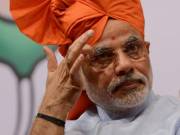
Criticism of Modi will not be tolerated: RSS

August 17, 2013

ModiLucknow, Aug 17: The Rashtriya Swayamsewak Sangh (RSS) has asked the BJP to act tough on leaders who criticise Gujarat Chief Minister Narendra Modi.

In his parleys with leaders of the Uttar Pradesh unit of the Bharatiya Janata Party (BJP), RSS points-person for BJP, Suresh Soni said Friday that the environment in the country was by far the best for the BJP to make a comeback.

"One has to realise that there is a strong anti-Congress wave in the country. The BJP should work hard to ensure that this anger against the Congress turns into goodwill for the BJP," Soni told party workers that included state president Laxmikant Bajpayi.

On a two-day visit to Lucknow to assess the preparedness of the saffron party for the Lok Sabha polls, Soni told RSS office bearers that the people of the country have taken Modi to be their prime minister and they were now duty bound to support him and bring good governance back.

Soni was instrumental in getting Modi appointed campaign chief of the BJP at the Goa national executive.

He told party workers that they should keep away from factionalism and should instead focus on the return of the party to power.

"Any factionalism or public criticism of each other will only harm party interests," he said.

Leaders attending the meeting said that Soni was categorical in his support for Modi and said the BJP should not go soft on leaders and workers who openly criticise the Gujarat chief minister.

In case, someone does not fall in line, he should be suspended from the party for six years, Soni told party leaders.

Comments

Add new comment

  • Coastaldigest.com reserves the right to delete or block any comments.
  • Coastaldigset.com is not responsible for its readers’ comments.
  • Comments that are abusive, incendiary or irrelevant are strictly prohibited.
  • Please use a genuine email ID and provide your name to avoid reject.
Agencies
June 6,2020

United Nations, Jun 6: The coronavirus disease has not "exploded" in India, but the risk of that happening remains as the country moves towards unlocking its nationwide lockdown that was imposed in March to contain the Covid-19, according to a top WHO expert.

WHO Health Emergencies Programme Executive Director Michael Ryan on Friday said the doubling time of the coronavirus cases in India is about three weeks at this stage.

“So the direction of travel of the epidemic is not exponential but it is still growing,” he said, adding that the impact of the pandemic is different in different parts of India and varies between urban and rural settings.

“In South Asia, not just in India but in Bangladesh and...in Pakistan, other countries in South Asia, with large dense populations, the disease has not exploded. But there is always the risk of that happening,” Ryan said in Geneva.

He stressed that as the disease generates and creates a foothold in communities, it can accelerate at any time as has been seen in a number of settings.

Ryan noted that measures taken in India such as the nationwide lockdown have had an impact in slowing transmission but the risk of an increase in cases looms as the country opens up.

“The measures taken in India certainly had an impact in dampening transmission and as India, as in other large countries, open up and as people begin to move again, there's always a risk of the disease bouncing back up,” he said.

He added that there are specific issues in India regarding the large amount of migration, the dense populations in the urban environment and the fact that many workers have no choice but to go to work every day.

India went past Italy to become the sixth worst-hit nation by the COVID-19 pandemic.

India saw a record single-day jump of 9,887 coronavirus cases and 294 deaths on Saturday, pushing the nationwide infection tally to 2,36,657 and the death toll to 6,642, according to the health ministry.

The lockdown in India, was first clamped on March 25 and spanned for 21 days, while the second phase of the curbs began on April 15 and stretched for 19 days till May 3. The third phase of the lockdown was in effect for 14 days and ended on May 17. The fourth phase ended on May 31.

The country had registered 512 coronavirus infection cases till March 24.

The nation-wide lockdown in containment zones will continue till June 30 in India but extensive relaxations in a phased manner from June 8 are listed in the Union home ministry's fresh guidelines on tackling the Covid-19 pandemic issued last week.

WHO Chief Scientist Soumya Swaminathan said the over 200,000 current coronavirus cases in India, a country of over 1.3 billion people, "look big but for a country of this size, it's still modest.”

She stressed that it is important for India to keep track of the growth rate, the doubling time of the virus and to make sure that that number doesn't get worse.

She said that India is a “heterogeneous and huge country” with very densely populated cities and much lower density in some rural areas and varying health systems in different states and these offer challenges to the control of Covid-19.

Swaminathan added that as the lockdown and restrictions are lifted, it must be ensured that all precautions are taken by people.

“We've been making this point repeatedly that really if you want behaviour change at a large level, people need to understand the rationale for asking them to do certain things (such as) wearing masks,” she said.

In many urban areas in India, it's impossible to maintain physical distancing, she said adding that it then becomes very important for people to wear appropriate face coverings when they are out, in office settings, in public transport and educational institutions.

“As some states are thinking about opening, every institution, organisation, industry and sector needs to think about what are the measures that need to be put in place before you can allow a functioning and it may never be back to normal.”

She said that in many professions working from home can be encouraged but in several jobs, people have to go to work and in such cases measures must be put in place that allow people to protect themselves and others.

“I think communication and behaviour change is a very large part of this whole exercise,” she added.


Comments

Add new comment

  • Coastaldigest.com reserves the right to delete or block any comments.
  • Coastaldigset.com is not responsible for its readers’ comments.
  • Comments that are abusive, incendiary or irrelevant are strictly prohibited.
  • Please use a genuine email ID and provide your name to avoid reject.
News Network
April 10,2020

Kochi, Apr 10: Kerala government is winning accolades for saving the life of eight foreigners including a very serious UK citizen who had been undergoing critical care for COVID-19 at a hospital here.

All the persons have been completely cured with the declaration of the test result of four persons. The persons, Roberto Tonozo (57) of Italy, Lanson (76) of UK, Elizabeth Lance (76), Brial Neil (57), Janet Layi (83), Steeven Hankok (61), Annie Wilson (61) and Jan Jackson (63) were completely cured and preparing to go for their countries, an official statement said on Thursday.

The last four persons who were cured expressed their desire to undergo treatment at a private hospital here.

Comments

Add new comment

  • Coastaldigest.com reserves the right to delete or block any comments.
  • Coastaldigset.com is not responsible for its readers’ comments.
  • Comments that are abusive, incendiary or irrelevant are strictly prohibited.
  • Please use a genuine email ID and provide your name to avoid reject.
News Network
May 11,2020

Kolkata, May 11: Murshidabad district, one of the biggest contributors to the army of migrant workers from West Bengal, received news of unnatural deaths of three of these people since Saturday. While two died in Kerala, one was found dead in a rented house in Odisha.

Residents of Baliaghati village in Murshidabad’s Suti police station area said Safikul Sheikh (31) was killed in a road accident in Kerala. Sheikh’s associates called up his family on Sunday morning and said he had gone to a local market, violating lockdown orders, when the accident took place. Sheikh wanted to return home before Eid but got stranded.

Mohammad Hafijul, one of Sheikh’s relatives, said, “A few days ago a special train from Kerala carried migrant workers to Murshidabad but Safikul did not have the money to buy a ticket. We do not know how his body will be brought back.”

In another incident, a 24-year-old resident of Domkal allegedly hanged himself in Kerala on Saturday. He used to work in a brick kiln. His mother said, “My son was depressed as he could not buy a ticket to board the special train that came to Murshidabad. We have appealed to the local administration to bring back his body.”

In the third incident, Bakul Sheikh (24) died under mysterious circumstances at Sonepur in Odisha where he went five months ago to work as a mason. Sheikh hails from Kohetpur village in Shamserganj. His relatives told the local police that his associates called up and said he was found dead inside the toilet of the house where he was living with other migrant workers.

Comments

Add new comment

  • Coastaldigest.com reserves the right to delete or block any comments.
  • Coastaldigset.com is not responsible for its readers’ comments.
  • Comments that are abusive, incendiary or irrelevant are strictly prohibited.
  • Please use a genuine email ID and provide your name to avoid reject.