



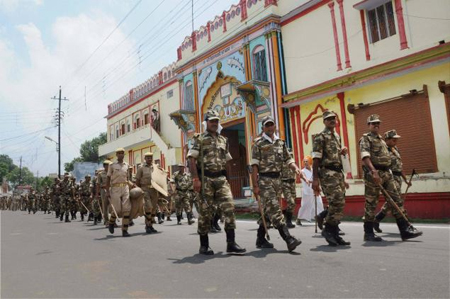
VHP yatra: 50 activists held, arrest warrants against 300

August 24, 2013

VHP_yatraAyodhya/Faizabad, Aug 24: Ahead of VHP's yatra from Ayodhya tomorrow, the Faizabad administration today cracked down on the saffron organisation arresting 50 of its activists and issuing arrest warrants against 300 members of the outfit.

Amid heavy deployment of police force in the twin towns, a team led by the Faizabad DM and SSP also carried out searches at VHP's local headquarter Karsewak Puram, Mani Ram Chawni, the temple of VHP leader and president of Ram Janam Bhumi Trust, Mahant Nritya Gopal Das and about half a dozen suspected hideouts of VHP's activists in and around Ayodhya.

The yatra has been banned by the Uttar Pradesh government over possible communal flareup.

The district administration, which had earlier issued arrest orders against 70 prominent VHP leaders, has now issued warrants against 300 more leaders.

"We are conducting preventive arrests of prominent VHP leaders who might create law and order problems in the name of banned 84-Kosi Parikrama yatra," Faizabad District Magistrate Vipin Kumar Dwivedi said.

"First we had issued arrest orders for 70 VHP activists and now 300 more have came on our target. Those arrested will be detained at temporary jails, and will be booked under section 144 of CrPC," he said.

Ashok Singhal, Pravin Togadia and Ram Vilas Vedanti were among the leaders against whom the warrants were issued yesterday.

Faizabad SSP K B Singh said 50 people have been taken into custody.

The VHP has proposed to take out Chaurasi Kosi parikrama yatra between August 25 to September 13 to push for Ram temple at the disputed site. Samajwadi Party government has denied permission for the yatra.

The yatra will travel through six districts, including Faizabad, Basti, Barabanki, Gonda, Bahraich and Ambedkar Nagar.

The district administration is expecting about 40,000-50,000 VHP activists to take part in the 84-kosi Parikrama yatra.

The Uttar Pradesh government has sought help from neighbouring states in intelligence-sharing on the movement of activists of the saffron outfit.

"Neighbouring states have been asked for intelligence sharing in wake of the proposed 84 kosi yatra of VHP on August 25," R K Vishwakarma, IG, Law and Order had said.

Asked if the borders of the district would be sealed, Vishwakarma had said a decision would be taken depending on the situation but for now anyone can visit the city.

"Only those going for the yatra will be stopped," he said, but did not elaborate how they would identify such people.

Vishwakarma said besides 13 companies of PAC and three company of RAF, two Superintendent of Police (SP), 19 Additional SPs, 42 Deputy SPs, 135 inspectors, 430 sub inspectors and 1,300 constables have been deployed in Faizabad.

Chief Minister Akhilesh Yadav had yesterday met legislators of Faizabad and adjoining districts and taken stock of the situation there.

The legislators were asked by Yadav to keep an eye on the situation and apprise the party and him about the ongoing developments in the area.

Though there was no restriction on movement of people in Ayodhya, all vehicles leading to Faizabad are being checked to restrict movement of VHP leaders for the yatra.

"Kya bataein...ye sab rajniti hai jisme hum garibon ko pareshani uthani padti hai. EK din bhi curfew lag jata hai to khana nahi naseeb hota" (All this is politics in which we poor have to suffer. If curfew is imposed for a day, we hardly get anything to eat), said Chhotu, who runs a roadside tea stall in Ayodhya.

Similar were the views of Rizwan Ali, who said there is no problem in the city, which is known for brotherhood between Hindus and Muslims.

"The yatra and temple issues are being raked for political reasons...and the worst hit is the common man like us", he said.

Meanwhile, over 40 sadhus were taken into police custody when they were proceeding to Ayodhya from Jaipur, shortly after their bus crossed into Agra district at Chauma Shahpur village on the UP-Rajasthan border, police said today.

46 sadhus were taken into custody in the wee hours today at around 1.45 AM, Additional District Magistrate of Kiraoli tehsil Radha Chauhan said.

The action comes in the wake off an information provided that sadhus would be crossing into Agra district from Rajasthan in order to proceed to Ayodhya for the Parikrama, Senior Superintendent of Police Shalabh Mathur said.

The sadhus were pushed around and misbehaved with by the policemen and hence they decided to protest and sit on a dharna, Harishankar Das Upraiti, one of the leaders of the group, alleged.

Some sadhus claimed that about 20 of their colleagues had managed to give the slip to the police and would try to reach Ayodhya for the 80 Kosi Parikrama yatra.

Meanwhile, Hindu organisations have criticised the arrest of the sadhus and expressed anger at the treatment meted out to them by policemen.

Comments

Add new comment

  • Coastaldigest.com reserves the right to delete or block any comments.
  • Coastaldigset.com is not responsible for its readers’ comments.
  • Comments that are abusive, incendiary or irrelevant are strictly prohibited.
  • Please use a genuine email ID and provide your name to avoid reject.
News Network
June 18,2020

New Delhi, Jun 18: The border clash between Indian and Chinese soldiers in Ladakh broke the brittle quiet – and also the sense of security for anxious Chinese nationals in India who fear a backlash with anti-Chinese sentiment spiralling in the country.

With the high altitude violent face-off in eastern Ladakh’s Galwan Valley spurring hashtags such as “Boycott China” and “Teach Lesson to China” and leading to street protests, the undercurrents of tension were evident.

Wary of being identified, some said they had been reassured by their friends but were still apprehensive for themselves and their families.

"They (Chinese families) don''t want to speak to the media. They are not going out and are worried about their security and well being. Their families are also worried back home," Mohammed Saqib, secretary general of the India China Economic & Cultural Council, told PTI.

He added that his Chinese friends in India been calling him since they heard news about Monday night’s clashes in which 20 Indian soldiers were killed -- the worst military confrontation in five decades -- and expressed concern over growing anti-China sentiments.

A Chinese national from Beijing working in Gurgaon for a Chinese mobile firm initially refused to talk, saying he did not want to speak to the media and later shared his thoughts only on condition of anonymity.

"There is talk of border standoff and tensions, but we know Indians are very warm people and that is why I have told my family that all is fine here and they should not worry," he said.

Another Chinese national working in Gurgaon said he and his family are feeling the stress amid the spiralling conflict between India and China, but many friends have been reassuring him.

"They (Chinese in India) are under a lot of stress naturally. Such a conflict puts a lot of stress as they could bear the brunt and the same applies to Indians in China," B R Deepak, professor at the Centre for Chinese and South East Asian Studies of the Jawaharlal Nehru University said.

He said it was unfortunate that the border standoff derailed the commemorative programmes aimed at strengthening ties at a time the two countries were gearing to celebrate 70 years of establishment of diplomatic ties.

Experts also feel the border clash is likely to have a significant negative impact on the economic and people to people ties.

There are scores of Chinese in India working in various Chinese firms and also those who are studying in universities like JNU.

About 3,000 Chinese people, doing business or studying in big cities in India, were stranded in India at the start of the COVID-19 crisis, and about half of them returned to China before the lockdown began on March 25.

The Chinese Embassy in New Delhi announced on May 25 that they will arrange for flights to take back students, tourists and businesspersons to five Chinese cities, including Shanghai and Guangzhou.

"It will impact the psychology of the Chinese here. There are 2,000 Chinese firms in various sectors in India which are going to be impacted," Deepak said.

Future investments from the Chinese side could also be impacted, he said.

Moreover, as far as people-to-people contacts are concerned, the number of Chinese students choosing India as a preferred destination is likely to go down, Deepak said.

Alka Acharya, another China expert, said there are two kinds of impacts of such an incident -- short term and medium term.

Usually after the initial nationalistic reaction in the short term things tend to normalise in the medium term, but with such a border clash happening for the first time in decades clearly the resonance would be much more in both India and China, said Acharya, professor at the Centre for East Asian Studies, School of International Studies, in JNU.

“Due to the impact of the COVID-19 crisis on the economy, whether India can take a hardline in terms of economics towards China, is a tricky question,” she said.

In the immediate context, there may be a dip in economic ties with calls for boycott of Chinese goods and services, Acharya said.

The manner in which this crisis is resolved will affect how ties will be affected in the medium term, she said.

The headlines have added to the anxiety.

A group of ex-armymen gathered near the Chinese embassy to protest the killing of 20 Indian Army personnel in Ladakh’s Galwan Valley. And another group of around 10 protesters belonging to the Swadeshi Jagaran Manch protested near the Teen Murti roundabout in Central Delhi.

The anti-China sentiment prevalent among the common public is also finding a reflection in government policy with sources saying the Department of Telecom (DoT) is set to ask state-owned Bharat Sanchar Nigam Ltd (BSNL) not to use Chinese telecom gear in its 4G upgradation.

Trade bodies like CAIT are also calling for a boycott of Chinese products.

And Chinese handset maker Oppo cancelled the livestream launch of its flagship 5G smartphone in the country amid protests.

Monday night’s clashes between the Chinese and Indian troops in Galwan Valley significantly escalated the already volatile border standoff between the two countries.

The casualties on the Chinese side are not yet known. However, government sources, citing an American intelligence report, claimed the total number of soldiers killed and seriously wounded could be 35.

Comments

Add new comment

  • Coastaldigest.com reserves the right to delete or block any comments.
  • Coastaldigset.com is not responsible for its readers’ comments.
  • Comments that are abusive, incendiary or irrelevant are strictly prohibited.
  • Please use a genuine email ID and provide your name to avoid reject.
News Network
March 7,2020

New Delhi, Mar 7: Prime Minister Narendra Modi turned emotional on Saturday when a woman beneficiary of his government's generic medicine programme told him that she had seen God in him.

Dehradun-resident Deepa Shah, who suffered paralysis in 2011, was interacting with the prime minister through video-conference on the occasion of Jan Aushadhi Diwas.

"I have not seen god, but I have seen God in you," she said, tears rolling down her eyes.

Modi was visibly emotional as the woman repeated her remark.

She also thanked the Uttarakhand chief minister and others who had helped her all along and said doctors had once told her that she cannot be cured.

"But on hearing your voice I have become better," she told Modi while profusely thanking the prime minister for his efforts to reduce the cost of medicines.

An emotional prime minister paused for a moment before telling her that it was her courage that had won over her disease and that she must carry on with the spirit.

Shah was expressing her plight and how she had suffered due to high cost of medicines after she suffered from paralysis in 2011 and has now started saving Rs 3,500 every month after benefitting from the government's low-cost generic medicines programme.

Soon after Shah rose to express her views, Modi asked her to sit and speak as he said she was uncomfortable while standing.

"You have defeated disease with your own will power. Your courage is your god and that same courage has given you the strength to emerge from such a big crisis. You should carry on this confidence in you," Modi told her.

He said some people still keep spreading rumours about generic medicines, going by their past experience, wondering how can medicines be available so cheap and that there must be something wrong with the medicine.

"But, by seeing you countrymen would gain confidence that there is nothing wrong in generic medicines. These medicines are not at all of inferior quality than any other medicine. These medicines have been certified by the best laboratories. These medicines are made in India and is 'Make in India' and are cheap," the prime minister said.

He said there is demand for generic medicines from India across the world and the government has made it mandatory for doctors to prescribe generic medicines to patients, unless necessary.

Comments

Sameeksha
 - 
Monday, 9 Mar 2020

Wowww so emotional... Lol .really god in you??? Drama king and queen

angry indian
 - 
Sunday, 8 Mar 2020

in 2002 riot we have seen shaitan in you..how come shaitan become GOD...


did he put atleat one tear for his mother, did he feel sad when pregnant muslim woman brutally murdered..

this guy is 21st century dajjal..

Suresh SS
 - 
Sunday, 8 Mar 2020

Big Nautanki, Dramebaz

Add new comment

  • Coastaldigest.com reserves the right to delete or block any comments.
  • Coastaldigset.com is not responsible for its readers’ comments.
  • Comments that are abusive, incendiary or irrelevant are strictly prohibited.
  • Please use a genuine email ID and provide your name to avoid reject.
Agencies
January 20,2020

New Delhi, Jan 20: The BJP has got a brand new President in the form of JP Nadda. At around 2.30 pm, the announcement was made, bringing an end to the Amit Shah era in BJP. The party's Working President Jagat Prakash Nadda won unopposed, sparking celebrations outside the BJP headquarters here on Monday. 

Amit Shah himself was among the people who proposed Nadda's name along with Nitin Gadkari and Rajnath Singh. Soon after his annointment, BJP election returning officer Radha Mohan Singh told the media, "I announce JP Nadda as the new BJP President." Shah was also seen hugging Nadda.

The nomination process for the post of the BJP President began at 10 am and went on till 12.30 pm. For the next hour, the filed nomination paper, which was just one, was examined. Party members waitied till 2.30 pm for the candidate to withdraw if he wished to. It was after this that Nadda was declared as the man who would step into the shoes of Amit Shah.

Many in the BJP believe that although Nadda is the BJP chief now, Shah would still make all macro-level decisions like pre poll alliances or top organisational appointments. Nadda would be in charge of monitoring the day-to-day needs of the organisation. BJP sources say that Amit Shah himself wanted an arrangement like this one and personally wanted Nadda to take over. as he helped Shah formulate legislations like Triple Talaq and Citizenship Amendment Act.

The party constitution mandates completion of election of at least 50 per cent of state Presidents for the election of national President to happen. In the last few days, the BJP has completed the election of a slew of state Presidents like in West Bengal, Nagaland among others.

The process of election of the national BJP President is quite elaborate and has been described in detail in the party constitution, which says that the national president shall be elected by an electoral college, comprising members of the national council and the state councils.

"Any 20 members of the electoral college of a state can jointly propose the name of a person, who has been an active member for four terms and has 15 years of membership, for the post of national president. Such joint proposal should come from not less than five states where elections have been completed for the national council. The consent of the candidate is necessary," it says.

Who is JP Nadda?

Jagat Prakash Nadda, 59, who has his roots in the Rashtriya Swayamsevak Sangh (RSS) and its affiliates, was appointed the Bharatiya Janata Party (BJP) national President on Monday, replacing his 'mentor' and Union Home Minister Amit Shah.

Former environment, health and law minister from Himachal Pradesh, which has just four of the Lok Sabha's 543 seats, Nadda has tried to carve out his own space in national politics with his low profile and astute organisational skills, believe his party leaders.

He rose through the ranks from the Akhil Bharatiya Vidyarthi Parishad (ABVP), the student wing of the RSS, from where he has managed to build inroads from university to the state politics.

Nadda has been active on the national political scene since 2010 when he was picked by then BJP chief Nitin Gadkari to join his new team. He was made the party's national general secretary.

Born on December 2, 1960, Nadda did his graduation from Patna and holds a post-graduate degree in political science and Bachelor of Legislative Law (LL.B) from Himachal Pradesh University in Shimla.

Starting his political career as a student leader of the ABVP in 1978, Nadda had also worked both with Gadkari and Shah even in the party's youth wing -- the Bharatiya Yuva Morcha -- from 1991 to 1994.

His wife Mallika Nadda, who teaches history at the Himachal Pradesh University and is currently posted in university's campus in Delhi, was an ABVP activist too, and its national general secretary from 1988 to 1999.

In the previous BJP government (2007-12) in the state, Nadda was forced to resign as Forest Minister in 2010 owing to differences between him and then chief minister Prem Kumar Dhumal.

He was elected to the Rajya Sabha in 2012.

Nadda won his first Assembly election from Bilaspur (Sadar) in Himachal in 1993. In 1998, he again won from that seat and became the state Health Minister.

He lost the Assembly elections in 2003, but again won in 2007 and was appointed the Forest Minister in the Himachal Pradesh.

Nadda, as a forest minister, was the brain behind opening forest police stations to check forest crimes, launching community-driven plantation, setting up forest ponds and the massive plantation of deodars to boost the depleting green cover of the 'Queen of Hills', as Shimla was fondly called by the British.

A close confidant of Prime Minister Narendra Modi, Nadda was among those who were mentioned as likely aspirants to the BJP top post after Rajnath Singh was inducted into the Central government as the Home Minister in 2014.

Later, Nadda was inducted into the union cabinet in its first expansion in 2014 as the Health Minister.

Hailing Nadda's appointment, Chief Minister Jai Ram Thakur told IANS it is a proud moment that a leader belonging to a small state in the national politics is today the leader of the country's biggest national party.

His father N.L. Nadda, who was a Vice-Chancellor of the Ranchi University, resides in Bilaspur town.

Comments

Add new comment

  • Coastaldigest.com reserves the right to delete or block any comments.
  • Coastaldigset.com is not responsible for its readers’ comments.
  • Comments that are abusive, incendiary or irrelevant are strictly prohibited.
  • Please use a genuine email ID and provide your name to avoid reject.