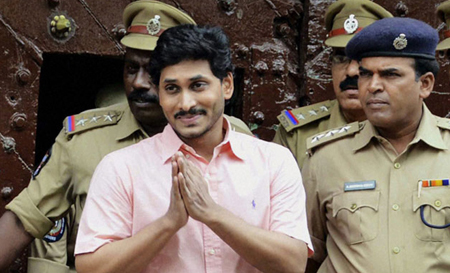
Jaganmohan Reddy to launch indefinite fast in jail from today

August 25, 2013

JaganmohanVijayawada, Aug 25: YSR Congress party chief Jaganmohan Reddy will go on indefinite fast from Sunday opposing proposed bifurcation of Andhra Pradesh.

Jagan's mother and YSR Congress honorary president Y S Vijayamma on Saturday had called off her indefinite fast after she was forcibly shifted to a hospital in Guntur in the wee hours.

Vijayamma, who began indefinite hunger strike at Guntur on August 19, called off the protest in the evening though she had vowed to continue it from the hospital.

She also announced that her son and jailed Kadapa MP Jagan Mohan Reddy will go on indefinite fast seeking "justice for Seemandhra people".

"I am ending my indefinite fast on request of Jagan," she told reporters at Gannavaram airport here while returning to Hyderabad from Guntur.

Vijayamma alongwith former TDP minister S Aruna, MLC N Raha Kumari and MLA Y Srinivas Rao, who were on hunger strike since last five days, were forcibly taken to government general hospital by police in the wee hours due to their deteriorating health.

She had vowed to continue her fast from the hospital even as both YSR Congress and TDP called for a shutdown on Saturday in Guntur town against the police action.

"Bifurcation (of Andhra Pradesh) is unfortunate and is injustice to Seemandhra region. The creation of Telangana would result into many complicated issues," she said.

Accusing Congress of taking the decision to divide the state in a haste Vijayamma, wife of former chief minister (late) Y S Rajasekhara Reddy, said various welfare and development programmes will come to a standstill if division is allowed.

"I wonder how government would be able to settle the pressing issues like sharing of water, development of irrigation projects," Vijayamma, who recently resigned as MLA from Pulivendula seat, said.

Referring to the CWC resolution, which proposed Hyderabad would be the joint capital of proposed Telangana and other regions--Rayalaseema and Andhra--for ten years, she said Seemandhra region would face the fund crunch due to such move.

She appealed to TDP president N Chandrababu Naidu to resign and lead the agitation against bifurcation.

Senior leaders of YSR Congress like Konathala Ramakrishna and Dharmana Krishna Das met Jaganmohan Reddy in Chanchalguda prison in Hyderabad and discussed the fast issue.

While maintaining that it was not against the state bifurcation per se, YSRC party has raised a protest over the manner in which the ruling Congress sought to go ahead with the process "without addressing the concerns of the people of Andhra-Rayalaseema regions".

Comments

Add new comment

  • Coastaldigest.com reserves the right to delete or block any comments.
  • Coastaldigset.com is not responsible for its readers’ comments.
  • Comments that are abusive, incendiary or irrelevant are strictly prohibited.
  • Please use a genuine email ID and provide your name to avoid reject.
News Network
June 16,2020

New Delhi, Jun 16: Jet fuel or ATF price on Tuesday was hiked by 16.3 per cent while petrol price was increased by 47 paise per litre and that of diesel by a record 93 paise on the back of firming international oil rates.

Aviation turbine fuel (ATF) price was hiked by ₹5,494.5 per kilolitre (kl), or 16.3 per cent, to ₹39,069.87 per kl in the national capital, according to a price notification by state-owned oil marketing companies.

This is the second straight increase in ATF price this month. Rates were hiked by a record 56.5 per cent (₹12,126.75 per kl) on June 1.

Simultaneously, petrol and diesel prices were hiked for the 10th day in a row.

Petrol price in Delhi was hiked to ₹76.73 per litre from ₹76.26, while diesel rates were increased to ₹75.19 a litre from ₹74.26, the price notification said.

In 10 hikes, petrol price has gone up by ₹5.47 per litre and diesel by Rs 5.8 a litre.

Rates have been increased across the country and vary from state to state depending on the incidence of local sales tax or VAT.

The hike in diesel rates is the highest daily increase since the state-owned fuel retailers started daily revision in rates in May 2017.

Hike for 10th consecutive day

Tuesday’s increase in petrol and diesel price marks the 10th straight day of rise in rates since oil companies on June 7 restarted revising prices in line with costs, after ending an 82-day hiatus.

The freeze in rates was imposed in mid-March soon after the government hiked excise duty on petrol and diesel to shore up additional finances.

Oil PSUs Indian Oil Corp (IOC), Bharat Petroleum Corp Ltd (BPCL) and Hindustan Petroleum Corp Ltd (HPCL) instead of passing on the excise duty hikes to customers adjusted them against the fall in the retail rates that was warranted because of fall in international oil prices.

The June 1 hike in jet fuel price had come after seven consecutive reductions in rates since February. ATF price in Delhi before the reduction cycle began in February was ₹64,323.76 per kilolitre, which got reduced to ₹21,448.62 last month.

Industry officials said the hike was necessitated because benchmark international rates have bounced back from a two-decade low.

While ATF prices are revised on 1st and 16th of every month, petrol and diesel prices are revised on a daily basis.

Oil companies used to revise ATF prices on the first of every month, but adopted fortnightly revisions on March 21 to pass on the benefit of falling international oil prices to airlines.

Comments

Add new comment

  • Coastaldigest.com reserves the right to delete or block any comments.
  • Coastaldigset.com is not responsible for its readers’ comments.
  • Comments that are abusive, incendiary or irrelevant are strictly prohibited.
  • Please use a genuine email ID and provide your name to avoid reject.
News Network
May 27,2020

Mumbai, May 27: The Maharashtra government on Tuesday ordered re investigation by the CID into the suicide of a 53-year-old interior designer and his mother, allegedly over non-payment of dues by TV journalist Arnab Goswami and two others.

State Home Minister Anil Deshmukh said he ordered re investigation after Adnya Naik, daughter of interior designer Anvay Naik, claimed that Alibag Police in neighbouring Raigad district did not probe the non-payment of dues which had driven her father and grandmother to suicide.

"Adnya Naik had complained to me that #AlibaugPolice had not investigated non-payment of dues from #ArnabGoswami's @republic which drove her entrepreneur father & grandmom to suicide in May 2018," Deshmukh tweeted.

"I've ordered a CID re-investigation of the case," the minister, an NCP leader, added.

He also used the hashtag "Maharashtra government cares" while sharing the tweet. Earlier this month, the police registered an abetment of suicide case against Republic TV editor-in-chief Goswami and two others.

The suicide note purportedly written by Anvay Naik, managing director of Concorde Designs Private Limited, said he was forced to take his life as he was not paid dues of Rs 5.40 crore by the three accused.

Republic TV denied the allegation and said that certain vested interest groups were running "a false and malicious campaign and making false statements and innuendos against the company by exploiting the tragic event".

Mumbai Police are also conducting a probe against Goswami over his statements about the Palghar lynching case of April this year.

Comments

Add new comment

  • Coastaldigest.com reserves the right to delete or block any comments.
  • Coastaldigset.com is not responsible for its readers’ comments.
  • Comments that are abusive, incendiary or irrelevant are strictly prohibited.
  • Please use a genuine email ID and provide your name to avoid reject.
News Network
June 9,2020

Jun 9: Prime Minister Narendra Modi wants all 1.3 billion Indians to be “vocal for local” — meaning, to not just use domestically made products but also to promote them. As an overseas citizen living in Hong Kong, I’m doing my bit by very vocally demanding Indian mangoes on every trip to the grocery. But half the summer is gone, and not a single slice so far.

My loss is due to India’s COVID-19 lockdown, which has severely pinched logistics, a perennial challenge in the huge, infrastructure-starved country. But more worrying than the disruption is the fruity political response to it. Rather than being a wake-up call for fixing supply chains, the pandemic seems to be putting India on an isolationist course. Why?

Granted that the liberal view that trade is good and autarky bad isn’t exactly fashionable anywhere right now. What makes India’s lurch troublesome is that the pace and direction of economic nationalism may be set by domestic business interests. The Indian liberals, many of whom are Western-trained academics, authors and — at least until a few years ago — policy makers, want a more competitive economy. They will be powerless to prevent the slide.

Modi’s call for a self-reliant India has been echoed by Home Minister Amit Shah, the cabinet’s unofficial No. 2, in a television interview. If Indians don’t buy foreign-made goods, the economy will see a jump, he said. The strategy — although it’s too nebulous yet to call it that — has a geopolitical element. A military standoff with China is under way, apparently triggered by India’s completion of a road and bridge near the common border in the tense Himalayan region of Ladakh. It’s very expensive to fight even a limited war there. With India’s economy flattened by COVID, New Delhi may be looking for ways to restore the status quo and send Beijing a signal.

Economic boycotts, such as Chinese consumers’ rejection of Japanese goods over territorial disputes in the East China Sea, are well understood as statecraft. In these times, it’s not even necessary to name an enemy. An undercurrent of popular anger against China, the source of both the virus and India’s biggest bilateral trade deficit, is supposed to do the job. But is it ever that easy?

A hastily introduced policy to stock only local goods in police and paramilitary canteens became a farcical exercise after the list of banned items ended up including products by the local units of Colgate-Palmolive Co., Nestle SA, and Unilever NV, which have had significant Indian operations for between 60 and 90 years, as well as Dabur India Ltd., a New Delhi-based maker of Ayurveda brands. The since-withdrawn list demonstrates the practical difficulty of bureaucrats trying to find things in a globalized world that are 100% indigenous.

Free-trade champions fret that the prime minister, whom they saw as being on their side six years ago, is acting against their advice to dismantle statist controls on land, labor and capital to help make the country more competitive. Engage with the world more, not less, they caution. But Modi also has to satisfy the Rashtriya Swayamsevak Sangh, the umbrella Hindu organisation that gets him votes. Its backbone of small traders, builders and businessmen — the RSS admits only men — was losing patience with the anemic economy even before the pandemic. Now, they’re in deep trouble, because India’s broken financial system won’t deliver even state-guaranteed loans to them.

The U.S.-China tensions — over trade, intellectual property, COVID responsibility and Hong Kong’s autonomy — offer a perfect backdrop. A dire domestic economy and trouble at the border provide the foreground. Big business will dial economic nationalism up and down to hit a trifecta of goals: Block competition from the People's Republic; make Western rivals fall in line and do joint ventures; and tap deep overseas capital markets. The first goal is being achieved with newly placed restrictions on investment from any country that shares a land border with India. The second aim is to be realized by corporate lobbying to influence India's whimsical economic policies. As for the third objective, with the regulatory environment becoming tougher for U.S.-listed Chinese companies like Alibaba Group Holding Ltd., an opportunity may open up for Indian firms.

All this may bring India Shenzhen-style enclaves of manufacturing and trade, but it will concentrate economic power in fewer hands, something that worries liberals. They’re moved by the suffering of India’s low-wage workers, who have borne the brunt of the COVID shutdown. But when their vision of a more just society and fairer income distribution prompts them to make common cause with the ideological Left, they’re quickly repelled by the Marxist voodoo that all cash, property, bonds and real estate held by citizens or within the nation “must be treated as national resources available during this crisis.” Who will invest in a country that does that instead of just printing money?

At the same time, when liberals look to the business class, they see a sudden swelling of support for ideas like a universal basic income. They wonder if this isn’t a ploy by industry to outsource part of the cost of labor to the taxpayer. Slogans like Modi’s vocal-for-local stir the pot and thicken the confusion. The value-conscious Indian consumer couldn’t give two hoots for calls to buy Indian, but large firms will know how to exploit economic nationalism. One day soon, I’ll get my mangoes — from them.


Comments

Add new comment

  • Coastaldigest.com reserves the right to delete or block any comments.
  • Coastaldigset.com is not responsible for its readers’ comments.
  • Comments that are abusive, incendiary or irrelevant are strictly prohibited.
  • Please use a genuine email ID and provide your name to avoid reject.