



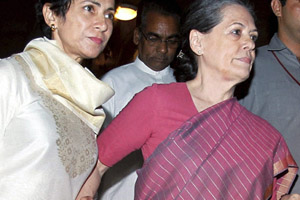
Sonia Gandhi fine, 'relieved' that Food Bill was passed, Modi wishes her good health

August 27, 2013

Sonia_Gandhi_fineNew Delhi, Aug 27: Sonia Gandhi is doing 'fine' after being discharged from Delhi's AIIMS hospital, where she was taken last night just before a crucial vote on the Food Security Bill, a landmark welfare scheme she had championed.

Hours after she returned home on Tuesday, the Congress president received wishes from across the political spectrum.

"Glad to know that Soniaji's health is fine. Wishing her best of health for the future," tweeted Gujarat Chief Minister Narendra Modi this morning.

Mrs Gandhi, 66, was taken straight from Parliament to AIIMS after she complained of chest pain and fever. She was in the hospital for nearly five hours.

"She was very tense about the Food Bill, and that she had to miss the voting. She was relieved when we told her it has been passed. Now she is fine. All the tests say everything is fine," said Union minister Kumari Selja.

Mrs Gandhi left Parliament at 8:15 pm escorted by her son and Congress vice-president Rahul Gandhi. She appeared to stumble as she walked down Parliament steps. Mrs Gandhi held Kumari Selja's hand and recovered her balance.

According to doctors, she was initially admitted to the Cardio-Neuro centre and later shifted to the ICU as a precautionary measure. Later she left for home in her own car at 1:30 am.

The Lok Sabha passed the Food Security Bill after nearly nine hours of debate and soon after senior leaders went to visit Mrs Gandhi at the hospital, including Prime Minister Manmohan Singh, Lok Sabha Speaker Meira Kumar and Union Ministers Anand Sharma and Jyotiraditya Scindia. Delhi Chief Minister Shiela Dikshit also visited the hospital.

The police cordoned off a 500-metre stretch leading to the Intensive Care Unit to allow a steady stream of VIPs.

Union Minister Ghulam Nabi Azad told reporters: "Madam had some medicine for a headache, because of which she felt uneasy."

In a rare speech in Parliament on Monday, Mrs Gandhi had urged parties to unanimously support a "chance to make history" by clearing the Food Security Bill, the world's largest scheme to fight hunger that legally entitles 67 per cent of India to cheap food.

Speculation over the Congress president's health peaked in 2011, when she left India for a surgery in the United States. But neither her family nor the ruling party disclosed anything about her condition at the time.

Comments

Add new comment

  • Coastaldigest.com reserves the right to delete or block any comments.
  • Coastaldigset.com is not responsible for its readers’ comments.
  • Comments that are abusive, incendiary or irrelevant are strictly prohibited.
  • Please use a genuine email ID and provide your name to avoid reject.
News Network
May 11,2020

New Delhi, May 11: Prime Minister Narendra Modi on Monday chaired a fresh round of consultation with chief ministers on ways to strengthen the COVID-19 containment strategy and stepping up of economic activities in a calibrated manner as the 54-day nationwide lockdown nears an end.

Large-scale movement of migrant workers from urban to rural India and the problems their return to home states may cause in restarting the economy will also be among the focus areas during the fifth virtual interaction between the prime minister and chief ministers since the outbreak of the deadly virus in the country.

There will be an effort to ensure that all participating chief ministers get an opportunity to air their views during the interaction, as some of the CMs had complaint that they were not allowed to put forth their views during the last interaction on April 27.

At a meeting on Sunday with Cabinet Secretary Rajiv Gauba, state chief secretaries told him that "while protection is required from COVID-19, economic activities also need to be stepped up in a calibrated manner", according to an official statement.       

With thousands of migrant workers taking special trains to go back to their home states, the restarting of industrial activities will prove to be a challenge for states though several relaxations have been made in labour laws to increase factory output.    

The meet is also likely to discuss efforts to convert 'red' zones with high COVID-19 case load into 'orange' or 'green' zones.       The prime minister interacted with the chief ministers last on April 27. Days after the meeting, the central government had extended the lockdown by two more weeks till May 17 to arrest the spread of the virus, but gave several relaxations in economic activities and movement of people.

The nationwide lockdown has been in force since March 25 to contain the spread of the virus, which has killed more than 2200 people, and afflicted more than 67,000 in the country.

Comments

Add new comment

  • Coastaldigest.com reserves the right to delete or block any comments.
  • Coastaldigset.com is not responsible for its readers’ comments.
  • Comments that are abusive, incendiary or irrelevant are strictly prohibited.
  • Please use a genuine email ID and provide your name to avoid reject.
News Network
May 17,2020

New Delhi, May 17: Spelling out the government’s fourth tranche of initiatives towards achieving Prime Minister Narendra Modi’s vision of ‘Atmanirbhar Bharat’, Union Finance Minister Nirmala Sitharaman on Saturday announced significant structural reforms in eight sectors of the economy — coal, minerals, defense production, aviation, power distribution in Union territories, space and atomic energy.

Addressing her fourth and the second-last press conference, Sitharaman said crucial sectors such as coal production and exploration, defence production and space would see an increased participation from private entities.

Coal sector:

In the realm of coal exploration, the government has decided to liberalise the entry norms for private entities, which would mean that any interested party could bid for a coal block and sell it in the open market. The minister said that the government would do away with all the eligibility conditions at the time of bidding for a coal block, except requiring an “upfront payment with a ceiling.”

Nearly 50 coal blocks would be offered to private players immediately, revealed Sitharaman.

She further said that Rs 50,000 crore would be spent by Centre in creating ‘coal evacuation’ infrastructure, which would expedite the transport of mined product to the destination.

Defence sector:

In defence production, Sitharaman revealed that the government would raise the foreign direct investment (FDI) limit in the sector from current 49 per cent to 74 per cent. Further, the government would also work towards corporatising the ordnance factory boards. “Corporatising doesn’t amount to privatization,” added Sitharaman.

In a bid to boost indigenous production of defence products and gave an impetus to Make in India, Sitharaman said that the government was in a process of notifying a list of weapons/platforms for an import ban with year-wise timelines.

These decisions would also help in reducing huge import bills, the finance minister said.

Privatisation of electricity:

In another announcement that could have an effect on electricity charges in the union territories, Union Finance Minister Nirmala Sitharaman announced on Saturday that power departments and utilities in all the centrally administered territories would be privatised.

Sitharaman said that the proposed move would lead to better service to consumers and improvement in operational and financial efficiency in distribution.

The finance minister said that decision was guided by 'sub-optimal' utilisation of performance of power distribution and supply'.

She said that the move to that effect would provide a model for emulation by other utilities across the country, in what could be an indicator of what's in the pipeline for utilities in other states as well.

Sitharaman said that the privation reform was in line with the tariff policy reforms and would help in enhancing consumer rights, promote industry and improve the overall sustainability of the sector.

Space sector:

Sitharaman also announced the opening up of the space exploration sector for private players. Till date, the government-run Indian Space Research Organisation (ISRO) has held a monopoly on all activities concerning space exploration and satellite launches.

The Indian private sector will be a co-traveller in India's space sector journey, said Sitharaman, while announcing a series of structural reforms in eight crucial areas of the economy. The Union Finance Minister was addressing her fourth press conference in as many days, as a follow-up towards realising Prime Minister Narendra Modi's vision of 'atmanirbhar Bharat', which was spelled out in his video address on May 12.

Sitharaman said that the reforms in the space sector will provide a level-playing field for private companies in satellite launches and space-based services.

She said that the private sector would be allowed to use ISRO facilities and other assets to improve their capacities. Stating that the government would provide predictable policy and regulatory environment to private players, Sitharaman also disclosed that future projects for planetary exploration and outer space travel among others would be opened up for private entities.

Comments

Add new comment

  • Coastaldigest.com reserves the right to delete or block any comments.
  • Coastaldigset.com is not responsible for its readers’ comments.
  • Comments that are abusive, incendiary or irrelevant are strictly prohibited.
  • Please use a genuine email ID and provide your name to avoid reject.
News Network
May 29,2020

New Delhi, May 29: Union Home Minister Amit Shah on Friday met Prime Minister Narendra Modi and informed him about the views of all chief ministers on the extension of the ongoing nationwide lockdown beyond May 31, officials said.

During the meeting, Shah briefed Modi about the suggestions and the feedback he received from the chief ministers during his telephonic conversations on Thursday, a government official said.

The nationwide curbs were first announced by Prime Minister Narendra Modi on March 24 for 21 days in a bid to contain the spread of novel coronavirus. It was first extended till May 3 and then again till May 17. The lockdown was further extended till May 31.

The home minister's telephonic conversations with the chief ministers came just three days before the end of the fourth phase of the lockdown.

During his talks with the chief ministers, Shah sought to know the areas of concern of the states and the sectors they want to open up further from June 1, the official said.

Interestingly, till now, it was Modi who had interacted with all chief ministers through video conference before the extension of each phase of the coronavirus-induced lockdown and sought their views.

This was for the first time that the home minister spoke to the chief ministers individually before the end of another phase of the lockdown.

Shah was present in all the conferences of chief ministers along with the prime minister. It is understood that the majority of the chief ministers wanted the lockdown to continue in some form but also favoured opening up of the economic activities and gradual return of the normal life, another official said.

The central government is expected to announce its decision on the lockdown within the next two days.

The number of COVID-19 cases in India has climbed to 1,65,799 on Friday, making it the world's ninth worst-hit country by the coronavirus pandemic.

The Health Ministry said the death toll due to COVID-19 rose to 4,706 in the country. While extending the fourth phase of the lockdown till May 31, the central government had announced the continuation of the prohibition on the opening of schools, colleges and malls but allowed the opening of shops and markets.

It said hotels, restaurants, cinema halls, malls, swimming pools, gyms will remain shut even as all social, political, religious functions, and places of worship will remain closed till May 31.

The government, however, allowed limited operations of the train and domestic flights. The Indian Railways is also running special trains since May 1 for transportation of migrant workers from different parts of the country to their native states.

Comments

Add new comment

  • Coastaldigest.com reserves the right to delete or block any comments.
  • Coastaldigset.com is not responsible for its readers’ comments.
  • Comments that are abusive, incendiary or irrelevant are strictly prohibited.
  • Please use a genuine email ID and provide your name to avoid reject.