



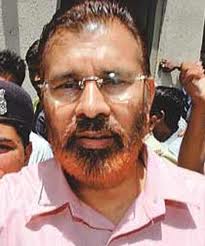
Gujarat top cop Vanzara quits, accuses Modi of betrayal

September 3, 2013
Ahmedabad, Sep 3: IPS officer D. G. Vanzara, suspended and behind the bars in a string of fake encounter cases, has resigned from service accusing Narendra Modi government of having failed to protect the jailed police officers who fought against “Pakistan inspired terrorism”. vanzara

Mr. Vanzara, a 1987 batch IPS officer considered close to Mr. Modi, has said in his resignation letter that police officers involved in alleged fake encounters “simply implemented the conscious policy” of the government whose place “should either be in Taloja central prison at Navi Mumbai or in Sabarmati Central Prison at Ahmedabad.”

Mr. Vanzara, lodged in Sabarmati central jail, in a 10-page hard-hitting resignation letter to Additional Chief Secretary of the state’s Home department, has accused the state government, particularly former Minister of State for Home Amit Shah of betraying him and 32 other officers, in jail in encounter killing cases being probed by the CBI.

He said he used to adore Mr. Modi like God, who could not rise to the occasion under the “evil” influence of Shah, a co-accused in Sohrabuddin Sheikh and Tulsiram Prajapati encounter cases.

Holding Narendra Modi government responsible for his and other police officers’ actions, Mr. Vanzara said they had only “complied” with the policy of the Gujarat government. “I would like to categorically state in the most unequivocal words that the officers and men of Crime Branch, ATS and Border Range, during the period between 2002 and 2007, simply acted and performed their duty in compliance of the conscious pro-active policy of zero tolerance towards terrorism of this government after Godhra riots,” he said.

“Gujarat CID and Central agency CBI had arrested me and my officers in different encounter cases holding us to be responsible for carrying out alleged fake encounters. If that is true then the CBI investigating officers have to arrest the policy formulators also as we, being field officers, have simply implemented the conscious policy of this government which was inspiring, guiding and monitoring our actions from the very close quarters,” Mr. Vanzara said.

“By this reasoning I am of the firm opinion that the place of this government instead of being in Gandhinagar, should either be in Taloja central prison at Navi Mumbai or in Sabarmati Central Prison at Ahmedabad,” he said, in his letter dated September 1.

Here are 10 quotes from Vanzara's letter bomb:

  1. I have been maintaining my graceful silence only because of my highest respect for Narendra Modi, whom I used to adore like a god.
  2. I am sorry to say my god did not rise to the occasion under the evil influence of Amit Shah, who usurped his eyes and ears and has been successfully misguiding him by converting goats into dogs and dogs into goats for the last 12 years.
  3. The criminal negligence of this government and willful acts of omission and commission by Amit Shah towards the fate of 32 jailed officers are so nauseating that it may take this government to the cremation ground sooner or later.
  4. Amit Shah introduced the dirty policy of use the officers and throw them by deliberately spreading disinformation about them.
  5. I categorically state that officers and men of the Crime Branch, ATS and Border Range, during the period 2002-2007, simply acted and performed their duties in compliance with a conscious policy of this government.
  6. But for the sacrifices made by me and my officers in thwarting the onslaught of initial disorder in the state, the 'Gujarat model of development' which this government is so assiduously showcasing at the national level would not have been possible.
  7. It would not be out of context to remind (Modi) that he, in the hurry of marching towards Delhi, may kindly not forget to repay the debt which he owes to jailed police officers who endowed him with the halo of Brave Chief Minister.
  8. This government, through the dirty tactics of Amit Shah, is only managing for its own self to swim and prosper in all directions while allowing police officers to sink and die a natural death.
  9. The Gujarat CID/CBI had arrested me and my officers in different encounter cases holding us to be responsible for carrying out alleged fake encounters. ...CBI investigating officers have to arrest the policy formulators also as we, being field officers, have simply implemented the conscious policy of this government which was inspiring, guiding and monitoring our actions from very close quarters.
  10. The government has been reaping very rich political dividends since last 12 years keeping the glow of encounter cases alive in Gujarat.

Comments

Add new comment

  • Coastaldigest.com reserves the right to delete or block any comments.
  • Coastaldigset.com is not responsible for its readers’ comments.
  • Comments that are abusive, incendiary or irrelevant are strictly prohibited.
  • Please use a genuine email ID and provide your name to avoid reject.
Agencies
June 29,2020

From March through May, around 1 crore migrant workers fled India’s megacities, afraid to be unemployed, hungry and far from family during the world’s biggest anti-Covid-19 lockdown.

Now, as Asia’s third-largest economy slowly reopens, the effects of that massive relocation are rippling across the country. Urban industries don’t have enough workers to get back to capacity, and rural states worry that without the flow of remittances from the city, already poor families will be even worse off -- and a bigger strain on state coffers.

Meanwhile, migrant workers aren’t expected to return to the cities as long as the virus is spreading and work is uncertain. States are rolling out stimulus programs, but India’s economy is hurtling for its first contraction in more than 40 years, and without enough jobs, a volatile political climate gets more so.

“This will be a huge economic shock, especially for households of short-term, cyclical migrants, who tend to come from vulnerable, poor and low-caste and tribal backgrounds,” said Varun Aggarwal, a founder of India Migration Now, a research and advocacy group based in Mumbai.

In the first 15 days of India’s lockdown, domestic remittances dropped by 90%, according to Rishi Gupta, chief executive officer of Mumbai-based Fino Paytech Ltd., which operates the country’s biggest payments bank.

By the end of May, remittances were back to around 1750 rupees ($23), about half the pre-Covid average. Gupta’s not sure how soon it’ll fully recover. “Migrants are in no hurry to come back,” Gupta said. “They’re saying that they’re not thinking of going back at all.”

If workers stay in their home states long term, policymakers will have more than remittances to worry about. If consumption falls and the new surplus of labor drives wages down, Agarwal said, “there will also be a second-order shock to the local economy. Overall, not looking good.”

India announced a $277 billion stimulus package in May and followed it up with a $7 billion program aimed at creating jobs for 125 days for migrants in villages across 116 districts. Separately, local authorities are also looking for solutions.

Officials in Bihar have identified 2,500 acres of land that could be made available to investors, said Sushil Modi, deputy chief minister of Bihar, a state in east India. “We can use this crisis as an opportunity to speed up reforms,” he said.

The investors haven’t materialised yet, and in the meanwhile, state governments are relying on the national cash-for-work program that guarantees 100 days worth of wages per household.

Skilled workers don’t want to do manual labor offered through the program, and even if they did, says Amitabh Kundu of RIS, many think of it as beneath their station. “There will be an increase in social tensions,” he predicts. “Caste may again start playing a role. It’s absolute chaos.”

For skilled workers, initiatives vary:

* Uttar Pradesh, which received 3.2 million people, is compiling lists of skilled workers who need employment and trying to place them with local manufacturing and real estate industry associations. So far, the government says, it’s placed 300,000 people with construction and real estate firms.

* Bihar has placed returners in state-run infrastructure projects and hired others to stitch uniforms and make furniture for government-run schools, even as they waited in quarantine centres, said Pratyay Amrit, head of the state’s disaster management department.

* The eastern state of Odisha announced an urban wage employment program aimed at putting as many as 450,000 day labourers to work through September. Some 25,000 people have been employed, so far, under the scheme, G. Mathivathanan, principal secretary for housing and urban development said.

Attracting Investments

It’s not clear any of this will be enough to make a dent, says Ravi Srivastava, professor at New Delhi-based Institute of Human Development, adding that the states don’t have much of a track record on economic development.

“It was the failure of these states to improve governance and put development plans in place that led to the out-migration in the first place,” he said.

But officials and workers’ rights advocates see opportunity. Uttar Pradesh has established liaisons to encourage companies from the US, Japan and South Korea to establish manufacturing in the state. There and in Madhya Pradesh and Rajasthan, the government has made labour laws more friendly to employers, making it easier to hire and fire workers.

Modi, the minister from Bihar, said the migration may also give workers--historically a disenfranchised group--new power, particularly as urban centres struggle. “The way industries treated workers during the lockdown -- didn’t pay them, the living conditions were poor -- now these industries will realize the value of this force,” Modi said.

“In the days to come, labour will emerge as a force that can’t be ignored anymore,” he added. “That’s the new normal. We will work out how to ensure dignity, rights to our people who are going to work in other states.”

Bihar is due for elections by November, a vote that could be an early test of the mass migration’s political consequences. The state is currently governed by a coalition that includes Prime Minister Narendra Modi’s Bharatiya Janata Party. Amitabh Kundu, a fellow at the Research and Information System for Developing Countries, a New Delhi-based government think-tank, said migrant workers are likely to be angry voters.

“Chief ministers are telling these migrants that they will not have to go back for work,” he said. “But their capacity to do something miraculous in the next four to five months is doubtful. If they can retain even one-fourth of the migrants, I would call it a success.”

Comments

Add new comment

  • Coastaldigest.com reserves the right to delete or block any comments.
  • Coastaldigset.com is not responsible for its readers’ comments.
  • Comments that are abusive, incendiary or irrelevant are strictly prohibited.
  • Please use a genuine email ID and provide your name to avoid reject.
News Network
April 15,2020

New Delhi, Apr 15: Tablighi Jamaat leader Maulana Saad Kandhalvi has been booked for culpable homicide after some of the attendees of the religious congregation died due to coronavirus, police said on Wednesday.

Kandhalvi had organised the religious gathering at Nizamuddin Markaz last month against the social distancing protocol imposed by the Centre to curb the spread of the deadly disease.

An FIR was registered against the cleric on March 31 at Crime Branch police station on a complaint of the Station House Officer of Nizamuddin.

He was earlier booked for holding the event, police said.

“After several attendees of the Tablighi Jamaat event succumbed to coronavirus, we added IPC section 304 (culpable homicide not amounting to murder) in the FIR against the leader, a police official said.

Some foreigners who attended the event have also been booked for violation of visa norms.

In an audio message, Kandhalvi had said that he was exercising self-quarantine after several hundreds who visited the Tablighi Jamaat congregation at Nizamudddin Markaz tested positive for coronavirus.

The FIR registered against the Tablighi Jamaat event says that the Delhi Police contacted the authorities of Nizamuddin Markaz on March 21 and reminded them of the government order which prohibited any political or religious gathering of more than 50 people.

It says that despite repeated efforts, the event organisers failed to inform the health department or any other government agency about the huge gathering inside the Markaz and deliberately disobeyed government orders.

“The sub district magistrate of Defence Colony inspected the premises several times and found that around 1,300 people, including foreign nationals, were residing there without maintaining social distance. It was also found that there were no arrangements of hand sanitizers and face masks,” the FIR adds.

The Nizamudddin centre, attended by thousands, turned out to be a hotspot for spread of coronavirus not only in the national capital, but the entire country.

More than 25,500 Tablighi members and their contacts have been quarantined in the country after the Centre and the state governments conducted a "mega operation" to identify them.

At least 9,000 people participated in the religious congregation in Nizamuddin. Later, many of the attendees travelled to various parts of the country.

Comments

Add new comment

  • Coastaldigest.com reserves the right to delete or block any comments.
  • Coastaldigset.com is not responsible for its readers’ comments.
  • Comments that are abusive, incendiary or irrelevant are strictly prohibited.
  • Please use a genuine email ID and provide your name to avoid reject.
News Network
June 10,2020

Chennai, Jun 10: DMK MLA J Anbazhagan who had tested positive for coronavirus and was on ventilator support from June 3 passed away at a hospital in Chennai on Wednesday.

Coincidently, today is the 62nd birthday of the MLA.

"Anbazhagan J, who has been fighting for his life with severe COVID 19 pneumonia rapidly deteriorated early this morning. In spite of full medical support including mechanical ventilation at our COVID facility, he succumbed to his illness. He was declared dead at 08:05 hours on the 10th of June 2020," the hospital said in a statement.

In 2001, Anbazhagan was elected from T Nagar Assembly constituency. He served for five years.

Later in 2011, he was elected to Tamil Nadu Assembly from Chepauk-Thiruvallikeni seat. The DMK leader was re-elected from the same constituency in 2016.

Comments

Add new comment

  • Coastaldigest.com reserves the right to delete or block any comments.
  • Coastaldigset.com is not responsible for its readers’ comments.
  • Comments that are abusive, incendiary or irrelevant are strictly prohibited.
  • Please use a genuine email ID and provide your name to avoid reject.