



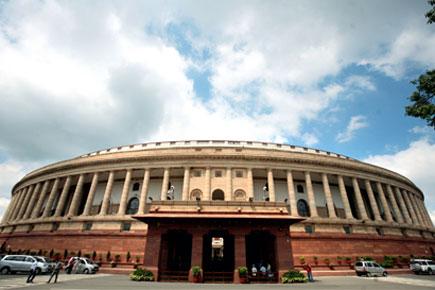
From now, lawmakers who get two years in jail will lose seats

September 7, 2013

Indian_ParliamentNew Delhi, Sep 7: The rules of the game have changed for the political class, with the Supreme Court asking the government on Friday to enforce its order for immediate disqualification of sitting MPs, MLAs and MLCs convicted for an offence attracting a sentence of two years.

"Sitting Members of Parliament and state legislators are no longer protected by clause 4 of Section 8 of the Representation of People Act," a decree issued by the SC said, spelling the extinction of the law which allowed convicted lawmakers to hold on to their seats during pendency of their appeals. The Centre was in the process of relaying the new reality to all state capitals.

The blow to tainted legislators was compounded as the anticipated antidote through a change in law to allow convicted MPs and MLAs to retain their membership pending an appeal failed to materialize in the face of BJP's last-minute resistance in Parliament.

This means that any lawmaker convicted from now for an offence punishable with a sentence of two years or more will be immediately unseated, and will be barred from contesting elections for at least six years. This could be longer, depending on the term of the sentence awarded.

In fact, the sting could be sharper for convicted MPs, MLAs and MLCs. For, while they lose their elected post on conviction, they will be no compensation for the years lost if they are acquitted. Further, those who get convicted closer to election may have to sit out more than one election, given the slow pace of judiciary.

Public censure made parties change tune

The scuttling of the RP Act amendment is a second setback to the political class in as many days. On Thursday, amendments to the Right to Information Act designed to exclude political parties from the ambit of the transparency law had to be referred to a standing committee in the face of similar political opposition.

Just as in the case of the amendment to the RP Act crafted to nullify the SC order for disqualification of convicted lawmakers, the amendment to the RTI Act had seemed set to go through when the fear of

popular opprobrium unravelled the consensus for preserving the status quo. Congress circles claimed that besides resistance from the opposition, Congress vice-president Rahul Gandhi's reservations were also a factor.

The re-think 24 hours ago and the reluctance on Friday to pursue the RP Act amendments reflect a new sensitivity to concerns that political parties have often dismissed as elitist, and limited to activists, the commentariat or a slice of middle-class India that they did not see as a significant or enthusiastic vote bank. Political circles wondered whether the developments over the last 48 hours marked a recognition, if grudging, among a section of the political class that there is a political cost attached to going against the grain of public opinion.

The proposed amendment to the RP Act fell through on Friday morning amid considerable drama as BJP said the proposal was bad in law and constitutionally invalid.

BJP leaders said the party — which fancies its prospects among the urbanized classes — does did not think it prudent to support amendments that risked being seen as a self-centred effort of the political class to protect criminals in its ranks.

The party stuck to its position despite feverish lobbying by at least one senior politician who is apprehensive of the outcome of his trial in a famous graft case.

BJP leader Arun Jaitley argued that disqualification of a legislator was provided for under Article 102 of the Constitution and any move to merely change the RP Act would not do.

Law minister Kapil Sibal said the BJP decision introduced a new calculus in arguments dealing with the SC order that went against a broad agreement that prevailed in Parliament.

But faced with BJP's determined opposition, with other parties like BJD also expressing doubts, the government had no option but to put aside its plans to move the amendment to the RP Act.

The government's decision reflects a hesitation to push against both the political opposition and the wider perception that UPA-2 has been lethargic in acting against corruption. Congress managers are wary of seeming impervious to popular sentiment at a time when the party is combating the fallout of a series of scams ranging from Commonwealth, 2G and Coalgate.

Comments

Add new comment

  • Coastaldigest.com reserves the right to delete or block any comments.
  • Coastaldigset.com is not responsible for its readers’ comments.
  • Comments that are abusive, incendiary or irrelevant are strictly prohibited.
  • Please use a genuine email ID and provide your name to avoid reject.
News Network
January 2,2020

Kolkata, Jan 2: In what could spark fresh tensions between West Bengal Chief Minister Mamata Banerjee and the BJP-led centre, the Union Ministry of Defence on Wednesday rejected her state's tableau proposal for the Republic Day parade on January 26.

"The tableau proposal of West Bengal government was examined by the expert committee in two rounds of meetings. The tableau proposal of the West Bengal government was not taken forward for further consideration by the committee after deliberations in the second meeting," the ministry said in its statement.

Twenty two proposals comprising 16 states and union territories and six ministries and departments have been shortlisted for the parade. The shortlist was compiled from as many as 56 tableau proposals - 32 from states and union territories and 24 from various ministries and departments - received by the central government.

"The expert committee examines the proposals on the basis of theme, concept, design and visual impact before making its recommendations. Due to time constraints arising out of the overall duration of the parade, only a limited number of tableaux can be shortlisted for participation in the parade," the statement read, adding that West Bengal was shortlisted for the 2019 Republic Day parade through a similar process.

"The rejection of the West Bengal tableau for the Republic Day parade is discriminatory. It has been done because West Bengal has been opposing the centre's CAA (Citizenship Amendment Act) and the NRC (National Register of Citizens) plans," Trinamool Congress MP Saugata Roy told news agency.

"West Bengal is known to be living state as far as culture, including arts, music and other things are concerned. So obviously, this is a discriminatory step taken by the central government against West Bengal," Mr Roy added.

The Trinamool Congress-led Bengal government is at loggerheads with the central government over several issues, and the expanding presence of the BJP in the eastern state ahead of the 2021 assembly elections has further intensified their rivalry.

Mamata Banerjee has repeatedly said that she will not allow Bengal to be a part of the proposed nationwide National Register of Citizens, an assertion that the BJP claims is proof of her minority appeasement strategy. Last month, a four-member delegation of Trinamool Congress politicians that visited BJP-ruled Uttar Pradesh to meet families of those killed in violent protests against the Citizenship Amendment Act were stopped by police personnel at the Lucknow airport.

The BJP leadership has now decided to launch a campaign blitzkrieg in West Bengal to counter what it claims is the Trinamool's "misinformation programmes" against the amended citizenship law and reach out to refugees. Protests across the country have currently put the party on the backfoot.

The Citizenship Amendment Act, for the first time, makes religion the test of citizenship in India. The government says it will help minorities from three Muslim-dominated countries get citizenship if they fled to India because of religious persecution before 2015. Critics say it is designed to discriminate against Muslims and violates the secular principals of the Constitution.

Brazilian President Jair Bolsonaro will be the chief guest at the Republic Day celebrations.

Comments

Add new comment

  • Coastaldigest.com reserves the right to delete or block any comments.
  • Coastaldigset.com is not responsible for its readers’ comments.
  • Comments that are abusive, incendiary or irrelevant are strictly prohibited.
  • Please use a genuine email ID and provide your name to avoid reject.
Agencies
January 21,2020

Pune, Jan 21: The Pune session court on Tuesday rejected the bail application of accused Vikram Bhave in the Dabholkar murder case.
Last year, Pune Sessions Court had granted an extension of 90 days to the Central Bureau of Investigation (CBI) to file a charge-sheet against Bhave.

On August 17, 2019, the court had rejected Bhave's bail plea.

During the course of hearing, Special Public Prosecutor (SPP) Prakash Suryavanshi, appearing for the CBI, had in June last year contended that Bhave helped the assailants to escape.

The CBI had arrested Bhave and another accused Sanjeev Punalekar from Mumbai on May 25, 2019 in connection with the matter.

Founder of the Maharashtra Andhashraddha Nirmoolan Samiti (MANS), Dabholkar was shot dead by bike-borne assailants while returning home from a morning walk on August 20, 2013. 

Comments

Add new comment

  • Coastaldigest.com reserves the right to delete or block any comments.
  • Coastaldigset.com is not responsible for its readers’ comments.
  • Comments that are abusive, incendiary or irrelevant are strictly prohibited.
  • Please use a genuine email ID and provide your name to avoid reject.
News Network
April 28,2020

New Delhi, Apr 28: Nafisa Ali took to Instagram to share the inspiring story of her niece, Diya Naidu, who donated her plasma to help patients suffering from Covid-19 after recovering from the disease. The veteran actress shared a photo of her niece from the hospital bed and asked fans to read Diya's post to get a detailed account of her experience.

Nafisa wrote, "Diya Naidu my niece - a COVID19 hero - is back home after donating her plasma - looks like liquid gold - it’s value is priceless as it will save lives. So please read her COVID19 story and share the information that is first hand. It is the need of the hour. Help save lives. #diyanise. #diyanaidu #covid_19 #india (sic)."

Diya Naidu, who is a dancer and choreographer based in Bengaluru, revealed in her Instagram post that she has donated her plasma for other Covid-19 patients. She said that the method has been super effective wherever it's been tried.

Earlier, Nafisa Ali gave a shout-out to her niece on Instagram and penned a heartfelt note for her. She wrote, "I am so grateful to you brave child - a COVID19 warrior (living in Bangalore) has agreed to donate her plasma to help cure other COVID19 serious patients (sic)."

Explaining the process of plasma therapy to treat Covid-19 patients, she wrote, "The process of donating plasma to treat COVID-19 is not very complex and can be done in just two hours. One of the most discussed methods of treatment of the disease caused by the novel coronavirus is plasma therapy, which involves the transfusion of plasma from a convalescent coronavirus patient to a critical patient. The blood of a recovering patient is rich in antibodies produced by the body to fight the virus, which are expected to help the critical patient recover (sic)."

Plasma therapy has been suggested to treat people suffering from Covid-19. People, who have recovered from the disease, are donating plasma as it contains antibodies to fight the disease. Earlier, Kanika Kapoor, who was the first Bollywood celebrity to be diagnosed with the disease, also offered to donate her plasma. She has recovered from Covid-19 and is currently living with her family in Lucknow.

Comments

Add new comment

  • Coastaldigest.com reserves the right to delete or block any comments.
  • Coastaldigset.com is not responsible for its readers’ comments.
  • Comments that are abusive, incendiary or irrelevant are strictly prohibited.
  • Please use a genuine email ID and provide your name to avoid reject.