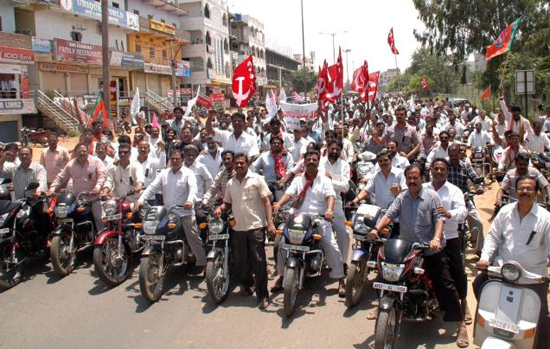
Seemandhra employees targeted in pro-Telangana stir

September 7, 2013

Pro-Telangana

Hyderabad, Sep 7: Pro-Telangana forces on Saturday pelted stones at police and employees from Andhra-Rayalaseema regions in a bid to thwart a rally organised here by AP Non-Gazetted Officers Association even as the 24-hour bandh called by the Telangana JAC disrupted life in the state capital.

Scores of pro-Telangana elements, masquerading as students, gathered clandestinely in the Nizam College hostel building adjacent to the Lal Bahadur Shastri Stadium, the venue of "Save Andhra Pradesh" rally, and hurled stones at employees from Andhra-Rayalaseema regions, who were making way into the stadium.

"We were quietly walking on the road leading to the stadium when suddenly we were pelted with stones. Two of my colleagues were wounded in the incident," Visweswara Rao, a government employee from Adoni in Kurnool district, said.

Police, who entered the hostel building to disperse the violent mob, were also greeted with stones.

However, police in riot gear took several "outsiders" into custody and whisked them away from the hostel building, a senior police officer said.

Police had to open teargas as violent Telangana elements, in the garb of students, rained stones on them.

Then they tried to march from the Osmania University campus to LB Stadium to spoil the rally, police said.

Notwithstanding the appeal made by TJAC and pro-Telangana parties for calm, several miscreants virtually ran riot both at the Nizam College hostel as well as the University.

Aggravating the tense atmosphere in the city, legislators belonging to the Telangana Rashtra Samiti rushed to the assembly in the afternoon to stage a "deeksha" at the statue of Mahatma Gandhi, protesting the discriminatory attitude of the state administration.

The TRS MLAs had a face-off with police at the assembly when the latter tried to foil the former's plan.

"This is a dark moment when our rights as legislators have been denied," TRS floor leader in the assembly E Rajender said.

Half-a-dozen TRS MLAs then staged a dharna on the assembly premises even as Independent MLA Nagam Janardhan Reddy, who recently joined the BJP, also joined them.

Meanwhile, Telangana Gazetted Officers Association leader Devi Prasad announced that they were planning to hold a rally either in Visakhapatnam or Vijayawada in coastal Andhra in support of the state's division.

"Misuse of official power and machinery in today's (Saturday) 'Save Andhra Pradesh' rally is glaring," he said and claimed the Telangana bandh was a "total success".

Comments

Add new comment

  • Coastaldigest.com reserves the right to delete or block any comments.
  • Coastaldigset.com is not responsible for its readers’ comments.
  • Comments that are abusive, incendiary or irrelevant are strictly prohibited.
  • Please use a genuine email ID and provide your name to avoid reject.
News Network
January 28,2020

Panaji, Jan 28: Bureaucrat-turned-activist Kannan Gopinathan on Tuesday said even some "RSS people" are convinced the Citizenship Amendment Act is a bad law but are keeping quiet as the NDA government at the Centre is their own baby.

Speaking in Panaji, he further said the Narendra Modi government was behaving like a "drunken teenager" which needs to be questioned or else it will end up destroying homes.

"I was detained twice in UP, kept the whole day, because they (government) do not want the questioning (of CAA). I have met so many RSS people, they also understand this...if you have this conversation, they also understand the government has done something (wrong) and they have been asked to support it," he claimed.

He said the line of thought among these RSS people (he met) was "just support it (CAA)" as they don't want an altercation because the "government is their baby".

"He (government) is not a normal baby, he is a drunken teenager. He should be asked questions because when he starts destroying, he does not destroy somebody else's home but your own home," Gopinathan said.

He also hit out at those who have been claiming that the people protesting against the CAA are unaware about the law and have not even read it.

Gopinathan claimed if one had asked supportive MPs about the CAA on the day it was passed in Parliament, several of them would not have been able to speak on it as "they would not have known what was passed, because they were not given time (to go through the bill)".

He said, earlier, such legislation was passed after several rounds of consultation but "now, by night, it becomes an Act", adding (now) "everything is a surgical strike".

Gopinathan, in a possible reference to the National Register of Citizens exercise carried out in Assam, also claimed "thousands of people are in detention centres".

"It is your fundamental right to peacefully assemble without arms, Article 19 (1) (D) (of the Constitution)," he said at a function organised by a group opposed to CAA.

Gopinathan said people "always felt they were in a democracy" because they never tried to fly, when in reality "you are in a cage".

"The moment you want to fly you realise you are in a cage," he said, adding that "we have to question, we have to ask ourselves where are we going".

"When you don't allow a person to speak against an incorrect legislation, then what is democracy? What is freedom of expression?" Gopinathan questioned.

Gopinathan, a 2012 batch AGMUT cadre Indian Administrative Service officer, was the secretary, Power Department of the Union Territories of Daman and Diu, and Dadra and Nagar Haveli when he resigned on August 21 last year.

At the time, he had claimed the people of Jammu and Kashmir were being denied freedom of expression following abrogation of Article 370 by the Centre.

Comments

Add new comment

  • Coastaldigest.com reserves the right to delete or block any comments.
  • Coastaldigset.com is not responsible for its readers’ comments.
  • Comments that are abusive, incendiary or irrelevant are strictly prohibited.
  • Please use a genuine email ID and provide your name to avoid reject.
Agencies
July 31,2020

New Delhi, Jul 31: With the highest single-day spike of 55,079 COVID-19 cases in the last 24 hours, India's coronavirus tally breached the 16 lakh mark on Friday, informed the Union Ministry of Health and Family Welfare.

With this latest spike, the total cases in the country stand at 16,38,871. Among these cases 5,45,318 are active. A total of 10,57,806 patients have been cured/discharged/migrated.

779 deaths due to COVID-19 have been reported in the country in the last 24 hours, taking the death toll to 35,747.

As per the Union Health Ministry, Maharashtra has a total of 1,48,454 active cases and recorded 14,729 deaths due to COVID-19.
Tamil Nadu has a total of 57,962 active cases and 3,838 deaths in the state.

Delhi has a total of 10,743 active cases and 3,936 deaths.

The Indian Council of Medical Research on Friday informed that a total number of COVID-19 samples tested up to 30th July is 1,88,32,970 including 6,42,588 samples tested yesterday.

Comments

Add new comment

  • Coastaldigest.com reserves the right to delete or block any comments.
  • Coastaldigset.com is not responsible for its readers’ comments.
  • Comments that are abusive, incendiary or irrelevant are strictly prohibited.
  • Please use a genuine email ID and provide your name to avoid reject.
News Network
April 23,2020

Washington, Apr 23: Air pollution over northern India has plummeted to a 20-year-low for this time of the year, according to satellite data published by US space agency National Aeronautics and Space Administration (NASA).
The US space agency's satellite sensors observed aerosol levels at a 20-year low post the countrywide lockdown, implemented to slow the spread of the novel coronavirus.

"We knew we would see changes in atmospheric composition in many places during the lockdown," said Pawan Gupta, a Universities Space Research Association (USRA) scientist at NASA''s Marshall Space Flight Center. "But I have never seen aerosol values so low in the Indo-Gangetic Plain at this time of year," added Mr Gupta.

Acting Assistant Secretary of State for South and Central Asia Alice G Wells tweeted, "These images from NASA were taken each spring starting in 2016 and show a 20-year low in airborne particle levels over India. When India and the world are ready to work and travel again, let's not forget that collaborative action can result in cleaner air."

The data published with maps show aerosol optical depth (AOD) in 2020 compared to the average for 2016-2019. Aerosol optical depth is a measure of how light is absorbed or reflected by airborne particles as it travels through the atmosphere.

If aerosols are concentrated near the surface, an optical depth of 1 or above indicates very hazy conditions. An optical depth, or thickness, of less than 0.1 over the entire atmospheric vertical column is considered "clean." The data were retrieved by the Moderate Resolution Imaging Spectroradiometer (MODIS) on NASA's Terra satellite.

In the first few days of the lockdown, it was difficult to observe a change in the pollution signature. "We saw an aerosol decrease in the first week of the shutdown, but that was due to a combination of rain and the lockdown," said Mr Gupta.

Around March 27, heavy rain poured over vast areas of northern India and helped clear the air of aerosols. Aerosol concentrations usually increase again after such heavy precipitation.

"After the rainfall, I was really impressed that aerosol levels did not go up and return to normal. We saw a gradual decrease and things have been staying at the level we might expect without anthropogenic emissions," Mr Gupta said.

On March 25, the Indian government placed its 1.3 billion citizens under a strict lockdown to reduce the spread of COVID-19. The countrywide mandate decreased activity at factories and severely reduced car, bus, truck and airplane traffic. Every year, aerosols from anthropogenic (human-made) sources contribute to unhealthy levels of air pollution in many Indian cities.

Aerosols are tiny solid and liquid particles suspended in the air that reduce visibility and can damage the human lungs and heart.

In southern India though, the story is a little hazier. Satellite data show aerosol levels have not yet decreased to the same extent. In fact, levels seem to be slightly higher than in the past four years. The reasons are unclear but could be related to recent weather patterns, agricultural fires, winds or other factors.

"This a model scientific experiment," Robert Levy, program leader for NASA's MODIS aerosol products, said about the lockdown and its effects on pollution.

"We have a unique opportunity to learn how the atmosphere reacts to sharp and sudden reductions in emissions from certain sectors. This can help us separate how natural and human sources of aerosols affect the atmosphere," Mr Levy added.

Comments

Add new comment

  • Coastaldigest.com reserves the right to delete or block any comments.
  • Coastaldigset.com is not responsible for its readers’ comments.
  • Comments that are abusive, incendiary or irrelevant are strictly prohibited.
  • Please use a genuine email ID and provide your name to avoid reject.