



21 killed in spiralling violence in Muzaffarnagar

September 8, 2013

Muzaffarnagar, Sep 8: At least 10 more people were killed in spiralling violence in Muzaffarnagar on Sunday, taking the toll to 21 in the western UP district where the army staged flag marches and thousands of anti-riot police personnel were deployed to restore law and order.

“As it (violence) is going on in several villages, it is taking time to defuse the situation,” Additional Director General of Police Arun Kumar, who took stock of the situation in the affected areas, told PTI here.Muzaffarnagar1
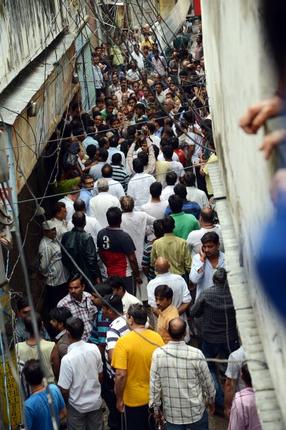
District Magistrate Kaushal Raj Sharma said that 21 people have died in the violence so far. However, in Lucknow, UP Home Secretary Kamal Saxena said that 19 people have so far been killed in the violence, including 11 on Saturday.

Mr. Saxena said that adequate force has been deployed in the affected areas and incidents of violence have been reported from Sisauli, Shahpur, Fugna, Kalapar and Dhaurakala areas of Muzaffarnagar.

In one place Army had to resort to firing after someone opened fire at them, he said. Asked whether shoot at site orders have been given, Saxena said that directives have been issued to control the situation and for that if necessary firing can be done.

While curfew remained in force in Civil Lines, Kotwali and Nai Mandi town areas of the district with Army carrying out a flag march, violence has now spread to more rural areas.

ADG Kumar, who was escorted by a massive contingent of security personnel, claimed that only four police station areas were affected.

Officials said apart from army, 10,000 Provincial Armed Constabulary personnel, 1300 CRPF men and 1200 Rapid Action Force personnel have been deployed.

In Kutba, where four people were killed, mobs set ablaze a religious place, several shops and vehicles. In Phugana village, cops said three members of a community had taken shelter in a police station, fearing violence.

The other badly affected villages were Shahpur, Bhuvana, Basi Kala.

Army’s assistance has been sought by UP government in nearby Shamli and Meerut district, Amry sources said.

Mulayam meets Akhilesh as army stages flag march

Facing flak from the opposition over Muzaffarnagar communal clashes, Samajwadi Party supremo Mulayam Singh Yadav on Sunday held a meeting with Chief Minister Akhilesh Yadav, ministers and senior officials while the Army staged a flag march in the strife-torn district.

Mr. Yadav held the meeting at his residence on Sunday afternoon in which Chief Secretary Javed Usmani, Principal Secretary Home RM Srivastava and several ministers were also present, sources said.

Expressing displeasure over spurt in violence, Yadav asked them to ensure that law and order is maintained in the state.

“The incident is unfortunate. Our government is committed to strictly dealing with such incidents. Directives have been issued in this regard,” U.P. minister Shahid Manzoor told reporters after the meeting.

However, SP spokesman Rajendra Chowdhury, who too was present at the meeting, did not elaborate details.

“It was not a meeting. We went there for talks...,” Mr. Chowdhury said avoiding questions.

Meanwhile, taking potshots at the ruling party, BJP spokesman Manoj Mishra said, "with Mulayam taking the charge, it has been proved that the present chief minister failed.”

“Due to failure of the present Chief Minister, Mulayam had to take the charge. It has been proved that the government has failed on administrative front,” Mr. Mishra said in a statement.

Meanwhile, following the violence in parts of West UP, Army was pressed into service in Muzzaffarnagar, Shamli and Meerut district, Amry sources said here.

“Eight Army columns from Meerut under Brigadier Jagdeep reached Muzaffarnagar early in the morning and had a meeting with the senior officials of the state police and the civil administration.

“Immediately after the meeting, the Army columns were located in various sensitive areas of the city,” they said.

The Army columns also conducted a mounted flag march in Muzaffarnagar.

Another call for requisitioning Army assistance in Shamli was received from the District Magistrate and accordingly one Army column was moved from Meerut to Shamli.

“Requisition for Army assistance in Meerut was received this afternoon. One more column is being located in Meerut,” they said.

Related: Mulayam holds emergency meet on Muzaffarnagar violence

Toll in UP communal clashes rises to 14

Muzaffarnagar: Army stages flag march; death toll climbs to 12

Comments

Add new comment

  • Coastaldigest.com reserves the right to delete or block any comments.
  • Coastaldigset.com is not responsible for its readers’ comments.
  • Comments that are abusive, incendiary or irrelevant are strictly prohibited.
  • Please use a genuine email ID and provide your name to avoid reject.
News Network
July 2,2020

Lucknow, Jul 2: After a video showing health workers allegedly tossing bodies of coronavirus victims in a large pit in Karnataka, BSP President Mayawati on Wednesday stated that the incident is the "height of cruelty and insult to humanity".
The former UP Chief Minister demanded that the guilty must be punished.

"The tragedy that the bodies of COVID-19 victims being thrown into trenches in Ballari, Karnataka is the height of cruelty and an insult to humanity. Though incidents related to inhuman cruelty with corona patients are rampant but guilty of Ballari must be punished by the state government," Mayawati said in a tweet.

Also, in another tweet, she asked the Central government to extend the Pradhan Mantri Garib Kalyan Anna Yojana till the end of the coronavirus pandemic.

"In order to check ignominy of starvation on account of long unprecedented hardship & unemployment due to coronavirus and the subsequent nationwide lockdown, the PM Garib Kalyan Anna Yojna must continue not till November but till the end of the pandemic, this is the demand of BSP," she tweeted. 

Comments

Add new comment

  • Coastaldigest.com reserves the right to delete or block any comments.
  • Coastaldigset.com is not responsible for its readers’ comments.
  • Comments that are abusive, incendiary or irrelevant are strictly prohibited.
  • Please use a genuine email ID and provide your name to avoid reject.
News Network
May 7,2020

Visakhapatnam, May 7: Andhra Pradesh Chief Minister Y S Jagan Mohan Reddy on Thursday announced an ex- gratia payment of Rs one crore each to the kin of those killed in the styrene gas leak incident at LG Polymers Limited near here.

The NDRF had put the death toll from the leak at 11.

The chief minister announced a committee to probe into the mishap and also said the government would talk to the LG Polymers management seeking job for the kin of the deceased in any of its businesses.

Speaking to reporters after conducting a review meeting, Reddy also announced Rs 10 lakh each to those undergoing treatment on ventilator support and Rs 25,000 to those who took treatment as out-patients after developing health complications due to inhalation of the styrene vapour.

Earlier, he held a review meeting at the Andhra Medical College with District Collector Vinay Chand and others.

The gas leak victims undergoing treatment in various hospitals would be paid Rs one lakh each. The 15,000-odd population in the five villages that were affected by the gas leak would be paid Rs 10,000 each, the chief minister added.

Reddy further announced constitution of a high-level committee, headed by the Special Chief Secretary (Environment and Forests), to probe into the mishap and make recommendations to prevent such tragedies in the future.

Earlier, he visited the King George Hospital and consoled the victims of the gas leak.

Accompanied by his Deputy holding the health portfolio A K K Srinivas and Chief Secretary Nilam Sawhney, Reddy flew down to the port city and went straight to the KGH.

He met the gas leak victims undergoing treatment and enquired about their well-being.

At the review meeting, the Collector informed the Chief Minister that the gas spread was limited to a 1.5 to 2 km area from the epicentre of the leak and that the locals were evacuated to safety.

Of the two styrene tanks in the plant, the leak occurred from one that was holding about 1,800 kilo litres of the chemical.

Comments

Add new comment

  • Coastaldigest.com reserves the right to delete or block any comments.
  • Coastaldigset.com is not responsible for its readers’ comments.
  • Comments that are abusive, incendiary or irrelevant are strictly prohibited.
  • Please use a genuine email ID and provide your name to avoid reject.
News Network
January 13,2020

Jan 13: For the first time in years, the government of India’s Prime Minister Narendra Modi is playing defense. Protests have sprung up across the country against an amendment to India’s laws — which came into effect on Friday — that makes it easier for members of some religions to become citizens of India. The government claims this is simply an attempt to protect religious minorities in the Muslim-majority countries that border India; but protesters see it as the first step toward a formal repudiation of India’s constitutionally guaranteed secularism — and one that must be resisted.

Modi was re-elected prime minister last year with an enhanced majority; his hold over the country’s politics is absolute. The formal opposition is weak, discredited and disorganized. Yet, somehow, the anti-Citizenship Act protests have taken hold. No political party is behind them; they are generally arranged by student unions, neighborhood associations and the like.

Yet this aspect of their character is precisely what will worry Modi and his right-hand man, Home Minister Amit Shah. They know how to mock and delegitimize opposition parties with ruthless efficiency. Yet creating a narrative that paints large, flag-waving crowds as traitors is not quite that easy.

For that is how these protests look: large groups of young people, many carrying witty signs and the national flag. They meet and read the preamble to India’s Constitution, into which the promise of secularism was written in the 1970’s.

They carry photographs of the Constitution’s drafter, the Columbia University-trained economist and lawyer B. R. Ambedkar. These are not the mobs the government wanted. They hoped for angry Muslims rampaging through the streets of India’s cities, whom they could point to and say: “See? We must protect you from them.” But, in spite of sometimes brutal repression, the protests have largely been nonviolent.

One, in Shaheen Bagh in a Muslim-dominated sector of New Delhi, began simply as a set of local women in a square, armed with hot tea and blankets against the chill Delhi winter. It has now become the focal point of a very different sort of resistance than what the government expected. Nothing could cure the delusions of India’s Hindu middle class, trained to see India’s Muslims as dangerous threats, as effectively as a group of otherwise clearly apolitical women sipping sweet tea and sharing their fears and food with anyone who will listen.

Modi was re-elected less than a year ago; what could have changed in India since then? Not much, I suspect, in most places that voted for him and his party — particularly the vast rural hinterland of northern India. But urban India was also possibly never quite as content as electoral results suggested. India’s growth dipped below 5% in recent quarters; demand has crashed, and uncertainty about the future is widespread. Worse, the government’s response to the protests was clearly ill-judged. University campuses were attacked, in one case by the police and later by masked men almost certainly connected to the ruling party.

Protesters were harassed and detained with little cause. The courts seemed uninterested. And, slowly, anger began to grow on social media — not just on Twitter, but also on Instagram, previously the preserve of pretty bowls of salad. Instagram is the one social medium over which Modi’s party does not have a stranglehold; and it is where these protests, with their photogenic signs and flags, have found a natural home. As a result, people across urban India who would never previously have gone to a demonstration or a political rally have been slowly politicized.

India is, in fact, becoming more like a normal democracy. “Normal,” that is, for the 2020’s. Liberal democracies across the world are politically divided, often between more liberal urban centers and coasts, and angrier, “left-behind” hinterlands. Modi’s political secret was that he was that rare populist who could unite both the hopeful cities and the resentful countryside. Yet this once magic formula seems to have become ineffective. Five of India’s six largest cities are not ruled by Modi’s Bharatiya Janata Party in any case — the financial hub of Mumbai changed hands recently. The BJP has set its sights on winning state elections in Delhi in a few weeks. Which way the capital’s voters will go is uncertain. But that itself is revealing — last year, Modi swept all seven parliamentary seats in Delhi.

In the end, the Citizenship Amendment Act is now law, the BJP might manage to win Delhi, and the protests might die down as the days get unmanageably hot and state repression increases. But urban India has put Modi on notice. His days of being India’s unifier are over: From now on, like all the other populists, he will have to keep one eye on the streets of his country’s cities.

Comments

Add new comment

  • Coastaldigest.com reserves the right to delete or block any comments.
  • Coastaldigset.com is not responsible for its readers’ comments.
  • Comments that are abusive, incendiary or irrelevant are strictly prohibited.
  • Please use a genuine email ID and provide your name to avoid reject.