



Schemes for minorities being cornered by non-Muslims: Report

September 16, 2013

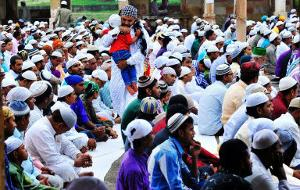
Non-MuslimsNew Delhi, Sep 16: Even as minority politics takes centrestage in the wake of recent riots in Uttar Pradesh, a report by the Council for Social Development shows how the UPA government has failed to implement the recommendations of the Sachar Committee, with its response to Muslim deprivation at best being "cautious and minimalist". The report said most of the benefits intended for minorities were being cornered by either the majority population or non-Muslim minorities.

The report listed misplaced focus of minority-oriented programmes, lack of funds and fear of 'minority appeasement' taunts as the reasons for government's failure to fulfil its promises.

The 'Social Development Report 2012: Minorities at the Margins' was prepared by scholars such as Zoya Hasan, Mushirul Hasan, Tanweer Fazal, Javed Alam Khan and Abusaleh Sharif among others.

For example, the report illustrates how programmes intended to improve school education among Muslims has focused on modernization of madarsas even though only 4% Muslims go there for education. In higher studies, the government has focused on providing assistance to minority institutions rather than expanding the overall education network to include Muslims.

It also brought out the failure of multi-sectoral development programme (MSDP) — launched after the Sachar Committee's report — targeting 90 districts with around 25% Muslim population for infrastructure development through enhanced funding. The report noted that benefits of the scheme reached only 30% of Muslim population in these areas, indicating others have cornered most of the resources. In states such as Bihar and Uttar Pradesh (with high concentration of Muslims), infrastructure projects have been diverted to non-minority areas.

The Reserve Bank of India's efforts to extend banking and credit facilities to Muslims, a major fallout of the Sachar Committee report which said Muslims were out of the banking system, has also ended up benefiting non-Muslim minorities whose socio-economic status is comparable to upper caste Hindus, the report said.

"Diffidence at the policy level to clearly focus on Muslim deprivation translates into active reluctance by the implementing agencies on the ground to target the Muslims even in districts with high Muslim concentration," the report said.

Mushirul Hasan blamed the minority affairs ministry for such failures. He told TOI, "The ministry has become a liability. It is devoid of any ideas and lacks social commitment."

According to the report, both funding and its utilization have been a problem. In the 11th plan, allocation for minorities was 6% of the total outlay with minority affairs ministry's share being only 0.79%. The report called it insignificant to address minority development. It also noted that unlike SC/ST, budgetary plans for minorities were not proportional to their population.

Even these funds are not utilized properly. During 2007-2012, state governments did not utilize even half of the allocated funds. Twelve states utilized less than 50% of funds and some states spent only 20%. States such as Bihar, UP, Maharashtra and Assam (all with high concentration of Muslims) were in the category of those that spent less than 50%.

Government's scholarship scheme for Muslim students has been widely praised, but the report found it to be too little and poorly implemented. While 2.45 crore Muslim students were enrolled up to upper primary level (2009-10 data), the government has provided 24 lakh pre-matric scholarships for minorities, the report said.

It also found the scholarship amount of Rs 1,000 to be too little. It noted that compared with SC/ST, the scheme was discriminatory. While income eligibility criteria for SC/ST to avail scholarship was kept at Rs 2 lakh per annum, for minorities it is only Rs 1 lakh.

Comments

Add new comment

  • Coastaldigest.com reserves the right to delete or block any comments.
  • Coastaldigset.com is not responsible for its readers’ comments.
  • Comments that are abusive, incendiary or irrelevant are strictly prohibited.
  • Please use a genuine email ID and provide your name to avoid reject.
News Network
February 21,2020

Thiruvananthapuram, Feb 21: Hindu temples, dedicated to Lord Shiva, witnessed heavy rush on Friday as devotees celebrated Maha Shivratri festival with traditional zeal and religious fervour across Kerala.

Cutting across age barriers, devotees, including women and children, thronged small and big shrines since early morning to offer prayers and take part in special poojas and rituals on the occasion.

Devotees used to mark the auspicious occasion by observing 'orikkal' (fasting), dedicating the leaves of Koovalam plant, which is considered holy according to Hindu tradition, to the Lord and by abandoning their sleep chanting 'Om Nama Shivaya' mantras.

Ardent devotees even remain awake throughout the night and spend their whole day in temples.

The Sreekandeswaram Mahadeva Temple here, Vadakkunnathan temple in Thrissur and Maha Deva temple in Vaikom were among the major shrines which witnessed heavy rush since early morning.

Temple authorities, especially Devaswom Boards which manage many major shrines in the state, have made elaborate arrangements in Shiva temples to ensure smooth darshan for devotees.

All arrangements have been put in place on the banks of River Periyar in Aluva in Ernakulam for 'Balitharppanam', a ritual in which people pay obeisance to their ancestors.

Performing the ritual on the midnight of Shivratri is considered auspicious by devotees.

Hundreds of 'bali taras' (specially erected platforms) have been set up on the banks of the river to perform the ritual and a large number of priests have been deployed to assist devotees.

Thousands of police personnel were deployed in view of the large turnout of devotees.

Comments

Add new comment

  • Coastaldigest.com reserves the right to delete or block any comments.
  • Coastaldigset.com is not responsible for its readers’ comments.
  • Comments that are abusive, incendiary or irrelevant are strictly prohibited.
  • Please use a genuine email ID and provide your name to avoid reject.
News Network
January 24,2020

Jan 24: India’s economy appears to be shaking off a slump, as activity in the services and manufacturing sectors expanded for a second straight month in December.

The needle on a gauge measuring so-called animal spirits signaled the economy may be taking a turn for the better, as five of the eight high-frequency indicators tracked by Bloomberg News came in stronger last month. The dial was last at the current position in August.

“Animal spirits” is a term coined by British economist John Maynard Keynes to refer to investors’ confidence in taking action, and the gauge uses the three-month weighted average to smooth out volatility in the single-month numbers.

The nascent recovery would need a helping hand, with expectations building that Finance Minister Nirmala Sitharaman will provide some stimulus when she presents the budget Feb. 1. Official forecasts show the economy is set to expand at 5% in the year ending March 2020 -- the weakest pace in more than a decade.

Here are the details of the dashboard:

Business Activity

The dominant services index rose to the highest level in five months in December as improving new work orders helped boost activity. The seasonally adjusted Markit India Services PMI index climbed to 53.3 from 52.7 in November, helping post a strong end to the calendar year.

India’s manufacturing PMI also rose -- to 52.7 from 51.2 a month ago -- boosted by the fastest increase in new orders since July. A reading above 50 means expansion while anything below that signals contraction.

The uptick in business confidence was accompanied by a rise in inflationary pressures, the survey showed. That trend may keep monetary policy makers from resuming interest-rate cuts anytime soon, leaving most of the heavy-lifting to boost growth with the government.

“The relative stability in macro indicators over the past two months suggests that the worst is behind, but the recovery is likely to be prolonged,” said Teresa John, an economist at Nirmal Bang Equities Pvt. in Mumbai. “Still, sluggish growth and rising inflation indicate that India may well remain in stagflation for most of 2020.”

Exports

Exports remained a laggard, falling 1.8% in December from a year ago. The drag was mainly because of a fall in export of engineering goods, which constitute a third of India’s non-oil exports.

Capital goods imports continued to contract and was lower by 16.5% year-on-year in December after a 22% drop in November. This was the seventh consecutive month of continuous decline, underscoring the weakness in the capex cycle, according to IDFC First Bank.

Consumer Activity

Weakness in demand for passenger vehicles persisted, with local sales falling 1.2% in December from a year ago, according to the Society of Indian Automobile Manufacturers. That capped the worst yearly passenger vehicle sales on record. A Nielsen study on demand for fast-moving consumer goods showed volume growth dropped to 3.5% in the last quarter of 2019 from 3.9% in the same period of 2018.

Funding conditions held out hope, showing considerable improvement in December, according to the Citi India Financial Conditions Index. Credit growth remained tardy though, with demand for loans rising at a slower 7.1% pace from a year ago compared with a nearly 8% growth in November.

Industrial Activity

Industrial output rose for the first time in four months in November. The pick up was broad-based, led by mining, manufacturing and electricity. Mining and manufacturing, in particular, posted a second month of sequential growth. Production of consumer goods also rose after a few months of contraction.

The index of eight core infrastructure industries, which feeds into the index of industrial production, however, declined 1.5% in November from a year ago -- the fourth straight month of contraction. That was on account of shrinking production of electricity, steel, coal, natural gas and crude oil. Both the core sector and industrial output numbers are reported with a one-month lag.

Comments

Add new comment

  • Coastaldigest.com reserves the right to delete or block any comments.
  • Coastaldigset.com is not responsible for its readers’ comments.
  • Comments that are abusive, incendiary or irrelevant are strictly prohibited.
  • Please use a genuine email ID and provide your name to avoid reject.
News Network
March 2,2020

Feb 2: The Supreme court on Monday decided to hear on March 4 a plea seeking registration of FIRs against politicians for hate speeches which allegedly led to violence in the national capital.

A bench headed by Chief Justice S A Bobde agreed to hear the plea filed by riots victims.

The petition was mentioned for urgent listing by senior advocate Colin Gonsalves, appearing for the riots victims.

Gonsalves said that the Delhi High Court has deferred for four weeks the matters related to riots in the national capital despite the fact that people are still dying due to the recent violence.

Comments

Add new comment

  • Coastaldigest.com reserves the right to delete or block any comments.
  • Coastaldigset.com is not responsible for its readers’ comments.
  • Comments that are abusive, incendiary or irrelevant are strictly prohibited.
  • Please use a genuine email ID and provide your name to avoid reject.