N D Tiwari back to his 'colourful' ways

September 24, 2013
ND_tiwar
Lucknow, Sep 24: Former Uttarakhand chief minister Narain Dutt Tiwari, who was recently in the limelight over a paternity row, seems to have retained his colourful ways.

Tiwari was also chief minister of Uttar Pradesh. In 1986–1987, he served in prime minister Rajiv Gandhi's cabinet as minister for external Affairs. He was serving as governor of Andhra Pradesh from 2007 until 2009, when he was forced to resign following a sex scandal.

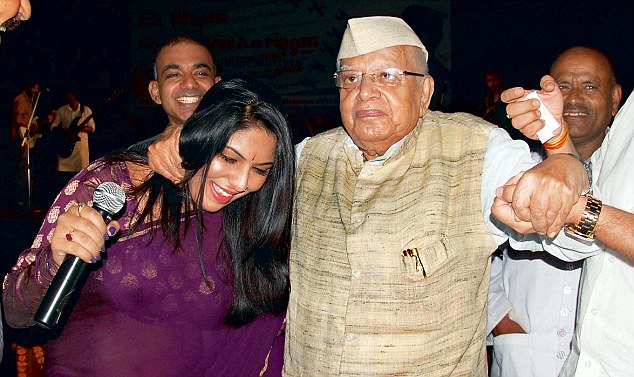
The octogenarian politician embarrassed organisers of a programme here on Sunday as he climbed the stage and started dancing with a woman singer, who was singing paeans to martyrs. The programme was organised to honour sacrifices by the martyrs.

Eye-witnesses said Tiwari “forced” the singer to dance with him.

The incident, which happened soon after the woman finished singing, put the organisers in “a very difficult position.” They had a tough time persuading Tiwari to return to his seat. Officials are apparently finding it difficult to cope with Tewari’s night trips.

Tiwari, who has been living in the state capital for the past few months, has been seen taking late night tours of the city, inspecting police stations and hospitals to check if the officials were discharging their duties properly. A few days ago, he arrived at a police station late in the night, inquiring about lady constables. He also visited hospitals to check if doctors were discharging their duties.

The bonhomie between Samajwadi Party supremo Mulayam Singh Yadav and Tiwari has fuelled speculation about the duo working together in the ensuing Lok Sabha elections. Both Mulayam and his son, Uttar Pradesh Chief Minister Akhilesh Yadav, had met Tiwari for a closed-door meeting earlier.

Though they called the meeting “a courtesy call,” Samajwadi Party leaders said they discussed state politics.

Party leaders said Mulayam has plans to expand the Samajwadi Party’s base to Uttarakhand and Tiwari, with his experience, could come in handy.

Comments

Add new comment

  • Coastaldigest.com reserves the right to delete or block any comments.
  • Coastaldigset.com is not responsible for its readers’ comments.
  • Comments that are abusive, incendiary or irrelevant are strictly prohibited.
  • Please use a genuine email ID and provide your name to avoid reject.
News Network
April 16,2020

United Nations, Apr 16: WHO chief Tedros Adhanom Ghebreyesus has welcomed the world health body's cooperation with India to leverage strategies that helped the country win its war against polio into the response to COVID-19 outbreak, saying such joint efforts will help defeat the pandemic.

The World Health Organization (WHO) has said it will work with India's Ministry of Health and Family Welfare to leverage the strategies that helped the country eradicate polio to fight the pandemic.

Migrants who returned to UP and Bihar were hurriedly housed in schools and panchayat buildings, which were turned into quarantine centres. However, unhygienic conditions and people running away have proved to be a problem

The WHO's national polio surveillance network will be engaged to strengthen COVID-19 surveillance and its field staff will continue to support immunization and elimination of tuberculosis and other diseases.

“Great news: @MoHFW_INDIA & @WHOSEARO initiated a systematic engagement of @WHO's national polio surveillance network, and other field staff, for India's #COVID19 response, tapping into the best practices & resources that helped win its war against polio,” the WHO director-general tweeted, referring to India's Ministry of Health and Family Welfare and World Health Organization Regional Office for South-East Asia.

According to the Johns Hopkins University data, over 2 million people are infected by the virus and more than 136,000 people have died of the disease globally.

Ghebreyesus expressed gratitude to Health and Family Welfare Minister Harsh Vardhan “for his leadership and collaboration” with WHO. “Through these joint efforts we can defeat the #coronavirus and save lives. Together!”

India eliminated polio in 2014.
According to a WHO press release, Vardhan said in New Delhi that “time and again the Government of India and WHO together have shown our ability, competence and prowess to the whole world. With our combined meticulous work, done with full sincerity and dedication, we were able to get rid of polio.”

“All of you in the field – IDSP (Integrated Disease Surveillance Project), state rapid response teams and WHO - are our ‘surveillance corona warriors'. With your joint efforts we can defeat the coronavirus and save lives,” Vardhan added.

WHO South-East Asia Regional Director Poonam Khetrapal Singh said the National Polio Surveillance Project (WHO-NPSP) played a critical role in strengthening surveillance for polio that generated useful, timely and accurate data to guide policies, strategies and interventions until transmission of the poliovirus was interrupted in the country,” adding that the other WHO field staff involved with elimination of tuberculosis and neglected tropical diseases and hypertension control initiative were also significant resources.

Singh added that “it is now time to use all your experience, knowledge and skills, with the same rigor and discipline that you showed while monitoring polio activities, to support districts with surveillance, contact tracing and containment activities.”

The WHO release said strengths of the NPSP team – surveillance, data management, monitoring and supervision, and responding to local situations and challenges – will be utilized to supplement efforts of National Centre for Disease Control, IDSP and Indian Council of Medical Research to strengthen COVID-19 surveillance.

The NPSP team will also support in sharing information and best practices and help states and districts calibrate their response based on transmission scenarios and local capacities.

The WHO field staff will continue to support immunization and surveillance and elimination of Tuberculosis and Neglected Tropical Diseases, Singh said, adding, “disease outbreaks can negatively impact progress in a range of areas, from maternal and child mortality to vaccine-preventable diseases and other treatable conditions. India had been making stupendous progress in these areas and we cannot afford for India's remarkable progress to be set back or reversed.”


Comments

Add new comment

  • Coastaldigest.com reserves the right to delete or block any comments.
  • Coastaldigset.com is not responsible for its readers’ comments.
  • Comments that are abusive, incendiary or irrelevant are strictly prohibited.
  • Please use a genuine email ID and provide your name to avoid reject.
News Network
March 20,2020

New Delhi, Mar 20: Bodies of the four Nirbhaya convicts who were hanged on Friday morning at Tihar Jail have been sent to hospital for a post-mortem, following which it will be handed over to the families, according to an official.

After the hanging at 5:30 am today, the bodies were taken from Tihar Jail to Deen Dayal Upadhyay (DDU) Hospital for post mortem at around 8:20 am.

Tihar jail Director-General Sandeep Goel said that the bodies will be handed over to the families after the post mortem.

The families, however, will have to give a written undertaking that they will not make a public demonstration of the cremation or burial of the executed person.

The superintendent will also consult the District Magistrate and the Deputy Commissioner of Police for arrangements for the disposal of the body.

The post mortem comes in line with the Supreme Court's order in Shatrughan Chauhan's case in January 2014, which had mandated the same observing that there is a dearth of experienced hangman in the country.

"By making the performance of post mortem obligatory, the cause of the death of the convict can be found out, which will reveal whether the person died as a result of the dislocation of the cervical vertebrate or by strangulation which results on account of too long a drop," the apex court had said in its order.

"Our constitution permits the execution of death sentence only through the procedure established by law and this procedure must be just, fair and reasonable," the order added.

All four convicts in the 2012 Nirbhaya gang-rape and murder case -- Akshay Singh Thakur, Pawan Gupta, Vinay Sharma, and Mukesh Singh -- were hanged till death at 5:30 am this morning.

The case pertains to the brutal gang-rape and killing of a 23-year-old paramedical student in a moving bus on the night of December 16, 2012, by six people including a juvenile in the national capital. The woman had died at a Singapore hospital a few days later.

One of the adults accused had allegedly committed suicide in the prison during the trial, while the juvenile was released from a correction home after a period of three years.

Comments

Add new comment

  • Coastaldigest.com reserves the right to delete or block any comments.
  • Coastaldigset.com is not responsible for its readers’ comments.
  • Comments that are abusive, incendiary or irrelevant are strictly prohibited.
  • Please use a genuine email ID and provide your name to avoid reject.
News Network
July 18,2020

New Delhi, Jul 18: The Covid-19 lockdown-led reduction in air pollution levels across five Indian cities, including Delhi and Mumbai, may have prevented about 630 premature deaths, and saved USD 690 million in health costs in the country, according to a new study.

Scientists, including those from the University of Surrey in the UK, assessed the levels of harmful fine particulate matter (PM2.5) from vehicles and other sources in five Indian cities -- Delhi, Mumbai, Kolkata, Chennai and Hyderabad -- since the beginning of the lockdown period.

The study, published in the journal Sustainable Cities and Society, compared these lockdown PM2.5 figures from 25 March up until 11 May, with those from similar periods of the preceding five years, and found that the measure reduced pollution levels in all these places.

According to the scientists, during this period, the levels of these harmful air pollutants reduced by 10 per cent in Mumbai, and by up to 54 per cent in Delhi.

"The percentage reduction for the other cities ranged from 24 to 32 per cent, which was slightly smaller than the measured values for Delhi and Mumbai," the scientists noted in the study.

"While the reduction in PM2.5 pollution may not be surprising, the size of the reduction should make us all take notice of the impact we have been having on the planet," said Prashant Kumar, a co-author of the study from the University of Surrey.

The scientists said these reductions in PM2.5 were comparable to those reported in other cities across the world, such as in Austria's capital Vienna (60 per cent), and Shanghai (42 per cent) in China.

They also calculated the monetary value of the reduced mortality due to air pollution and found that the lowered levels of PM2.5 may have saved 630 people from premature death, and USD 690 million in health costs in India.

Coronavirus India update: State-wise total number of confirmed cases, deaths on July 17

According to the researchers, the present lockdown situation offers observational opportunities regarding potential control systems and regulations for improved urban air quality.

They said an integrated approach might help in understanding the overall impacts of Covid-19 lockdown-style interventions and support the implementation of relevant policy frameworks.

"This is an opportunity for us all to discuss and debate what the 'new normal' should look like - particularly when it comes to the quality of the air we breathe," Kumar said.

Comments

Add new comment

  • Coastaldigest.com reserves the right to delete or block any comments.
  • Coastaldigset.com is not responsible for its readers’ comments.
  • Comments that are abusive, incendiary or irrelevant are strictly prohibited.
  • Please use a genuine email ID and provide your name to avoid reject.