



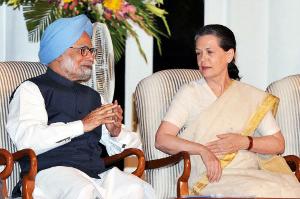
Pay panel a vote magnet? Congress trying to woo middle class

September 26, 2013

Pay_panelNew Delhi, Sep 26: The Congress trumpeted the constitution of seventh pay commission as another of its welfare measures in line with land and food bills, in what appeared a thinly-veiled attempt to milk the olive branch to government employees at the upcoming state and Lok Sabha polls.

The surprise decision on the pay commission targetting middle-classes comes on the back of legislations to win over the poor and the sudden urgency in Congress establishment to facilitate new alliances: clear evidence that the ruling party has hit poll mode.

The belief is that tough reforms are over for good in UPA-2 and the ruling camp would try the time-tested sops to win electoral favour.

Not surprisingly, Congress patted the leadership for bringing the pay panel just ahead of festivals while slamming NDA for not doing so in 2003 when the sixth commission was due. "It has brought happiness to lakhs of people," AICC spokesman Raj Babbar said, adding it would benefit 80 lakh people.

With the Centre having rushed to pass the land and food bills as 'aam aadmi' sops earlier, the Centre has now picked on middle classes -- the pay panel coinciding with assurance from petroleum minister Veerappa Moily that there would be no hike in petrol prices.

The importance of the new step in bolstering urban constituencies is evident from how AICC general secretary Ajay Maken first made the demand for pay panel in a letter to Prime Minister Manmohan Singh this March. His New Delhi constituency, populated by government servants, is especially susceptible to such overtures.

Besides the electorate, rural and urban, Congress has moved with alacrity to woo regional satraps -- the Cabinet on Tuesday passed an ordinance to save convicted MPs from disqualification, aimed at appeasing Lalu Prasad who faces a final verdict in the infamous fodder scam on September 30.

The Centre's hidden hand is seen in the sudden softening of enforcement agencies facilitating the bail for YSR Congress chief Jaganmohan Reddy: an olive branch to the rebellious Reddy.

Many believe that Bihar may also get the tag of "backward state" ahead of polls that would open up the Congress option with JD(U) in the crucial state.

The urgency in Congress ranks appears to stem from the realisation that 2014 as well as end-year assembly polls would be a tough test. The decision on pay panel seems an acknowledgment that Delhi polls may be a challenge this time.

Observers say that central pay panel also has an effect on state employees since it brings pressure on the states governments to follow suit. The public employees and teachers are believed to play a big role in influencing the opinion of voters.

Comments

Add new comment

  • Coastaldigest.com reserves the right to delete or block any comments.
  • Coastaldigset.com is not responsible for its readers’ comments.
  • Comments that are abusive, incendiary or irrelevant are strictly prohibited.
  • Please use a genuine email ID and provide your name to avoid reject.
News Network
March 27,2020

Mumbai, Mar 27: The Reserve Bank of India (RBI) on Friday lowered the key repo rate by 75 basis points to 4.4 per cent in a bid to arrest the economic slowdown amid coronavirus (COVID-19) outbreak.
The reverse repo rate now stands at 4 per cent, down by 90 basis points, said RBI Governor Shaktikanta Das adding this has been done to make it unattractive for banks to passively deposit funds with the central bank and instead lend it to the productive sectors.
The six-member monetary policy committee (MPC) met on March 24, 25 and 27 and voted 4:2 in favour of the repo rate reduction. The MPC also decided to continue with the accommodative stance as long as it is necessary to revive growth and mitigate the impact of COVID-19 on the economy while ensuring that inflation remains within the target.
"The need of the hour is to shield the economy from the pandemic," said Das. "We need to mitigate the impact of coronavirus, revive economic growth and provide financial stability."
Repo rate is the rate at which a country's central bank lends money to commercial banks, and the reverse repo rate is the rate at which it borrows from them.
The RBI Governor further said that the economic growth and inflation projection will be highly contingent depending on the duration, spread and intensity of the pandemic.
"Global economic activity has come to a near standstill as COVID-19 related lockdowns and social distancing are imposed across a widening swathe of affected countries. Expectations of a shallow recovery in 2020 from 2019's decade low in global growth have been dashed," said Das.
"The outlook is now heavily contingent upon the intensity, spread and duration of the pandemic. There is a rising probability that large parts of the global economy will slip into recession," he said.
However, the RBI has injected liquidity of Rs 2.8 lakh crore via various instruments equal to 1.4 per cent of GDP. "Along with today's measures, liquidity measures equal to 3.2 per cent of GDP. The RBI will take continuous measures to ensure liquidity in the system."
The RBI governor has said that all banking institutions can offer a three-month moratorium on all loans for a period of three months. The RBI has also allowed banks to restructure the working capital cycle for companies without worrying that these will have to be classified as a non-performing asset (NPA).
The three-month moratorium will permit banks to avoid a large onset of NPAs during the 21-day lockdown and keep their books healthy.
Das said banks and other financial institutions should do all they can to keep credit flowing to economic agents facing financial stress on account of the isolation that the virus has imposed.
"Market participants should work with regulators like the RBI and the Securities and Exchange Board of India (SEBI) to ensure the orderly functioning of markets in their role of price discovery and financial intermediation," he said.

Comments

Add new comment

  • Coastaldigest.com reserves the right to delete or block any comments.
  • Coastaldigset.com is not responsible for its readers’ comments.
  • Comments that are abusive, incendiary or irrelevant are strictly prohibited.
  • Please use a genuine email ID and provide your name to avoid reject.
News Network
January 14,2020

New Delhi, Jan 14: The curative petitions of Vinay Sharma and Mukesh, who were sentenced to death in the Nirbhaya gang rape and murder case, was on Tuesday rejected by a five-judge Supreme Court Bench led by Justice N.V. Ramana.

In a three-page order, the Bench concluded, after an in chamber consideration that began about 1.45 p.m., that there was no merit in their pleas to spare them from the gallows.

“We have gone through the curative petitions and relevant documents. In our opinion, no case is made out within the parameters indicated in the decision of this Court in Rupa Ashok Hurra versus Ashok Hurra. Hence, the curative petitions are dismissed,” the court held.

Curative is a rare remedy devised by a Constitution Bench of the Supreme Court in its judgment in the Rupa Ashok Hurra case in 2002. A party can take only two limited grounds in a curative petition - one, he was not heard by the court before the adverse judgment was passed, and two, the judge was biased. A curative plea, which follows the dismissal of review petition, is the last legal avenue open for convicts in the Supreme Court. Sharma was the first among the four convicts to file a curative.

The Bench also rejected their pleas to stay the execution of their death sentence and for oral hearing in open court.

Besides Justice Ramana, the Bench comprised Arun Mishra, Rohinton Nariman, R. Banumathi and Ashok Bhushan.

Curative petitions were filed in the Supreme Court by both convicts on January 9. The petitions had come just days after a Delhi sessions court schedulled the execution of all the four convicts in Tihar jail on January 22.

Sharma and Mukesh, in separate curative petitions, argued that there was a “sea change” in the death penalty jurisprudence since their convictions. Carrying out the death sentence on such changed circumstances would be a “gross miscarriage of justice”.

In his plea, Sharma said the Court had commuted the death penalty in several rape and murder cases since 2017, when it first confirmed the death penalty to the Nirbhaya convicts.

“fter the pronouncement of judgment in 2017, there have been as many as 17 cases involving rape and murder in which various three-judge Benches of the Supreme Court have commuted the sentence of death,” the petition contended.

The Supreme Court recently dismissed a review petition filed by Akshay Singh, another of the four four condemned men, to review its May 5, 2017 judgment confirming the death penalty. It also refused his plea to grant him three weeks' time to file a mercy petition before the President of India.

A Bench led by Justice R. Banumathi had said it was open for the Nirbhaya case convicts to avail whatever time the law prescribes for the purpose of filing a mercy plea.

Akshay (33), Mukesh (30), Pawan Gupta (23) and Sharma (24) had brutally gang-raped a 23-year-old paramedical student in a moving bus on the intervening night of December 16-17, 2012. She died of her injuries a few days later.

The case shocked the nation and led to the tightening of anti-rape laws. Rape, especially gang rape, is now a capital crime.

One of the accused in the case, Ram Singh, allegedly committed suicide in the Tihar jail. A juvenile, who was among the accused, was convicted by a juvenile justice board. He was released from a reformation home after serving a three-year term.

Comments

Add new comment

  • Coastaldigest.com reserves the right to delete or block any comments.
  • Coastaldigset.com is not responsible for its readers’ comments.
  • Comments that are abusive, incendiary or irrelevant are strictly prohibited.
  • Please use a genuine email ID and provide your name to avoid reject.
Agencies
June 2,2020

Singapore, Jun 2: Moody's Investors Service on Tuesday downgraded 11 Indian banks along with as many non-financial companies and infrastructure majors besides four government-related issuers following a downgrade of the Indian government's issuer rating to Baa3 from Baa2 with a negative outlook.

The rapid and widening spread of the coronavirus outbreak, deteriorating global economic outlook, volatile oil prices and asset price declines are creating a severe and extensive credit shock across many sectors, regions and markets, said Moody's.

The Indian banking sector has been affected given the disruptions to India's economic activity from the coronavirus outbreak, which is weakening borrowers' credit profiles, it added.

The 11 lenders include Bank of Baroda, Bank of India, Canara Bank, Central Bank of India, Export-Import Bank of India, HDFC Bank, Indian Overseas Bank, IndusInd Bank, Punjab National Bank, State Bank of India and Union Bank of India.

The 11 non-finance companies are Oil and Natural Gas Corporation, Hindustan Petroleum Corporation, Oil India, Indian Oil Corporation, Bharat Petroleum Corporation, Petronet LNG, Tata Consultancy Services, Infosys, Reliance Industries, UPL Corporation and Genpact.

The 11 infrastructure companies are NTPC, NHPC, National Highways Authority of India, Power Grid Corporation, Gail India, Adani Green Energy Restricted Group (RG-2), Adani Transmission Restricted Group, Adani Ports and Special Economic Zone, Adani Transmission, Adani Electricity Mumbai and Azure Power Solar Energy.

The four Indian government-related issuers are Indian Railway Finance Corporation, Housing and Urban Development Corporation, Power Finance Corporation and REC Ltd.

"Government-related issuers in India have been affected because of disruptions to India's economy which will weaken borrowers' credit profiles," said Moody's.

Comments

Add new comment

  • Coastaldigest.com reserves the right to delete or block any comments.
  • Coastaldigset.com is not responsible for its readers’ comments.
  • Comments that are abusive, incendiary or irrelevant are strictly prohibited.
  • Please use a genuine email ID and provide your name to avoid reject.