Violence continues in Andhra town despite curfew

October 6, 2013
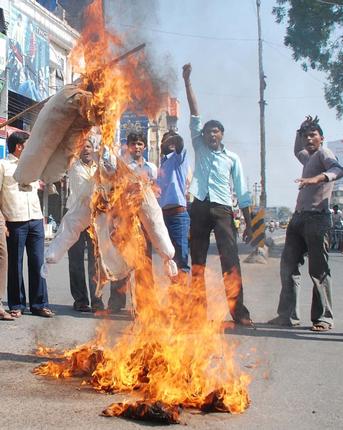
Hyderabad, Oct 6: Violence continued in Vizianagaram town in coastal Andhra Sunday despite indefinite curfew imposed by police to tackle violent protests, which broke out after union cabinet's decision to divide the state.

telangana_curfew

Violating the curfew, people in some parts of the town took to the streets, clashed with police and indulged in arson and stone pelting.

Police fired rubber bullets, teargas shells and carried out to baton charge as protestors including women attacked them with stones at few places in the town, about 700 km from Hyderabad.

Two policemen sustained injuries in stone pelting by protestors. Despite the curfew, the agitators attacked Satya College owned by state Congress chief Botsa Satyanarayana and ransacked furniture.

Protestors have been damaging the properties of Satyanarayana and his relatives, blaming him for failure to stall the state's division.

Security was further tightened at the residences and other properties of Satyanarayana and his family members.

With violence continuing in the fort town, paramilitary forces were deployed. Personnel of Central Reserve Police Force (CRPF), Rapid Action Force (RAF) and Border Security Force (BSF) were patrolling the streets.

Special police officer Vikram Singh Mann said the police would deal firmly with those violating curfew. He said anti-social elements were indulging in violence and looting.

The official said the curfew would continue till the situation completely comes under control. Police arrested dozens of people indulging in violence.

The curfew was clamped after large-scale violence and arson for the second consecutive day Saturday. The protestors set afire dozens of vehicles, public and private property.

The streets turned into battle zone with protestors pelting stones on policemen at several places.

Police repeatedly baton-charged the mob and used teargas shells but this failed to check the violence, forcing the authorities to impose curfew.

Chief Minister N. Kiran Kumar Reddy has directed police to deal firmly with anti-social elements destroying government and private properties.

As protests continued in Seemandhra (Rayalaseema and coastal Andhra) against the decision to divide the state, the chief minister reviewed the law and order situation.

He asked chief secretary and director general of police to closely monitor the situation with district collectors and superintendents of police. He directed officials to be on alert and to ensure that no untoward incident takes place.

Comments

Add new comment

  • Coastaldigest.com reserves the right to delete or block any comments.
  • Coastaldigset.com is not responsible for its readers’ comments.
  • Comments that are abusive, incendiary or irrelevant are strictly prohibited.
  • Please use a genuine email ID and provide your name to avoid reject.
Agencies
May 23,2020

New Delhi, May 23: The nationwide lockdown will no longer help India in its fight against COVID-19, and in its place community-driven containment, isolation and quarantine strategies have to be brought into play, leading virologist Shahid Jameel said.

The recipient of Shanti Swarup Bhatnagar Prize for Science and Technology also stressed that testing should be carried out vigorously to identify coronavirus hotspots and isolate those areas.

"Our current testing rate at 1,744 tests per million population is one of the lowest in the world. We should deploy both antibody tests and confirmatory PCR tests. This will tell us about pockets of ongoing infection and past (recovered) infection. This will provide data to open up gradually and let economic activity resume," Jameel told PTI in an interview.

He stressed that testing has to be dynamic to continuously monitor red, orange and green zones and change these based on that data.

About community transmission of COVID-19 in India, Jameel said the country reached that stage long ago.

"We reached community transmission a long time ago. It's just that the health authorities are not admitting it. Even ICMR's own study of SARI (severe acute respiratory illness) showed that about 40 per cent of those who tested positive for SARS-CoV-2 did not have any history of overseas travel or contact to a known case. If this is not community transmission, then what is?" he posed.

Lockdown bought India time in its fight against coronavirus, but continuing it is unlikely to yield any further dividend, Jameel said.

"Instead, community-driven local lockdowns, isolations and quarantines have to come into play. Building trust is most important so that people follow rules. A public health problem cannot be dealt with as a law-and-order problem."

The nationwide lockdown, initially imposed from March 25 to April 14, has been extended thrice and will continue at least till May 31. The virus has claimed 3,720 lives and infected over 1.25 lakh people in the country so far.

Jameel has expertise in the fields of molecular biology, infectious diseases, and biotechnology. He is the CEO of Wellcome Trust/Department of Biotechnology's India Alliance and is best known for extensive research in Hepatitis E virus and HIV.

He said COVID-19 will eventually be controlled through herd immunity, which is acquired in two ways – when a sufficient fraction of the population gets infected and recovers, and with vaccination.

"It is estimated that for SARS-CoV-2 at least 60 per cent of the population would have to be infected and recovered, or vaccinated. This will happen over the course of the next few years," Jameel said.

Herd immunity is reached when the majority of a population becomes immune to an infectious disease, either because they have become infected and recovered, or through vaccination. When that happens, the disease is less likely to spread to people who aren't immune, because there just aren't enough infectious carriers.

"India has 1.38 billion people, a population density of about 400/sq km and a healthcare system ranked at 143 in the world. If we allow 60 per cent people to get infected quickly in the hopes of herd immunity, that would mean 830 million infections," Jameel said.

"If 15 per cent need hospitalization that means about 125 million isolation beds (we have 0.3 million). If five per cent need oxygen and ventilatory support, this amounts to about 42 million oxygen support and ICU beds; we have 0.1 million oxygen support beds and 34,000 ICU beds. This would overwhelm the healthcare system causing mayhem," he said.

Jameel said if the population level mortality is 0.5 per cent that would mean 40 lakh deaths. "Are we prepared to pay this price for herd immunity in the short term? Clearly not," he said.

He said it is unlikely that a vaccine would be available by the end of the year.

"Even then, we don't know yet how long it would give protection – weeks, months, one year, a few years? I don't think we will return to pre-coronavirus days for at least the next 3-5 years. This is also a chance to evaluate if we want to return to those unsustainable, environment-damaging ways. COVID-19 is a timely warning to reform our way of living," he said.

Jameel said it is hard to predict but plausible that COVID-19 would return in second or third wave.

"Later waves come when we don't understand the disease and become lax. A comparison to Spanish Flu is not entirely valid because in 1918 no one knew what caused it. No one had seen a virus till the mid-1930s as the electron microscope needed to view those was invented in 1931," he said.

"Today we know a lot more about the pathogen, its genetic makeup, how it transmits and how to prevent it. We need to be sensible and follow expert advice," he said.

If there is any scientific evidence linking deforestation, rapid urbanisation, climate change with pandemics like COVID-19, he said zoonotic viruses -- those that jump from animals to humans -- happen so when wild animal–human contacts increase.

"Deforestation destroys animal habitats bringing them closer to humans. When you cut forests, bats come to roost on trees closer to human habitations. Their viruses in secretions/stool get transmitted to domestic animals and on to humans. This happened clearly with Nipah virus outbreak in Malaysia in 1997-98 from fruit bats to pigs to humans," he said.

"COVID-19 possibly arose in wet animal markets due to dietary habits that bring all kinds of live and dead wild animals in close contact with humans," Jameel added.

Comments

Add new comment

  • Coastaldigest.com reserves the right to delete or block any comments.
  • Coastaldigset.com is not responsible for its readers’ comments.
  • Comments that are abusive, incendiary or irrelevant are strictly prohibited.
  • Please use a genuine email ID and provide your name to avoid reject.
The wire
May 20,2020

Bhopal, May 20: Two months after Deepak Bundele, an advocate and former journalist, was brutally assaulted by the Madhya Pradesh’s Betul Police on March 23, an Assistant Sub-Inspector of Kotwali Police Station in Betul district, BS Patel, approached the victim to record his statement. However, he allegedly tried to convince Bundele to withdraw the case saying that the cops had mistaken him for a Muslim since he has a long beard and assaulted him. But, the cop added, they were ashamed of the incident after they came to know that they had beaten their ‘Hindu brother’.
Bundele was on his way to the government hospital for diabetes treatment, a day before the countrywide lockdown was announced, when the assault occurred. Miffed with the incident and after the district police denied to register the case, he wrote to the State Human Rights Commission; Chief Justice of Madhya Pradesh High Court; Chief Minister Shivraj Singh Chouhan; Vivek Johri, Director General of Police, Madhya Pradesh; and SP Betul to register an FIR against the police officials and take punitive action against them.
In the wake of COVID-19 pandemic outbreak, section 144 had been imposed in Betul district and public movement was restricted when the incident had occurred. 
Talking to Bundele, ASI Patel had said, “We seek an apology on behalf of those officials [who assaulted Bundele]. We are truly embarrassed because of the incident. If you want, I can bring those officials and make them apologise in person to you. They mistook you as a Muslim and assaulted you, since you had a long beard. And the man (who assaulted you) is a kattar (staunch) Hindu…In Hindu-Muslim riots whenever a Muslim is arrested, they beat them up brutally, always,” the police official can be heard saying in an audio recording shared by the victim.
In the 14 minutes long audio, he further said, “I request to you to withdraw the complaint. Please agree to our request; understand that we are living in Gandhi’s country; we are all Gandhi’s children…I have at least 50 friends from your caste.”
The cop continued, “All those people are ashamed that they did something like this to a Hindu brother without knowing his identity. We do not have any enmity against you. Whenever there is a Hindu-Muslim riot, police always supports the Hindus; even Muslims know this. But whatever happened with you was because of ignorance. For that, I have no words.” 
Refuting ASI Patel’s claim, Bundele claimed that there was no Hindu-Muslim riot that day, and asked whether he was beaten for being wrongly identified as a Muslim. The police officials agreed, and said: “Yes, exactly.”
“When I constantly declined to withdraw the compliant, he indirectly threatened me saying, ‘Agree to our request, else you and your advocate brother will face consequences’,” Bundele claimed. 
When contacted Betul SP DS Bhadoriya said, “I’m not aware of this audio clip. I will taken strict action, if I receive any such complain.”
Bundele said that he has written to the DGP and other senior police officials with details about the incident.   
THE ASSAULT
On March 23 evening, when Bundele was on his way to a hospital for the treatment, Betul Police allegedly thrashed him. The 32-year-old advocate had worked as a journalist for various dailies in Madhya Pradesh’s state capital for a decade. He moved to Betul in 2017 and started practising in the district court with his brother. “I have been a patient of diabetes and blood pressure for the last 15 years. On March 23, since I was not feeling well, I decided to visit the hospital and get some medicines. But I was stopped by the police midway,” Bundele had said. 
Even though the advocate, who sports a beard, said that he explained to police personnel that he had to get his medicines but one of them slapped him without trying to listen to what he was saying. “When I protested and said that police have no right to beat the public, they got anxious and within no time, many police officials came and started beating me up with sticks,” he added. 
"I need constant medication and lifesaving medicines to survive and I told the policemen everything while they were assaulting me. But, they kept hitting me, even after I fell,” he said, adding, "I bled for almost a 2-3 days after the incident.”
Bundele, sustained multiple injuries and his ear bled for almost two days after the incident, but, Betul police denied to file an FIR in the incident.
‘WILL MOVE TO THE HIGH COURT’
“Even after two months of the incident, no FIR has been registered and it seems that police is trying to sweep the matter under the carpet,” Bundele said, adding, “I have talked to the Supreme Court’s veteran advocate Vivek Tankha and Etasham Hashmi and will take this matter to the court.”
He also raised serious concerns about the communal angle of the incident, saying, “It’s a matter of grave concern that the police is turning communal and targeting a particular community.”

Source: https://www.google.com/amp/s/m.thewire.in/article/communalism/madhya-pr…

Comments

Add new comment

  • Coastaldigest.com reserves the right to delete or block any comments.
  • Coastaldigset.com is not responsible for its readers’ comments.
  • Comments that are abusive, incendiary or irrelevant are strictly prohibited.
  • Please use a genuine email ID and provide your name to avoid reject.
News Network
April 21,2020

New Delhi, Apr 21: The historic rout in oil markets that sent US crude prices plummeting to as much as minus USD 40 a barrel is unlikely to translate into any big reduction in petrol and diesel prices in India as domestic pricing is based on different benchmark, and refineries are already filled up to brim and cannot buy US crude just yet.

With storage capacity already overflowing amid coronavirus-induced demand collapse, traders rushed to to get rid of unwanted stocks triggering the collapse of US West Texas Intermediate (WTI) crude for May delivery.

Indian Oil Corp (IOC) Chairman Sanjiv Singh said the collapse was triggered by traders unable to take deliveries of crude they had previously booked because of a demand collapse. And so they paid the seller to keep oil in their storage.

"If you look at June futures, it is trading in positive territory... around USD 20 per barrel," he said.

Low oil prices may seem good in short-term but in the long run it will hurt the oil economy as producers will have no surplus to invest in exploration and production which will lead to a drop in production, he said.

He did not comment on retail fuel prices that have been static since March 16.

Oil companies have not changed rates despite a fall in international prices as they first adjusted them against the increase that was warranted from a Rs 3 per litre hike in excise duty and close to Re 1 per litre additional cost of switching over to cleaner BS-VI grade fuel from April 1.

Petrol in Delhi is priced at Rs 69.59 a litre and diesel comes for Rs 62.29 per litre.

"The negative price has no direct impact on India or Indian oil prices, as this has taken place due to crude oil produced and traded within the US. India's prices are driven partly by another benchmark, the Brent, which is still trading at USD 25/barrel. Therefore, the retail price of fuels in India are unlikely to fall," said Amit Bhandari, Fellow, Energy and Environment Studies, Gateway House.

Also, Indian refineries are already overflowing as fuel demand has evaporated due to the unprecedented nationwide lockdown imposed to curb spread of COVID-19. So, they can't rush to buy US crude.

The refineries have already cut operating rate to half because the fuel they produce has not been sold yet.

India imports 4 million barrels/day (1.4 billion barrels/year) of oil. The country has been benefitting from the falling prices of oil for the last five years, when oil dropped from a peak of USD 110/barrel to USD 50-60/barrel last year, enabling India to invest in public service programmes.

"However, the additional USD 30 fall of this week is good for India - but there is also a downside. If oil prices are too low, the economies of oil-rich gulf countries will be hurt, threatening the job prospects of the 8 million Indians working in the Gulf countries. India is the largest recipient of foreign remittances due to these workers – very low oil prices will hurt this cash stream," Bhandari said.

He said the negative price of oil shows how much oil oversupply exists in international markets today. "Global oil consumption has fallen due to the COVID-19 pandemic that traders are willing to pay customers to get rid of the barrels they can't store. The world does not have enough storage capacity, and dumping the oil is an environmental crime."

The first half of April saw Brent crude oil prices plummet 63.6 per cent to USD 26.9 per barrel. Prices of Western Texas Intermediate (WTI), the American oil, had also fallen similarly by 63.1 per cent.

But on April 20, WTI prices turned rapidly negative because traders on the Nymex exchange rushed to offload their May futures positions a day before expiry of contracts (on April 21).

Such WTI futures are traded on the Nymex exchange with contracts settled in physical crude oil. Problem is, those who had gone long are unable to find storage facilities for the oil and had to liquidate their contracts before expiry. This caused the plunge in WTI prices.

Contrast to this, June WTI Nymex futures prices is hovering around USD 21, while Brent for June delivery is at USD 25.

Miren Lodha, Director, CRISIL Research said the demand for crude oil was declining already because of economic slowdown when the COVID-19 pandemic-driven lockdowns crushed it further.

Consequently, oil demand is expected to contract by 8-10 million barrels per day (mbpd) in 2020 assuming demand recovery begins from the third quarter of the year, he said, adding if recovery doesn't happen by then, further demand destruction could occur.

On the supply side, producers reining in output following a strategic deal between OPEC members, Russia and the US.

Under this agreement, OPEC+ would reduce oil production by 9.7 mbpd for May and June, but gradually ease the curb to 7.7 mbpd between July and December 2020, and to 5.8 mbpd till April 2022 to stabilise prices.

"This is expected to reduce some surplus in the market by the end of 2020," Lodha said.

Crude oil demand is expected to decline by over 20 mbpd in April alone. Typically, monthly global demand is about 100 mbpd. Given this scenario, supply curbs would have limited influence.

Consequently, Brent oil prices is expected to be in the USD 25-30 range for the second quarter while increasing marginally in the last 2 quarters of 2020.

"The gigantic inventory build-ups and lack of storage facilities would also put pressure on prices," he said, adding overall Brent could average USD 30-35 in 2020, with a strong downward bias.


Comments

Add new comment

  • Coastaldigest.com reserves the right to delete or block any comments.
  • Coastaldigset.com is not responsible for its readers’ comments.
  • Comments that are abusive, incendiary or irrelevant are strictly prohibited.
  • Please use a genuine email ID and provide your name to avoid reject.