



Govt may go slow on Telangana to douse Seemandhra anger; no deadline for GoM report

October 9, 2013

GoM_reportNew Delhi, Oct 9: In a move to pacify protesters in the coastal region of the state, the Centre on Tuesday signalled that it would slow the process of splitting Andhra Pradesh, setting up a group of ministers for the bifurcation but not giving it a deadline to submit a report.

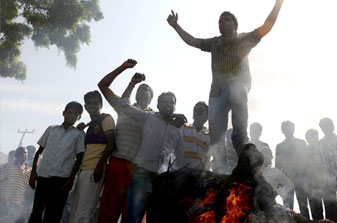
The Congress party has been caught off balance by the intensity of protests in Seemandhra, the part of Andhra left behind after the government conceded the long-pending demand for the creation of Telangana. Its own chief minister, Kiran Kumar Reddy, has opposed the breakup of the state but refused to quit, virtually daring the party to risk sacking him ahead of general elections next year.

The home ministry had originally proposed a six-week deadline for the GoM to submit its findings, but this did not find favour with a government desperate to show that while it wants to create Telangana, there is still scope to accommodate some demands of the dissenters.

The GoM, likely to be headed by home minister Sushilkumar Shinde, will divide the assets of Andhra and determine the boundaries of Telangana and Seemandhra with reference to electoral constituencies, and split judicial and statutory bodies, and other administrative units.

One reason the Congress wants to split Andhra is to minimise electoral losses in the state after popular leader Jaganmohan Reddy left the party in 2010. It reckons it will sweep a newly created Telangana, and pick up a few seats in a multi-cornered contest in Seemandhra. Telangana will have 17 Members of Parliament and Seemandhra, 25.

But things have gone from bad to worse over the past few days.

"It seems the Centre trusted the state's political leadership to explain the mechanics of the division to the people. But the AP chief minister is trying to sabotage the central decision," said Gautam Pingle, former Director, Center for Public Policy at Administrative Staff College of India.

One of the options before the government is to impose President's rule in the troubled state, though Shinde categorically denied any such move. With elections approaching, the Congress would not like to give the Opposition a stick to beat it with.

There is a precedent of forming a new state under President's rule:  Haryana in 1966. But given the bitter feud among pro and anti-Telangana parties, this time such a move will also be vulnerable to a legal challenge.

The Congress started the day by trying to discredit two of its bête noires in the state -- former chief minister Chandrababu Naidu and Jaganmohan Reddy -- by showing they had actually supported the split  before professing to oppose it.

Congress spokesperson Digvijaya Singh released letters written by Naidu in 2008 and 2012 and Reddy in 2012 expressing their support for Telangana. The two leaders are on indefinite fasts to protest the bifurcation of the state.

After the announcement of the GoM, Singh appealed to the people of Seemandhra to give up their protests "so that a healthy dialogue process can move forward and a solution that will benefit both the sides be arrived at".

Comments

Add new comment

  • Coastaldigest.com reserves the right to delete or block any comments.
  • Coastaldigset.com is not responsible for its readers’ comments.
  • Comments that are abusive, incendiary or irrelevant are strictly prohibited.
  • Please use a genuine email ID and provide your name to avoid reject.
News Network
January 2,2020

Kolkata, Jan 2: In what could spark fresh tensions between West Bengal Chief Minister Mamata Banerjee and the BJP-led centre, the Union Ministry of Defence on Wednesday rejected her state's tableau proposal for the Republic Day parade on January 26.

"The tableau proposal of West Bengal government was examined by the expert committee in two rounds of meetings. The tableau proposal of the West Bengal government was not taken forward for further consideration by the committee after deliberations in the second meeting," the ministry said in its statement.

Twenty two proposals comprising 16 states and union territories and six ministries and departments have been shortlisted for the parade. The shortlist was compiled from as many as 56 tableau proposals - 32 from states and union territories and 24 from various ministries and departments - received by the central government.

"The expert committee examines the proposals on the basis of theme, concept, design and visual impact before making its recommendations. Due to time constraints arising out of the overall duration of the parade, only a limited number of tableaux can be shortlisted for participation in the parade," the statement read, adding that West Bengal was shortlisted for the 2019 Republic Day parade through a similar process.

"The rejection of the West Bengal tableau for the Republic Day parade is discriminatory. It has been done because West Bengal has been opposing the centre's CAA (Citizenship Amendment Act) and the NRC (National Register of Citizens) plans," Trinamool Congress MP Saugata Roy told news agency.

"West Bengal is known to be living state as far as culture, including arts, music and other things are concerned. So obviously, this is a discriminatory step taken by the central government against West Bengal," Mr Roy added.

The Trinamool Congress-led Bengal government is at loggerheads with the central government over several issues, and the expanding presence of the BJP in the eastern state ahead of the 2021 assembly elections has further intensified their rivalry.

Mamata Banerjee has repeatedly said that she will not allow Bengal to be a part of the proposed nationwide National Register of Citizens, an assertion that the BJP claims is proof of her minority appeasement strategy. Last month, a four-member delegation of Trinamool Congress politicians that visited BJP-ruled Uttar Pradesh to meet families of those killed in violent protests against the Citizenship Amendment Act were stopped by police personnel at the Lucknow airport.

The BJP leadership has now decided to launch a campaign blitzkrieg in West Bengal to counter what it claims is the Trinamool's "misinformation programmes" against the amended citizenship law and reach out to refugees. Protests across the country have currently put the party on the backfoot.

The Citizenship Amendment Act, for the first time, makes religion the test of citizenship in India. The government says it will help minorities from three Muslim-dominated countries get citizenship if they fled to India because of religious persecution before 2015. Critics say it is designed to discriminate against Muslims and violates the secular principals of the Constitution.

Brazilian President Jair Bolsonaro will be the chief guest at the Republic Day celebrations.

Comments

Add new comment

  • Coastaldigest.com reserves the right to delete or block any comments.
  • Coastaldigset.com is not responsible for its readers’ comments.
  • Comments that are abusive, incendiary or irrelevant are strictly prohibited.
  • Please use a genuine email ID and provide your name to avoid reject.
News Network
April 21,2020

New Delhi, Apr 21: The historic rout in oil markets that sent US crude prices plummeting to as much as minus USD 40 a barrel is unlikely to translate into any big reduction in petrol and diesel prices in India as domestic pricing is based on different benchmark, and refineries are already filled up to brim and cannot buy US crude just yet.

With storage capacity already overflowing amid coronavirus-induced demand collapse, traders rushed to to get rid of unwanted stocks triggering the collapse of US West Texas Intermediate (WTI) crude for May delivery.

Indian Oil Corp (IOC) Chairman Sanjiv Singh said the collapse was triggered by traders unable to take deliveries of crude they had previously booked because of a demand collapse. And so they paid the seller to keep oil in their storage.

"If you look at June futures, it is trading in positive territory... around USD 20 per barrel," he said.

Low oil prices may seem good in short-term but in the long run it will hurt the oil economy as producers will have no surplus to invest in exploration and production which will lead to a drop in production, he said.

He did not comment on retail fuel prices that have been static since March 16.

Oil companies have not changed rates despite a fall in international prices as they first adjusted them against the increase that was warranted from a Rs 3 per litre hike in excise duty and close to Re 1 per litre additional cost of switching over to cleaner BS-VI grade fuel from April 1.

Petrol in Delhi is priced at Rs 69.59 a litre and diesel comes for Rs 62.29 per litre.

"The negative price has no direct impact on India or Indian oil prices, as this has taken place due to crude oil produced and traded within the US. India's prices are driven partly by another benchmark, the Brent, which is still trading at USD 25/barrel. Therefore, the retail price of fuels in India are unlikely to fall," said Amit Bhandari, Fellow, Energy and Environment Studies, Gateway House.

Also, Indian refineries are already overflowing as fuel demand has evaporated due to the unprecedented nationwide lockdown imposed to curb spread of COVID-19. So, they can't rush to buy US crude.

The refineries have already cut operating rate to half because the fuel they produce has not been sold yet.

India imports 4 million barrels/day (1.4 billion barrels/year) of oil. The country has been benefitting from the falling prices of oil for the last five years, when oil dropped from a peak of USD 110/barrel to USD 50-60/barrel last year, enabling India to invest in public service programmes.

"However, the additional USD 30 fall of this week is good for India - but there is also a downside. If oil prices are too low, the economies of oil-rich gulf countries will be hurt, threatening the job prospects of the 8 million Indians working in the Gulf countries. India is the largest recipient of foreign remittances due to these workers – very low oil prices will hurt this cash stream," Bhandari said.

He said the negative price of oil shows how much oil oversupply exists in international markets today. "Global oil consumption has fallen due to the COVID-19 pandemic that traders are willing to pay customers to get rid of the barrels they can't store. The world does not have enough storage capacity, and dumping the oil is an environmental crime."

The first half of April saw Brent crude oil prices plummet 63.6 per cent to USD 26.9 per barrel. Prices of Western Texas Intermediate (WTI), the American oil, had also fallen similarly by 63.1 per cent.

But on April 20, WTI prices turned rapidly negative because traders on the Nymex exchange rushed to offload their May futures positions a day before expiry of contracts (on April 21).

Such WTI futures are traded on the Nymex exchange with contracts settled in physical crude oil. Problem is, those who had gone long are unable to find storage facilities for the oil and had to liquidate their contracts before expiry. This caused the plunge in WTI prices.

Contrast to this, June WTI Nymex futures prices is hovering around USD 21, while Brent for June delivery is at USD 25.

Miren Lodha, Director, CRISIL Research said the demand for crude oil was declining already because of economic slowdown when the COVID-19 pandemic-driven lockdowns crushed it further.

Consequently, oil demand is expected to contract by 8-10 million barrels per day (mbpd) in 2020 assuming demand recovery begins from the third quarter of the year, he said, adding if recovery doesn't happen by then, further demand destruction could occur.

On the supply side, producers reining in output following a strategic deal between OPEC members, Russia and the US.

Under this agreement, OPEC+ would reduce oil production by 9.7 mbpd for May and June, but gradually ease the curb to 7.7 mbpd between July and December 2020, and to 5.8 mbpd till April 2022 to stabilise prices.

"This is expected to reduce some surplus in the market by the end of 2020," Lodha said.

Crude oil demand is expected to decline by over 20 mbpd in April alone. Typically, monthly global demand is about 100 mbpd. Given this scenario, supply curbs would have limited influence.

Consequently, Brent oil prices is expected to be in the USD 25-30 range for the second quarter while increasing marginally in the last 2 quarters of 2020.

"The gigantic inventory build-ups and lack of storage facilities would also put pressure on prices," he said, adding overall Brent could average USD 30-35 in 2020, with a strong downward bias.

Comments

Add new comment

  • Coastaldigest.com reserves the right to delete or block any comments.
  • Coastaldigset.com is not responsible for its readers’ comments.
  • Comments that are abusive, incendiary or irrelevant are strictly prohibited.
  • Please use a genuine email ID and provide your name to avoid reject.
News Network
March 16,2020

Mar 16: An investigation into Coffee Day Enterprises Ltd., initiated by its board after the death of founder V.G. Siddhartha, is likely to conclude that at least Rs 2,000 crore is missing from its accounts, according to people familiar with the matter.

The months-long probe following the suicide of Siddhartha in July examined the financial transactions of India’s largest coffee chain and its dealings with dozens of private companies owned by the entrepreneur. The draft report, running more than a hundred pages, points to thousands of rupees that have gone missing, said the people, asking not to be named because the details aren’t public. It also details hundreds of transactions between the founder’s listed and personal businesses that were not conducted at arm’s length, they said.

Though the report is in its final stages, the precise details could change before its release, expected as early as this week, the people said. The missing funds could total more than Rs 2500 crore, one person said.

“The investigation report is still a work in progress, and not finalized,” a spokesman for the company said. “The board of directors and the company are unaware of its content at this point of time. Hence it would be premature to speculate on the investigation findings.”

The priority for management and Siddhartha’s family “is to keep the business running in a challenging environment and meet all stakeholder commitments, including 30,000 jobs associated with the group,” the spokesman added.

The disappearance of the 59-year-old founder last year stunned India’s business community. He had last been seen telling his driver he was going for an evening walk along a bridge in southern India; his body was found by local fishermen two days later. A letter delivered to Coffee Day’s board and employees, which appeared to be signed by Siddhartha, described massive debts and complained of pressure from lenders and tax authorities. It claimed he bore sole responsibility for the company’s financial transactions.

The probe began about a month later when the company brought in Ashok Kumar Malhotra, a retired senior official from India’s federal enforcement agency, to investigate. A senior lawyer practicing in India’s top court is assisting, the company said in a regulatory filing at the time.

The publicly traded Coffee Day was supposed to be India’s answer to Starbucks Corp. More than 1,500 of its Café Coffee Day outlets blanketed cities and highways, with affordable options for the country’s aspiring middle classes. The chain’s tagline: “A lot can happen over coffee.”

But the empire has been battered since the founder’s death. Its shares plummeted about 90% and its market value dropped to about $80 million. Trading was suspended in February.

India’s regulators are tracking the situation and may use the company’s final report as part of a deeper dive into its internal affairs, the people said. Coffee Day showed about Rs 2400 crore in cash and cash equivalents on its balance sheet as of March 2019, the most recent figures the company has issued.

After the death of Siddhartha however, the company faced a severe liquidity crunch and had “zero cash in the bank,” according to one of the people. It struggled with day-to-day expenses and paying salaries has been a strain, the person said.

The draft report details personal guarantees by Siddhartha for loans taken by Coffee Day, and his unsecured loans at high interest rates from local money lenders, the people said. It also probes Coffee Day’s defaults to coffee growers and other vendors, they said.

A related issue is that coffee estates owned by Siddhartha and several employees had been used as collateral for bank loans. The report found that valuations for properties were inflated to get the loans, one person said.

Investigators have examined several theories about what happened to the company’s money, including whether Coffee Day was manipulating its finances to show cash and profit and whether Siddhartha was taking cash out of the listed company to pay off a large investor to whom he had guaranteed a return, the person said. From the filings of his listed and private companies, the entrepreneur’s loans had totaled more than Rs 10,000 crore, and he had been squeezed by borrowing to repay interest on earlier loans, the person said.

In the letter purportedly from Siddhartha, the entrepreneur said he had tried his best but failed as an entrepreneur. “I am solely responsible for all mistakes,” the letter read. “Every financial transaction is my responsibility. My team, auditors and senior management are totally unaware of all my transactions. The law should hold me and only me accountable, as I have withheld this information from everybody including my family.”

As the report nears release, Coffee Day is finalizing a deal with Blackstone Group Inc. for real estate assets. A large tranche of the payment is due in about a week, one person said.

Coffee Day said it is working to reduce its debt load by divesting non-core enterprises.

“The aim is to save employment and preserve this iconic Indian brand,” the spokesman said.

Comments

Add new comment

  • Coastaldigest.com reserves the right to delete or block any comments.
  • Coastaldigset.com is not responsible for its readers’ comments.
  • Comments that are abusive, incendiary or irrelevant are strictly prohibited.
  • Please use a genuine email ID and provide your name to avoid reject.