



Govt may go slow on Telangana to douse Seemandhra anger; no deadline for GoM report

October 9, 2013

GoM_reportNew Delhi, Oct 9: In a move to pacify protesters in the coastal region of the state, the Centre on Tuesday signalled that it would slow the process of splitting Andhra Pradesh, setting up a group of ministers for the bifurcation but not giving it a deadline to submit a report.

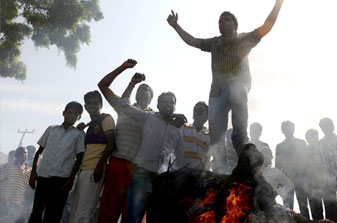
The Congress party has been caught off balance by the intensity of protests in Seemandhra, the part of Andhra left behind after the government conceded the long-pending demand for the creation of Telangana. Its own chief minister, Kiran Kumar Reddy, has opposed the breakup of the state but refused to quit, virtually daring the party to risk sacking him ahead of general elections next year.

The home ministry had originally proposed a six-week deadline for the GoM to submit its findings, but this did not find favour with a government desperate to show that while it wants to create Telangana, there is still scope to accommodate some demands of the dissenters.

The GoM, likely to be headed by home minister Sushilkumar Shinde, will divide the assets of Andhra and determine the boundaries of Telangana and Seemandhra with reference to electoral constituencies, and split judicial and statutory bodies, and other administrative units.

One reason the Congress wants to split Andhra is to minimise electoral losses in the state after popular leader Jaganmohan Reddy left the party in 2010. It reckons it will sweep a newly created Telangana, and pick up a few seats in a multi-cornered contest in Seemandhra. Telangana will have 17 Members of Parliament and Seemandhra, 25.

But things have gone from bad to worse over the past few days.

"It seems the Centre trusted the state's political leadership to explain the mechanics of the division to the people. But the AP chief minister is trying to sabotage the central decision," said Gautam Pingle, former Director, Center for Public Policy at Administrative Staff College of India.

One of the options before the government is to impose President's rule in the troubled state, though Shinde categorically denied any such move. With elections approaching, the Congress would not like to give the Opposition a stick to beat it with.

There is a precedent of forming a new state under President's rule:  Haryana in 1966. But given the bitter feud among pro and anti-Telangana parties, this time such a move will also be vulnerable to a legal challenge.

The Congress started the day by trying to discredit two of its bête noires in the state -- former chief minister Chandrababu Naidu and Jaganmohan Reddy -- by showing they had actually supported the split  before professing to oppose it.

Congress spokesperson Digvijaya Singh released letters written by Naidu in 2008 and 2012 and Reddy in 2012 expressing their support for Telangana. The two leaders are on indefinite fasts to protest the bifurcation of the state.

After the announcement of the GoM, Singh appealed to the people of Seemandhra to give up their protests "so that a healthy dialogue process can move forward and a solution that will benefit both the sides be arrived at".

Comments

Add new comment

  • Coastaldigest.com reserves the right to delete or block any comments.
  • Coastaldigset.com is not responsible for its readers’ comments.
  • Comments that are abusive, incendiary or irrelevant are strictly prohibited.
  • Please use a genuine email ID and provide your name to avoid reject.
News Network
March 29,2020

Thiruvananthapuram, Mar 29: Kerala Chief Minister Pinarayi Vijayan on Saturday expressed his concern over the ''non-cooperation from the Karnataka Government in removing the roadblocks erected by them in the roads bordering Malapuram district''.

Addressing a press conference at the Government Secretariat, the Chief Minister said, "Karnataka has not heeded to our request to remove the roadblocks. I have been trying to contact their Chief Minister B S Yeddyurappa but not able to reach him."

"We have briefed the Union Minister D V Sadananda Gowda and he has offered to resolve the issue. Our Chief Secretary has also briefed the Central Cabinet Secretary and we expect a resolution soon," he added.

Comments

Add new comment

  • Coastaldigest.com reserves the right to delete or block any comments.
  • Coastaldigset.com is not responsible for its readers’ comments.
  • Comments that are abusive, incendiary or irrelevant are strictly prohibited.
  • Please use a genuine email ID and provide your name to avoid reject.
News Network
January 13,2020

Jan 13: India lost more than $1.33 billion to internet restrictions in 2019 as Prime Minister Narendra Modi’s government pushed ahead with his party’s Hindu nationalist agenda, raising tensions and sparking nationwide protests.

The worst shutdown has been in Kashmir, where after intermittent closures in the first half of the year, the internet has been cut off since Aug. 5 following the government’s decision to revoke the special autonomous status of the country’s only Muslim-majority state, a study said. The prologued closure was criticized by India’s highest court, which ruled Friday that the “limitless” internet shutdown enforced by the government for the last five months was illegal and asked that it be reviewed.

India imposed more internet restrictions than any other large democracy, according to the Cost of Internet Shutdowns 2019 report released by Top10VPN, a U.K.-based digital privacy and security research group. The South Asian nation recorded the third-highest losses after Iraq and Sudan, which lost $2.31 billion and $1.86 billion respectively to disruptions. Worldwide internet restrictions caused losses worth $8.05 billion, the report said.

The cost of internet blackouts was calculated using indicators from groups including the World Bank, International Telecommunication Union, and the Delhi-based Software Freedom Law Center. It includes social media shutdowns in its calculations.

India’s ministry of information and technology didn’t respond to an email seeking a response to the report’s findings.

‘Conservative Estimates’

Through 2019, India shut access to the internet for over 4,000 hours. The report added shutdowns in India were often narrowly targeted, down to the level of blocking city districts for a few hours to allow security forces to restore order. Many of these incidents were not included in the report.

“These are conservative estimates,” said Simon Migliano, head of research at U.K.-based Top10VPN. “Internet shutdowns are increasing and it shows a damaging trend.”

India’s other major internet disruptions coincided with two moves by the government that affect India’s Muslim minority. The first disruption took place in November in the states of Uttar Pradesh and Rajasthan after the Supreme Court handed a victory to Hindu groups over Muslim petitioners in a long-simmering dispute over a plot of land.

There were further disruptions in December when protests erupted against the introduction of a religion-based law that allows undocumented migrants of all faiths except Islam from neighbouring countries to seek Indian citizenship. The government enforced shutdowns across Uttar Pradesh and some Northeastern states in order to quell the protests, the report said.

Comments

Add new comment

  • Coastaldigest.com reserves the right to delete or block any comments.
  • Coastaldigset.com is not responsible for its readers’ comments.
  • Comments that are abusive, incendiary or irrelevant are strictly prohibited.
  • Please use a genuine email ID and provide your name to avoid reject.
News Network
January 1,2020

Jan 1: The ban on the practice of instant triple talaq, making it a penal offence and the increase in the strength of Supreme Court judges were two of the major achievements of the law ministry in 2019.

In July, Parliament gave its nod to The Muslim Women (Protection of Rights on Marriage) Bill, 2019. The new law makes talaq-e-biddat or any other similar form of talaq having the effect of instantaneous and irrevocable divorce pronounced by a Muslim husband void and illegal.

It makes it illegal to pronounce talaq three times in spoken, written or through SMS or WhatsApp or any other electronic chat in one sitting.

According to the new law, any Muslim who pronounces the illegal form of talaq upon his wife shall be punished with imprisonment for a term which may extend to three years, and shall also be liable to fine.

During the year, four new judges were appointed to the Supreme Court in September, taking its strength to 34, the highest-ever.

However, vacancies in high courts and lower courts are on the rise and convincing state governments and the 25 high courts to come on board to create an all-India judicial service to recruit judges for the subordinate courts tops the agenda of the Law Ministry in 2020.

Besides creating a consensus on setting up the All-India Judicial Services, the ministry will also have to focus on filling up vacancies in the high court. On an average, the vacancies stood at 400 throughout this year.

With more than 5,000 positions of judicial officers in district and subordinate courts lying vacant, the Law Ministry has pitched for setting up all-India judicial services.

The sanctioned strength of the judicial officers in district and subordinate courts was 22,644. The number of judicial officers in position and vacant posts is 17,509 and 5,135, respectively.

The government has proposed that while states and high courts can recruit judicial officers, the Union Public Service Commission (UPSC) can hold pan-India entrance tests.

The ministry has made it clear that such services would not encroach on the powers of the states.

As of now, the selection and appointment of judges in subordinate courts is the responsibility of the high courts and state governments concerned.

The Narendra Modi government has given a fresh push to the long-pending proposal to set up the new service to have a separate cadre for the lower judiciary in the country.

But there is a divergence of opinion among state governments and respective high courts on the constitution of the All India Judicial Service (AIJS).

One of the problems cited is that since several states have used powers under Code of Criminal Procedure (CrPC) and Code of Civil Procedure (CPC) to declare that the local language would be used in lower courts even for writing orders, a person say selected from Tamil Nadu may find it difficult to hold proceedings in states like Uttar Pradesh and Bihar.

The other point of opposition is that an all India service may hamper the career progression of state judicial services officers.

Another key issue the ministry has to handle in 2020 is vacancies in the 25 high courts.

Throughout 2019, on an average, the high courts faced a shortage of 400 judges.

According to Law Ministry data, as on September 1, the high courts had 414 vacant positions as compared to the sanctioned strength of 1,079 judges. The figure was 409 in August and 403 in July, as per the data.

A three-member Supreme Court collegium recommends the names of candidates for appointment as high court judges. In case of appointments to the Supreme Court, the collegium consists of five top judges of the top court.

High court collegiums shortlist candidates for their respective high courts and send the names to the law ministry.

The ministry, along with background check reports by the Intelligence Bureau, forwards it to the Supreme Court collegium for a final call.

The government has maintained that appointment of judges in the high courts is a "continuous collaborative process" between the Executive and the Judiciary, as it requires consultation and approval from various Constitutional authorities.

Vacancies keep arising on account of retirement, resignation or elevation of judges and increase in judges' strength. In June last year, the vacancy position stood at 399, while it was 396 in May.

In April, 399 posts of judges were vacant, while the figure was 394 in March. The vacancy position in February stood at 400 and in January, it was 392, according to the data collated by the Department of Justice.

Over 43 lakh cases are pending in the 25 high courts.

Another priority would be the finalisation of the memorandum of the procedure to guide the appointment and transfer of the Supreme Court and high court judges. The issue had now been pending for over two years now with the SC collegium and the government failing to reach a consensus.

Successive governments have also been working on making India a hub of international arbitration. It has taken several steps to change laws dealing with commercial disputes.

Comments

Add new comment

  • Coastaldigest.com reserves the right to delete or block any comments.
  • Coastaldigset.com is not responsible for its readers’ comments.
  • Comments that are abusive, incendiary or irrelevant are strictly prohibited.
  • Please use a genuine email ID and provide your name to avoid reject.