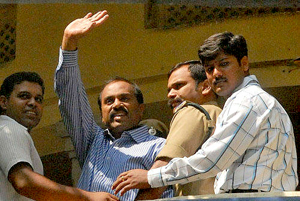
Ex-Karnataka minister Janardhana Reddy used fake permits from AP to carry out illegal mining operations

October 10, 2013

Janardhana_ReddyBangalore, Oct 10: It's rather ironic that former Karnataka tourism minister G Janardhana Reddy is cooling his heels in Hyderabad's Chanchalguda prison, considering that it was close business links with Andhra Pradesh that brought him untold riches.

Reddy, who controlled a three-tier system spanning the entire operation of illegal iron ore mining from excavation to the wharfs of Belekeri port, used fake permits from Andhra Pradesh to carry out his operations.

"Reddy's associates, including Swastik Nagaraj and Kharapudi Mahesh, were delivering envelopes containing fake permits of the Andhra Pradesh department of mines and geology, forest permits, invoices, et al for the transportation of illegal ore to Belekeri port during January 1, 2009 to May 31, 2010," according to a chargesheet filed by the Central Bureau of Investigation (CBI) before the special CBI court here.

The document reveals that racketeers created firms, including Shafia Minerals, Manjunatheswara Minerals, in the names of their employees and relatives and printed invoices in their names which they used to give to trucks carrying illegal material, along with fake permits.

"Such firms were opened at the behest of Janardhana Reddy and his personal assistant Mehfuz Ali Khan and huge amounts were routed through the accounts of the said firms...which finally reached Reddy," the CBI has charged.

Pointing out that Ali Khan, Reddy's main accomplice, was managing excavation, weighing and dispatch of illegally extracted ore from various mines, CBI sources said Khan would threaten mine owners and forcibly take away ore they'd mined.

"He was also threatening officials from the forest department, DMG and police among others when they raised objections against illegal extraction/transportation of ore carried out on behalf of Reddy," the chargesheet says.

Janardhana Reddy was not only illegally mining iron ore but extorted money from others involved in the trade. His aides Khan, Mahesh and Nagaraj were in charge of collecting money from trucks carrying ore mined illegally by others. "They collected about Rs 200 per MT (tonne) from each truck carrying illegally extracted ore for arranging safe passage of the trucks for transit to Belekeri," the chargesheet says.

Comments

Add new comment

  • Coastaldigest.com reserves the right to delete or block any comments.
  • Coastaldigset.com is not responsible for its readers’ comments.
  • Comments that are abusive, incendiary or irrelevant are strictly prohibited.
  • Please use a genuine email ID and provide your name to avoid reject.
Agencies
July 24,2020

Lucknow, Jul 24: The Congress in Uttar Pradesh on Friday protested against what it dubbed as deliberate and systematic deletions of chapters dealing in freedom struggle and the party's role in it from the syllabi of Classes 10 and 12 of the Secondary Education Board.

Congress leader Anugrah Narain Singh said: "The deletions effected in Class 12 syllabus clearly has political overtones. Chapters dealing with the freedom movement and the Congress role in it have been cut out. The BJP has no role of its own in the country's history and, therefore, wants that the new generations should not learn about the Congress contribution as well."

A Congress delegation submitted a memorandum to UP Eduction Board Secretary Divya Kant Shukla to demand restoration of the deleted chapters and topics.

BJP MP Rita Bahuguna Joshi accused the opposition Congress of "turning every occasion into a political opportunity during the pandemic".

"The Congress is unnecessarily making an issue out of this. Only some portions have been deleted from the syllabi due to shortening of the academic session due to the nationwide lockdown. People already know about the Congress and the cut in the syllabi is only temporary. The Congress is unnecessarily trying to create a political controversy," she said.

Prof Yogeshwar Tiwari of the History Department in the Allahabad University dubbed the changes made in the syllabi as "unfortunate". "The history is not of the Congress alone -- it is the history of the nation and every student must know about it," he said.

Comments

Add new comment

  • Coastaldigest.com reserves the right to delete or block any comments.
  • Coastaldigset.com is not responsible for its readers’ comments.
  • Comments that are abusive, incendiary or irrelevant are strictly prohibited.
  • Please use a genuine email ID and provide your name to avoid reject.
News Network
June 18,2020

New Delhi, Jun 18: The border clash between Indian and Chinese soldiers in Ladakh broke the brittle quiet – and also the sense of security for anxious Chinese nationals in India who fear a backlash with anti-Chinese sentiment spiralling in the country.

With the high altitude violent face-off in eastern Ladakh’s Galwan Valley spurring hashtags such as “Boycott China” and “Teach Lesson to China” and leading to street protests, the undercurrents of tension were evident.

Wary of being identified, some said they had been reassured by their friends but were still apprehensive for themselves and their families.

"They (Chinese families) don''t want to speak to the media. They are not going out and are worried about their security and well being. Their families are also worried back home," Mohammed Saqib, secretary general of the India China Economic & Cultural Council, told PTI.

He added that his Chinese friends in India been calling him since they heard news about Monday night’s clashes in which 20 Indian soldiers were killed -- the worst military confrontation in five decades -- and expressed concern over growing anti-China sentiments.

A Chinese national from Beijing working in Gurgaon for a Chinese mobile firm initially refused to talk, saying he did not want to speak to the media and later shared his thoughts only on condition of anonymity.

"There is talk of border standoff and tensions, but we know Indians are very warm people and that is why I have told my family that all is fine here and they should not worry," he said.

Another Chinese national working in Gurgaon said he and his family are feeling the stress amid the spiralling conflict between India and China, but many friends have been reassuring him.

"They (Chinese in India) are under a lot of stress naturally. Such a conflict puts a lot of stress as they could bear the brunt and the same applies to Indians in China," B R Deepak, professor at the Centre for Chinese and South East Asian Studies of the Jawaharlal Nehru University said.

He said it was unfortunate that the border standoff derailed the commemorative programmes aimed at strengthening ties at a time the two countries were gearing to celebrate 70 years of establishment of diplomatic ties.

Experts also feel the border clash is likely to have a significant negative impact on the economic and people to people ties.

There are scores of Chinese in India working in various Chinese firms and also those who are studying in universities like JNU.

About 3,000 Chinese people, doing business or studying in big cities in India, were stranded in India at the start of the COVID-19 crisis, and about half of them returned to China before the lockdown began on March 25.

The Chinese Embassy in New Delhi announced on May 25 that they will arrange for flights to take back students, tourists and businesspersons to five Chinese cities, including Shanghai and Guangzhou.

"It will impact the psychology of the Chinese here. There are 2,000 Chinese firms in various sectors in India which are going to be impacted," Deepak said.

Future investments from the Chinese side could also be impacted, he said.

Moreover, as far as people-to-people contacts are concerned, the number of Chinese students choosing India as a preferred destination is likely to go down, Deepak said.

Alka Acharya, another China expert, said there are two kinds of impacts of such an incident -- short term and medium term.

Usually after the initial nationalistic reaction in the short term things tend to normalise in the medium term, but with such a border clash happening for the first time in decades clearly the resonance would be much more in both India and China, said Acharya, professor at the Centre for East Asian Studies, School of International Studies, in JNU.

“Due to the impact of the COVID-19 crisis on the economy, whether India can take a hardline in terms of economics towards China, is a tricky question,” she said.

In the immediate context, there may be a dip in economic ties with calls for boycott of Chinese goods and services, Acharya said.

The manner in which this crisis is resolved will affect how ties will be affected in the medium term, she said.

The headlines have added to the anxiety.

A group of ex-armymen gathered near the Chinese embassy to protest the killing of 20 Indian Army personnel in Ladakh’s Galwan Valley. And another group of around 10 protesters belonging to the Swadeshi Jagaran Manch protested near the Teen Murti roundabout in Central Delhi.

The anti-China sentiment prevalent among the common public is also finding a reflection in government policy with sources saying the Department of Telecom (DoT) is set to ask state-owned Bharat Sanchar Nigam Ltd (BSNL) not to use Chinese telecom gear in its 4G upgradation.

Trade bodies like CAIT are also calling for a boycott of Chinese products.

And Chinese handset maker Oppo cancelled the livestream launch of its flagship 5G smartphone in the country amid protests.

Monday night’s clashes between the Chinese and Indian troops in Galwan Valley significantly escalated the already volatile border standoff between the two countries.

The casualties on the Chinese side are not yet known. However, government sources, citing an American intelligence report, claimed the total number of soldiers killed and seriously wounded could be 35.


Comments

Add new comment

  • Coastaldigest.com reserves the right to delete or block any comments.
  • Coastaldigset.com is not responsible for its readers’ comments.
  • Comments that are abusive, incendiary or irrelevant are strictly prohibited.
  • Please use a genuine email ID and provide your name to avoid reject.
Agencies
January 4,2020

New Delhi, Jan 4: "Sovereign, socialist, secular, democratic republic" is how India is referred to in the preamble of the Constitution. However, J Nandakumar, a key RSS leader and All India Convenor Prajna Pravah, a Sangh offshoot, wants India to reconsider the inclusion of the word "secular", claiming secularism is a "western, Semitic concept".

In an exclusive interview to news agency, Nandakumar said: "Secularism is a western, Semitic concept. It came into existence in the West. It was actually against Papal dominance."

He argued that India does not need a secular ethos as the nation has moved "way beyond secularism" since it believes in universal acceptance as against the western concept of tolerance.

The RSS functionary on Thursday released a book here named "Hindutva in the changing times". The book launch event was also attended by senior RSS functionary Krishna Gopal.

Nandakumar, who has attacked the Mamata Banerjee government in his book for alleged "Islamisation of West Bengal", told IANS: "We have to see whether we need to put up a board of being secular, or that whether we should prove this through our behaviour, actions and roles."

It is for society to take a call on this, rather than by any political class, on whether the preamble to the Indian Constitution should continue to have the word "secular" in it or not, he added.

In between signing his books and obliging wannabe Hindutva cadres with selfies, Nandakumar said that the very existence of the word "secular" in the preamble was not necessary and how the constitution founders too were against it.

"Baba Saheb Ambedkar, Ladi Krishnaswamy Aiyaar -- all debated against it and said it (secular) wasn't necessary to be included in the preamble. That time it was demanded, discussed and decided not to include it," he said.

Ambedkar's opinion was, however, disregarded when Indira Gandhi "bulldozed" the word "secular", in 1976, said the head of the Prajna Pravah, an umbrella body of several right-wing think-tanks

As Nandakumar prepared to return to his base in Kerala, where, he emphasises, the RSS has its work cut out in the "fight against the Kunnor model", he said that the inclusion of "secular" was done with the intent to damage the concept of Hindutva.

"It was to demolish, destroy the overarching principle of Hindutva that binds us together", he said.

Asked whether the Sangh would pressurise the BJP, which has 303 seats in the Lok Sabha, to omit "secular" from the Constitution preamble, Nandakumar smilingly refused to reply.

Comments

Add new comment

  • Coastaldigest.com reserves the right to delete or block any comments.
  • Coastaldigset.com is not responsible for its readers’ comments.
  • Comments that are abusive, incendiary or irrelevant are strictly prohibited.
  • Please use a genuine email ID and provide your name to avoid reject.