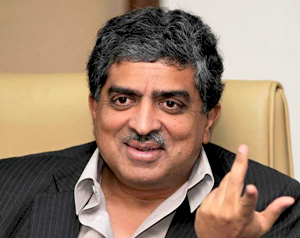
Aadhaar example of using technology to leapfrog: Nilekani

October 16, 2013

Nandan_NilekaniMelbourne, Oct 16: Aadhaar project is an example of using modern technology to leapfrog for future development and transformation of a country, UIDAI chairman Nandan Nilekani has said.

"Aadhaar project is one such example of using modern technology to leapfrog," Nilekani told a packed audience while giving an oration titled 'India's transformation: The role of Information Technology' here last night.

"Aadhaar project is to solve the problem of people who do not have an acknowledgement of their existence by people and the state or lack of acknowledgement of their identity," he said.

Nilekani, an IIT-ian who left Infosys to join the government as the head of the Unique Identification Authority of India (UIDAI), stressed that by giving every Indian person a unique 12-digit number under the Aadhaar project could change their lives, and the nation.

Nelikani said that in India which has the total population of over one billion, only 50 million people had passports which was mere five per cent of total population, around 30 million people paid taxes and over 150 million people had driver licence.

"All these traditional IDs are only available to a very narrow segment of India's population," he said, adding that the need to create an ID system which can then provide an access to other host of public services and utilities was imperative in modern times.

"Not having an identity today can be a huge impediment."

"Government has set up this Aadhaar programme principally for two main reasons. One is to give everybody an ID so that they can participate in so called modern economy and second, is to see that its numerous welfare schemes which goes to individuals are being passed to the genuine beneficiaries."

The project can be used to demonstrate that modern technology can be used for future development and transformation of a country

With Aadhaar in place, the government could deliver entitlement and subsidies in much more efficient and equitable way, he said.

"Aadhaar", or identification number, is merely a platform that can be utilised for other applications that many people are unable to access without formal identification, he said.

Since the commencement of the project 30 million bank accounts have been opened as a direct benefit of the Aadhaar card, and 10 million transactions have been made using the unique ID number.

Comments

Add new comment

  • Coastaldigest.com reserves the right to delete or block any comments.
  • Coastaldigset.com is not responsible for its readers’ comments.
  • Comments that are abusive, incendiary or irrelevant are strictly prohibited.
  • Please use a genuine email ID and provide your name to avoid reject.
Agencies
June 30,2020

United Nations, Jun 30: India accounts for 45.8 million of the world's 142.6 million "missing females" over the past 50 years, a report by the United Nations said on Tuesday, noting that the country along with China form the majority of such women globally.

The State of World Population 2020 report released on Tuesday by the United Nations Population Fund (UNFPA), the world organisation's sexual and reproductive health agency, said that the number of missing women has more than doubled over the past 50 years - from 61 million in 1970 to a cumulative 142.6 million in 2020.

Of this global figure, India accounted for 45.8 million missing females as of 2020 and China accounted for 72.3 million.

Missing females are women missing from the population at given dates due to the cumulative effect of postnatal and prenatal sex selection in the past, the agency said.

Between 2013 and 2017, about 460,000 girls in India were missing' at birth each year. According to one analysis, gender-biased sex selection accounts for about two-thirds of the total missing girls, and post-birth female mortality accounts for about one-third, the report said.

Citing data by experts, it said that China and India together account for about 90-95 per cent of the estimated 1.2 million to 1.5 million missing female births annually worldwide due to gender-biased (prenatal) sex selection.

The two countries also account for the largest number of births each year, it said.

The report cites data by Alkema, Leontine and others, 2014 National, Regional, and Global Sex Ratios of Infant, Child, and under-5 Mortality and Identification of Countries with Outlying Ratios: A Systematic Assessment' from The Lancet Global Health.

According to their analysis, India has the highest rate of excess female deaths, 13.5 per 1,000 female births, which suggests that an estimated one in nine deaths of females below the age of 5 may be attributed to postnatal sex selection.

The report notes that governments have also taken action to address the root causes of sex selection. India and Vietnam have included campaigns that target gender stereotypes to change attitudes and open the door to new norms and behaviours.

They spotlight the importance of daughters and highlight how girls and women have changed society for the better. Campaigns that celebrate women's progress and achievements may resonate more where daughter-only families can be shown to be prospering, it said.

The report said that successful education-related interventions include the provision of cash transfers conditional on school attendance; or support to cover the costs of school fees, books, uniforms and supplies, taking note of successful cash-transfer initiatives such as Apni Beti Apna Dhan' in India.

It said that preference for a male child manifested in sex selection has led to dramatic, long-term shifts in the proportions of women and men in the populations of some countries.

This demographic imbalance will have an inevitable impact on marriage systems. In countries where marriage is nearly universal, many men may need to delay or forego marriage because they will be unable to find a spouse, the report said.

This so-called "marriage squeeze", where prospective grooms outnumber prospective brides, has already been observed in some countries and affects mostly young men from lower economic strata.

"At the same time, the marriage squeeze could result in more child marriages, the report said citing experts.

Some studies suggest that the marriage squeeze will peak in India in 2055. The proportion of men who are still single at the age of 50 is forecast to rise after 2050 in India to 10 per cent, it said.

The UN report said that every year, millions of girls globally are subjected to practices that harm them physically and emotionally, with the full knowledge and consent of their families, friends and communities.

At least 19 harmful practices, ranging from breast ironing to virginity testing, are considered human rights violations, according to the UNFPA report, which focuses on the three most prevalent ones: female genital mutilation, child marriage, and extreme bias against daughters in favour of sons.

Harmful practices against girls cause profound and lasting trauma, robbing them of their right to reach their full potential, says UNFPA Executive Director Dr. Natalia Kanem.

This year, an estimated 4.1 million girls will be subjected to female genital mutilation. Today, 33,000 girls under age 18 will be forced into marriages, usually to much older men and an extreme preference for sons over daughters in some countries has fuelled gender-biased sex selection or extreme neglect that leads to their death as children, resulting in the 140 million missing females.

The report said that ending child marriage and female genital mutilation worldwide is possible within 10 years by scaling up efforts to keep girls in school longer and teach them life skills and to engage men and boys in social change.

Investments totalling USD 3.4 billion a year through 2030 would end these two harmful practices and end the suffering of an estimated 84 million girls, it said.

A recent analysis revealed that if services and programmes remain shuttered for six months due to the COVID-19 pandemic, an additional 13 million girls may be forced into marriage and 2 million more girls may be subjected to female genital mutilation between now and 2030.

The pandemic both makes our job harder and more urgent as so many more girls are now at risk, Kanem said.

Comments

Add new comment

  • Coastaldigest.com reserves the right to delete or block any comments.
  • Coastaldigset.com is not responsible for its readers’ comments.
  • Comments that are abusive, incendiary or irrelevant are strictly prohibited.
  • Please use a genuine email ID and provide your name to avoid reject.
News Network
May 18,2020

New Delhi, May 18: The nationwide tally of COVID-19 cases crossed one lakh on Monday with more people testing positive for the deadly virus in Maharashtra, Gujarat, Tamil Nadu and other states, even as a much-relaxed fourth phase of the lockdown began with restarting of market complexes, autos, taxis and inter-state buses in various parts of the country.

The death toll due to COVID-19 crossed the 3,000-mark too.

With an aim to reboot numerous locked down economic activities, authorities across the country ordered reopening of markets, intra-state transport services and even of barber shops and salons in some states, barring in containment zones.

However, schools, colleges, theatres, malls and religious gatherings are among those that would remain shut down, at least till May 31.

India has been under a lockdown since March 25, which was first supposed to be for 21 days or toll April 14, but was later extended till May 3, then further till May 17 and now for another two weeks till May 31.

However, a number of relaxations have been given in the current fourth phase, while states and union territories have also been granted significant flexibility for deciding the red, orange or green zones in terms of the quantum and severity of the virus spread.

In its morning 8 AM update, the Union Health Ministry put the total number of confirmed COVID-19 cases 96,169 and the death toll at 3,029.

It also said that 36,824 people have so far recovered from the infection.

However, a news agency tally of figures announced by different states and UTs as of 9.40 PM put the number of those having tested positive for the infection at 1,00,096, with a death toll of 3,078 and recoveries at 38,596 across the country.

Maharashtra topped the nationwide tally with over 35,000 confirmed cases and 1,249 deaths, followed by Tamil Nadu with 11,760 confirmed cases and 81 deaths.

Gujarat has also reported 11,746 confirmed cases, while its death toll is higher than that of Tamil Nadu at 694.

Delhi has also crossed the 10,000 mark in terms of the number of confirmed cases, while its death toll has now reached 160.

Gujarat, during the day, recorded 366 new COVID-19 cases and 35 deaths, including 31 from the worst-hit Ahmedabad, taking the state's case count to 11,746 and the number of fatalities to 694, a health department official said.

Maharashtra reported 2,033 new cases, taking the tally to 35,058.

This was the second consecutive day when the state has reported more than 2,000 COVID-19 cases.

Mumbai alone reported 1,185 fresh cases and 23 more deaths, taking the total count of the city to 21,152 and the fatalities to 757.

Of the 1,185 new cases, 300 samples were tested positive in private laboratories between May 12 and 16.

Kerala also saw 29 new cases -- all but one being returnees from overseas and other states --  raising concerns about the state witnessing a possible third wave of the dreaded virus infection.

The state was first to report the virus infection, but at least twice it has already been seen as having flattened the curve of the infection.

The nationwide count of confirmed infections incidentally crossed the crucial one-lakh mark on a day when the fourth phase of the nationwide lockdown kicked in with several relaxations for economic and public activities, barring in containment zones or areas identified as serious hotspots of the virus infection.

Revising its strategy for COVID-19 testing, ICMR also said on Monday that returnees and migrants who show symptoms for influenza-like illness will be tested for coronavirus infection within seven days of ailment and stressed that no emergency clinical procedure, including deliveries, should be delayed for lack of testing.

The Indian Council of Medical Research (ICMR) in its revised strategy for coronavirus testing in India also added that all hospitalised patients who develop symptoms for influenza-like illness (ILI) and frontline workers involved in containment and mitigation of COVID-19 having such signs will also be tested for coronavirus infection through RT-PCR test.

Besides, asymptomatic direct and high-risk contacts of a confirmed case are to be tested once between day five and day 10 of coming in contact, the new document stated.

Asymptomatic contacts of a confirmed case were being tested once between day five and day 14.

The Health Ministry also said that for every one lakh population, there are 7.1 coronavirus cases in India so far as against 60 globally.

It also said the recovery rate of coronavirus cases in India stood at 38.39 per cent.

Besides, India also joined nearly 120 countries at a crucial conference of the World Health Organisation in pushing for an impartial and comprehensive evaluation of the global response into the coronavirus crisis as well as to examine the origin of the deadly infection.

Since the first case of the deadly coronavirus was reported in China last December, more than 47 lakh people have tested for this virus across the world and over 3 lakh have lost their lives.

India is the 11th most affected country, while the US tops the chart with over 14.9 lakh confirmed cases so far.

China's official tally of confirmed infections is less than 84,000, while it has reported more than 4,600 deaths.


Comments

Add new comment

  • Coastaldigest.com reserves the right to delete or block any comments.
  • Coastaldigset.com is not responsible for its readers’ comments.
  • Comments that are abusive, incendiary or irrelevant are strictly prohibited.
  • Please use a genuine email ID and provide your name to avoid reject.
News Network
July 20,2020

New Delhi, Jul 20: Alleging that 2,426 companies have "looted" people's savings to the tune of Rs 1.47 lakh crore from banks, Congress leader Rahul Gandhi has asked if the Prime Minister Narendra Modi led government will conduct a probe into it to punish those guilty.

"2,426 companies looted 1.47 lakh crore rupees of people's savings from banks. Will this government investigate this loot and punish the culprits?" Gandhi said on Twitter, without elaborating.

"Or will it allow them to flee like Nirav and Lalit Modi?" he asked.

Gandhi's attack came after media reports claimed that the All India Bank Employees Association (AIBEA) had released a list of 2,426 borrower accounts that have been categorised as “wilful defaulters” with dues amounting to Rs 1,47,350 crore to the banking system.

Comments

Add new comment

  • Coastaldigest.com reserves the right to delete or block any comments.
  • Coastaldigset.com is not responsible for its readers’ comments.
  • Comments that are abusive, incendiary or irrelevant are strictly prohibited.
  • Please use a genuine email ID and provide your name to avoid reject.