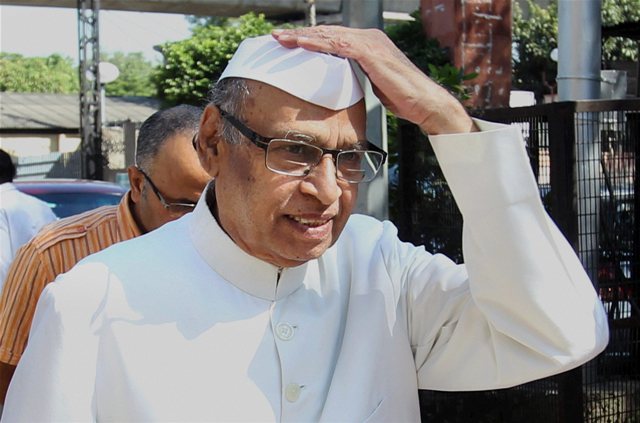
Rashid Masood appeals against conviction in HC

October 22, 2013

New Delhi, Oct 22: A day after his disqualification from the Rajya Sabha, Congress leader Rashid Masood on Tuesday moved the Delhi High Court challenging his conviction and four years sentence in a corruption case.

Rasheed_Masood

Justice Hima Kohli issued notice to the CBI and sought its response by November 13, on Mr. Masood’s appeal.

Mr. Masood’s counsel H.R. Khan Suhail also sought suspension of his client’s jail term on medical grounds.

He said 67-year-old Mr. Masood is acute diabetic and is taking insulin several times a day besides other medicines for his old-age ailments.

He also submitted that the trial was going on against Mr. Masood for past 17 years and he is in custody since October 1, when he was sentenced to four years jail by the trial court.

Justice Kohli admitted his appeal and asked the CBI to respond to Mr. Masood’s plea for suspension of sentence on the next date of hearing, i.e. November 13.

Mr. Masood was held guilty by the trial court of fraudulently nominating undeserving candidates to MBBS seats allotted to Tripura in medical colleges across the country from the central pool as Health Minister in the National Front government of 1990. The court had also imposed a fine of Rs. 60,000 on him.

Mr. Masood is the first MP to lose his seat after the July 10 Supreme Court judgement which had removed the immunity for convicted lawmakers.

Mr. Masood’s conviction and sentencing was the first case after the apex court judgement that struck down a provision in the Representation of the People Act, under which incumbent MPs and MLAs could avoid disqualification till pendency of the appeal against conviction in a higher court.

Comments

Add new comment

  • Coastaldigest.com reserves the right to delete or block any comments.
  • Coastaldigset.com is not responsible for its readers’ comments.
  • Comments that are abusive, incendiary or irrelevant are strictly prohibited.
  • Please use a genuine email ID and provide your name to avoid reject.
News Network
January 28,2020

Jehanabad, Jan 28: Anti-CAA activist Sharjeel Imam, who was on the run after sedition charges were slapped against him for allegedly making inflammatory statements, was arrested from Bihar's Jehanabad district on Tuesday, the state's police chief Gupteshwar Pandey said.

The JNU scholar was wanted by police of several states, including Uttar Pradesh, Assam, Manipur, Arunachal Pradesh and Delhi.

"Sharjeel Imam has been arrested from his native Kako village in Jehanabad," Bihar's director-general of police Gupteshwar Pandey said.

Earlier in the day, Sharjeel Imam’s brother was picked up by police in a fresh attempt to trace the anti-CAA activist.

Police had raided his ancestral home on Sunday as it went hunting for him but Imam eluded the dragnet.

He is likely to be produced in a Bihar court where police will seek his remand for questioning. It is not yet clear whether he will be questioned in Bihar or taken to the national capital.

A graduate in computer science from IIT-Mumbai, Imam had shifted to Delhi to pursue research at the Centre for Historical Studies at Jawaharlal Nehru University.

He was slapped with a sedition case after a video of his purported speech went viral on social media in which he was heard speaking about "cutting off" Assam and the Northeast from the rest of India.

"If five lakh people are organised, we can cut off the Northeast and India permanently. If not, at least for a month or half a month. Throw as much 'mawad' (variously described as pus or rubbish) on rail tracks and roads that it takes the Air Force one month to clear it.

"Cutting off Assam (from India) is our responsibility, only then they (the government) will listen to us. We know the condition of Muslims in Assam....they are being put into detention camps," he was shown in the video as saying.

Meanwhile, reacting to Imam's arrest, Bihar chief minister Nitish Kumar said people have the right to protest but nobody can talk about the country's disintegration.

Kumar told reporters that police must have acted in accordance with law in arresting Imam and now the courts will take appropriate action.

Comments

Add new comment

  • Coastaldigest.com reserves the right to delete or block any comments.
  • Coastaldigset.com is not responsible for its readers’ comments.
  • Comments that are abusive, incendiary or irrelevant are strictly prohibited.
  • Please use a genuine email ID and provide your name to avoid reject.
Agencies
January 15,2020

Mumbai, Jan 15: Michael Debabrata Patra took over as Deputy Governor of the Reserve Bank of India (RBI) on Wednesday.

He was an Executive Director of India's central bank before being elevated to the post of Deputy Governor.

An RBI release said that as Deputy Governor, Patra will look after Monetary Policy Department including Forecasting and Modelling Unit (MPD/MU), Financial Markets Operations Department (FMOD), Financial Markets Regulation Department.

He will also look after Market Intelligence (FMRD/MI), International Department (Intl. D), Department of Economic and Policy Research (DEPR), Department of Statistics and Information Management (including Data and Information Management Unit) (DSIM/DIMU), Corporate Strategy and Budget Department (CSBD) and Financial Stability Unit.

Patra, a career central banker since 1985, has worked in various positions in the Reserve Bank of India.

As Executive Director, he was a member of the Monetary Policy Committee (MPC) of RBI, which is invested with the responsibility of monetary policy decision making in India. He will continue to be an ex-officio member of the MPC as Deputy Governor.

Prior to this, he was Principal Adviser of the Monetary Policy Department, Reserve Bank of India between July 2012 and October 2014.

He has worked in the International Monetary Fund (IMF) as Senior Adviser to Executive Director (India) during December 2008 to June 2012, when he actively engaged in the work of the IMF's Executive Board through the period of the global financial crisis and the ongoing Euro area sovereign debt crisis.

The release said that his book "The Global Economic Crisis through an Indian Looking Glass" vividly captures this experience.

He has also published papers in the areas of inflation, monetary policy, international trade and finance, including exchange rates and the balance of payments.

A fellow of the Harvard University where he undertook post-doctoral research in the area of financial stability, he has a PhD in Economics from the Indian Institute of Technology, Mumbai.

He will hold the post for three years or until further orders. The post fell vacant after Viral Acharya resigned on July 23 last year.

Comments

Add new comment

  • Coastaldigest.com reserves the right to delete or block any comments.
  • Coastaldigset.com is not responsible for its readers’ comments.
  • Comments that are abusive, incendiary or irrelevant are strictly prohibited.
  • Please use a genuine email ID and provide your name to avoid reject.
News Network
February 21,2020

Washington, Feb 21: Days ahead of his India visit, US President Donald Trump on Thursday said the two countries could make a "tremendous" trade deal.

"We're going to India, and we may make a tremendous deal there," Trump said in his commencement address at the Hope for Prisoners Graduation Ceremony in Las Vegas.

Trump, accompanied by First Lady Melania Trump, is scheduled to travel to Ahmedabad, Agra and New Delhi on February 24 and 25.

Ahead of the visit, there have been talks about India and the United States agreeing on a trade package as a precursor to a major trade deal.

During his commencement address, Trump indicated that the talks on this might slowdown if he did not get a good deal.

"Maybe we'll slow down. We'll do it after the election. I think that could happen too. So, we'll see what happens," he said.

"But we're only making deals if they're good deals because we're putting America first. Whether people like it or not, we're putting America first," Trump said.

Bilateral India-US trade in goods and services is about three per cent of the US' world trade.

In a recent report, the Congressional Research Service (CRS) said the trading relationship is more consequential for India -- in 2018 the United States was its second largest goods export market (16.0 per cent share) after the European Union (EU, 17.8 per cent), and third largest goods import supplier (6.3 per cent) after China (14.6 per cent) and the EU 28 (10.2 per cent).

"The Trump Administration takes issue with the US trade deficit with India, and has criticised India for a range of 'unfair' trading practices," the CRS said.

"Indian Prime Minister Modi's first term fell short of many observers' expectations, as India did not move forward with anticipated market opening reforms, and instead increased tariffs and trade restrictions," it said.

"Modi's strong electoral mandate may embolden the Indian government to press ahead with its reform agenda with greater vigour. Slowing economic growth in India raises concerns about its business environment," CRS said.

As per a fact sheet issued by the Council on Foreign Relations (CFR), trade in goods and services between the two countries from 1999 to 2018 surged from $16 billion to $142 billion.

India is now the United States' eighth-largest trading partner in goods and services and is among the world's largest economies.

India's trade with the United States now resembles, in terms of volume, the US' trade with South Korea ($167 billion in 2018) or France ($129 billion), said Alyssa Ayres from CFR.

"The United States for two years now has set out in stone pretty clearly the things that they wanted to see to try to get an agreement, and it's basically then on India's doorstep on whether they want to take those steps," Rick Rossow, Wadhwani Chair in US-India Policy Studies at the Center for Strategic and International Studies think-tank told reporters during a conference call.

"The list of US asks has been pretty static all throughout. Not to say that any of these things are easy for India to do, but the United States to my knowledge didn't change the goalposts just because we now consider India to be a middle-income country. The things that we wanted to see happen to get this trade agreement have been pretty static all throughout, no matter how difficult they are," he said in response to a question.


Comments

Add new comment

  • Coastaldigest.com reserves the right to delete or block any comments.
  • Coastaldigset.com is not responsible for its readers’ comments.
  • Comments that are abusive, incendiary or irrelevant are strictly prohibited.
  • Please use a genuine email ID and provide your name to avoid reject.