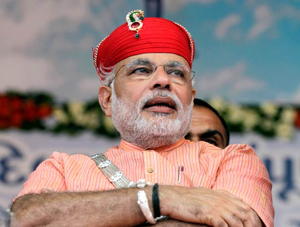
Modi cannot lead India effectively: NYT Editorial Board

October 27, 2013

NYT_Editorial_BoardNew York, Oct 27: Narendra Modi, BJP's prime ministerial candidate, cannot hope to lead India effectively if he inspires "fear" and "antipathy" among many of its people, the New York Times has commented in an unusual move.

"Mr Modi has shown no ability to work with opposition parties or tolerate dissent," the Editorial Board of the New York Times said in a stinging editorial on the 63-year-old BJP leader.

The editorial said that Modi has already "alienated" BJP's political partners when Janata Dal (United), an important regional party broke off its 17-year alliance with the "party because it found Mr Modi unacceptable."

India was a country with multiple religions and "Mr Modi cannot hope to lead it effectively if he inspires fear and antipathy among many of its people," it said while recalling that nearly 1,000 people died in the 2002 riots in Gujarat.

The editorial, published yesterday, also questioned Modi's economic track record in Gujarat.

The "economic record in Gujarat is not entirely admirable, either," it said.

"Muslims in Gujarat, for instance, are much more likely to be poor than Muslims in India as a whole, even though the state has a lower poverty rate than the country," the editorial said.

"His rise to power is deeply troubling to many Indians, especially the country's 138 million Muslims and its many other minorities," said the 19-member Editorial Board, headed by India-born Andrew Rosenthal, the editorial page editor of The New York Times.

Comments

Add new comment

  • Coastaldigest.com reserves the right to delete or block any comments.
  • Coastaldigset.com is not responsible for its readers’ comments.
  • Comments that are abusive, incendiary or irrelevant are strictly prohibited.
  • Please use a genuine email ID and provide your name to avoid reject.
News Network
March 2,2020

New Delhi, Mar 2: Senior Congress leader P Chidambaram on Sunday hit out at Union Home Minister Amit Shah for his comments that no one from the minority community will be affected by amended Citizenship Act and asked why then was the community excluded from the law in the first place.

Addressing a rally in Kolkata, Shah assured people of the minority community that not a single person will lose citizenship due to the Citizenship (Amendment) Act (CAA).

"The Home Minister says that no minority will be affected by CAA. If this is correct, they should tell the country who would be affected by CAA. If no one would be affected by CAA, as it currently is, why did the government pass the law?

"If the CAA aims to benefit all minorities (no one will be affected, says HM), then why are Muslims excluded from the list of minorities mentioned in the Act?," the former finance minister asked in a post on Twitter.

At his first public rally in Kolkata after the 2019 general elections, Shah said, "The opposition is terrorising the minorities. I assure every person from the minority community that the CAA only provides citizenship, does not take it away. It won't affect your citizenship."

"The opposition parties are spreading canards that refugees will have to show papers but this is absolutely false. You don't have to show any paper. We will not stop until all refugees are granted citizenship," Shah told the public.

Comments

Add new comment

  • Coastaldigest.com reserves the right to delete or block any comments.
  • Coastaldigset.com is not responsible for its readers’ comments.
  • Comments that are abusive, incendiary or irrelevant are strictly prohibited.
  • Please use a genuine email ID and provide your name to avoid reject.
News Network
May 17,2020

New Delhi, May 17: Spelling out the government’s fourth tranche of initiatives towards achieving Prime Minister Narendra Modi’s vision of ‘Atmanirbhar Bharat’, Union Finance Minister Nirmala Sitharaman on Saturday announced significant structural reforms in eight sectors of the economy — coal, minerals, defense production, aviation, power distribution in Union territories, space and atomic energy.

Addressing her fourth and the second-last press conference, Sitharaman said crucial sectors such as coal production and exploration, defence production and space would see an increased participation from private entities.

Coal sector:

In the realm of coal exploration, the government has decided to liberalise the entry norms for private entities, which would mean that any interested party could bid for a coal block and sell it in the open market. The minister said that the government would do away with all the eligibility conditions at the time of bidding for a coal block, except requiring an “upfront payment with a ceiling.”

Nearly 50 coal blocks would be offered to private players immediately, revealed Sitharaman.

She further said that Rs 50,000 crore would be spent by Centre in creating ‘coal evacuation’ infrastructure, which would expedite the transport of mined product to the destination.

Defence sector:

In defence production, Sitharaman revealed that the government would raise the foreign direct investment (FDI) limit in the sector from current 49 per cent to 74 per cent. Further, the government would also work towards corporatising the ordnance factory boards. “Corporatising doesn’t amount to privatization,” added Sitharaman.

In a bid to boost indigenous production of defence products and gave an impetus to Make in India, Sitharaman said that the government was in a process of notifying a list of weapons/platforms for an import ban with year-wise timelines.

These decisions would also help in reducing huge import bills, the finance minister said.

Privatisation of electricity:

In another announcement that could have an effect on electricity charges in the union territories, Union Finance Minister Nirmala Sitharaman announced on Saturday that power departments and utilities in all the centrally administered territories would be privatised.

Sitharaman said that the proposed move would lead to better service to consumers and improvement in operational and financial efficiency in distribution.

The finance minister said that decision was guided by 'sub-optimal' utilisation of performance of power distribution and supply'.

She said that the move to that effect would provide a model for emulation by other utilities across the country, in what could be an indicator of what's in the pipeline for utilities in other states as well.

Sitharaman said that the privation reform was in line with the tariff policy reforms and would help in enhancing consumer rights, promote industry and improve the overall sustainability of the sector.

Space sector:

Sitharaman also announced the opening up of the space exploration sector for private players. Till date, the government-run Indian Space Research Organisation (ISRO) has held a monopoly on all activities concerning space exploration and satellite launches.

The Indian private sector will be a co-traveller in India's space sector journey, said Sitharaman, while announcing a series of structural reforms in eight crucial areas of the economy. The Union Finance Minister was addressing her fourth press conference in as many days, as a follow-up towards realising Prime Minister Narendra Modi's vision of 'atmanirbhar Bharat', which was spelled out in his video address on May 12.

Sitharaman said that the reforms in the space sector will provide a level-playing field for private companies in satellite launches and space-based services.

She said that the private sector would be allowed to use ISRO facilities and other assets to improve their capacities. Stating that the government would provide predictable policy and regulatory environment to private players, Sitharaman also disclosed that future projects for planetary exploration and outer space travel among others would be opened up for private entities.


Comments

Add new comment

  • Coastaldigest.com reserves the right to delete or block any comments.
  • Coastaldigset.com is not responsible for its readers’ comments.
  • Comments that are abusive, incendiary or irrelevant are strictly prohibited.
  • Please use a genuine email ID and provide your name to avoid reject.
News Network
January 22,2020

New Delhi, Jan 22: Delhi Chief Minister Arvind Kejriwal has assets worth Rs 3.4 crore, an increase of Rs 1.3 crore from 2015, according to his election affidavit.

Kejriwal's total assets were worth Rs 2.1 crore in 2015.

The cash and fixed deposits of Kejriwal's wife Sunita Kejriwal increased from Rs 15 lakh in 2015 to Rs 57 lakh in 2020.

A party functionary said Rs 32 lakh worth cash and fixed deposits have been received by Sunita Kejriwal as voluntary retirement benefits while the rest are savings.

The cash and fixed deposits of the chief minister increased from Rs 2.26 lakh in 2015 to Rs 9.65 lakh in 2020.

There was no change in the value of immovable assets of his wife while Kejriwal's immovable assets' worth increased from Rs 92 lakh to Rs 177 lakh.

The party functionaries said increase in Kejriwal's immovable assets' worth is due to the increased valuation of the same asset as in 2015.

Comments

Add new comment

  • Coastaldigest.com reserves the right to delete or block any comments.
  • Coastaldigset.com is not responsible for its readers’ comments.
  • Comments that are abusive, incendiary or irrelevant are strictly prohibited.
  • Please use a genuine email ID and provide your name to avoid reject.