



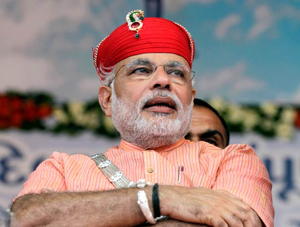
Modi cannot lead India effectively: NYT Editorial Board

October 27, 2013

NYT_Editorial_BoardNew York, Oct 27: Narendra Modi, BJP's prime ministerial candidate, cannot hope to lead India effectively if he inspires "fear" and "antipathy" among many of its people, the New York Times has commented in an unusual move.

"Mr Modi has shown no ability to work with opposition parties or tolerate dissent," the Editorial Board of the New York Times said in a stinging editorial on the 63-year-old BJP leader.

The editorial said that Modi has already "alienated" BJP's political partners when Janata Dal (United), an important regional party broke off its 17-year alliance with the "party because it found Mr Modi unacceptable."

India was a country with multiple religions and "Mr Modi cannot hope to lead it effectively if he inspires fear and antipathy among many of its people," it said while recalling that nearly 1,000 people died in the 2002 riots in Gujarat.

The editorial, published yesterday, also questioned Modi's economic track record in Gujarat.

The "economic record in Gujarat is not entirely admirable, either," it said.

"Muslims in Gujarat, for instance, are much more likely to be poor than Muslims in India as a whole, even though the state has a lower poverty rate than the country," the editorial said.

"His rise to power is deeply troubling to many Indians, especially the country's 138 million Muslims and its many other minorities," said the 19-member Editorial Board, headed by India-born Andrew Rosenthal, the editorial page editor of The New York Times.

Comments

Add new comment

  • Coastaldigest.com reserves the right to delete or block any comments.
  • Coastaldigset.com is not responsible for its readers’ comments.
  • Comments that are abusive, incendiary or irrelevant are strictly prohibited.
  • Please use a genuine email ID and provide your name to avoid reject.
News Network
July 25,2020

New Delhi, Jul 25: The Indian Air Force (IAF) has made key appointments in its different commands all across the country including formations that look after operations along the borders with China and Pakistan.

Air Marshal Vivek Ram Chaudhari has been appointed as the head of the Delhi-based Western Air Command (WAC) which looks after both the crucial borders, with China in Ladakh and all along Pakistan from Ladakh up to Bikaner in Rajasthan.

Chaudhari would be assuming charge of the new office on August 1, replacing Air Marshal B Suresh who is superannuating after a brief tenure of nine months there.

In the Shillong-based Eastern Command, incumbent Air Marshal RD Mathur would be moving to the Bangalore-based Training Command on October 1, he will be replaced by Air Marshal Amit Dev. The Eastern Command looks after the entire Northeastern region including the border with China from Sikkim to Arunachal Pradesh.

As per the new appointments issued on July 24, Kargil war gallantry awardee Air Marshal Dilip Kumar Patnaik would be taking over as the Senior Air Staff Officer (SASO) at the Prayagraj-based Central Air Command.

On October 1, the Air Force would also get a new in-charge of personnel in Air Marshal RJ Duckworth who is presently the SASO in the WAC.

Air Marshal Vikram Singh would be the next SASO of the WAC. Air Marshal J Chalapati-- the officer who had briefed the Supreme Court on the Rafale issue last year, would be the SASO of the Trivandrum-based Southern Air Command.

Comments

Add new comment

  • Coastaldigest.com reserves the right to delete or block any comments.
  • Coastaldigset.com is not responsible for its readers’ comments.
  • Comments that are abusive, incendiary or irrelevant are strictly prohibited.
  • Please use a genuine email ID and provide your name to avoid reject.
News Network
May 28,2020

New Delhi, May 28: The Crime Branch of the Delhi Police will file 12 chargesheets against 536 Tablighi Jamaat members from three countries, officials said on Thursday.

Till now, the police has already filed chargesheets against 374 foreigners from 32 countries.

The officials said the charges against the Tablighi Jamaat members pertain to violation of visa rules, government guidelines regarding the Epidemic Disease Act and acting negligently in a way that was likely to spread infection of disease dangerous to life.

The Tablighi Jamaat, a religious organisation in Nizamuddin in South Delhi, had allegedly organised a congregation in March in violation of mass gatherings.

The Tablighi Jamaat’s Nizamuddin Markaz (centre) had become a coroavirus hotspot in the national capital.

Comments

Add new comment

  • Coastaldigest.com reserves the right to delete or block any comments.
  • Coastaldigset.com is not responsible for its readers’ comments.
  • Comments that are abusive, incendiary or irrelevant are strictly prohibited.
  • Please use a genuine email ID and provide your name to avoid reject.
News Network
June 20,2020

New Delhi, Jun 20: Diesel price on Saturday hit a record high after rates were hiked by 61 paise per litre while petrol price was up 51 paise, taking the cumulative increase in rates in two weeks to Rs 8.28 and Rs 7.62 respectively.

Petrol price in Delhi was hiked to Rs 78.88 per litre from Rs 78.37, while diesel rates were increased to Rs 77.67 a litre from Rs 77.06, according to a price notification of state oil marketing companies.

Rates have been increased across the country and vary from state to state depending on the incidence of local sales tax or VAT.

The 14th daily increase in rates since oil companies on June 7 restarted revising prices in line with costs after ending an 82-day hiatus in rate revision, has taken diesel prices to new high. Petrol price too is at a two-year high.

Prior to the current rally, diesel rate had touched a peak of Rs 75.69 per litre in Delhi on October 16, 2018.

The highest-ever petrol price was on October 4, 2018, when rates soared to Rs 84 a litre in Delhi.

When rates had peaked in October 2018, the government had cut excise duty on petrol and diesel by Rs 1.50 per litre each. State-owned oil companies were asked to absorb another Re 1 a litre to help cut retail rates by Rs 2.50 a litre.

Oil companies had quickly recouped the Re 1 and the government in July 2019 raised excise duty by Rs 2 a litre.

The 82-day freeze in rates this year was imposed in mid-March soon after the government hiked excise duty on petrol and diesel to shore up additional finances.

The government on March 14 hiked excise duty on petrol and diesel by Rs 3 per litre each and then again on May 5 by a record Rs 10 per litre in case of petrol and Rs 13 on diesel. The two hikes gave the government Rs 2 lakh crore in additional tax revenues.

Oil PSUs Indian Oil Corp (IOC), Bharat Petroleum Corp Ltd (BPCL) and Hindustan Petroleum Corp Ltd (HPCL), instead of passing on the excise duty hikes to customers, adjusted them against the fall in retail rates that was warranted because of a decline in international oil prices to two-decade lows.

International oil prices have since rebounded and oil firms are now adjusting retail rates in line with them.

In 14 hikes, petrol price has gone up by Rs 7.62 per litre and diesel by Rs 8.28 a litre.

Comments

Add new comment

  • Coastaldigest.com reserves the right to delete or block any comments.
  • Coastaldigset.com is not responsible for its readers’ comments.
  • Comments that are abusive, incendiary or irrelevant are strictly prohibited.
  • Please use a genuine email ID and provide your name to avoid reject.