



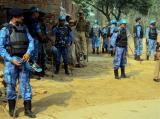
Centre seeks report on Muzaffarnagar situation

November 1, 2013
Lucknow, Nov 1: Tension continued to prevail in Uttar Pradesh's Muzaffarnagar district which was rocked by fresh communal violence on Wednesday that claimed four lives even as the state police chief admitted that the violence would not have occurred had the police been `more alert'.

muz_copy

UP police chief Devraj Nagar, who rushed to Muzaffarnagar on Wednesday after the killings, said security personnel should have ensured that such incidents did not occur. “Certainly there seem to be lapses on the part of the police,” Nagar told reporters at Muzaffarnagar.

He, however, said all measures would be adopted to make sure that peace prevailed in the district. Action would be taken against the police officials if any laxity on their part was established. Nagar held a meeting with the civil and police officials and reviewed the situation, according to sources here.

The Union Home Ministry has sought a report from the UP government on the fresh bout of violence in Muzaffarnagar with the United Progressive Alliance government becoming more vigilant to ensure that the situation does slip out of hand as it did last time owing to negligence on the part of the Akhilesh Yadav government. “We are keeping a watch on the situation. We have also sought a report from UP,” Home Minister Sushilkumar Shinde told reporters in New Delhi.

When asked about the need to send additional paramilitary forces to contain communal violence in the western UP, Shinde said the Centre was ready to offer all help to maintain law and order. “A decision on sending additional paramilitary forces will be taken after we receive the report,” he clarified.

Police officials said in Lucknow on Thursday that security personnel had been deployed in strength both in the urban and rural areas in the district to maintain law and order and senior officials were camping in the district to monitor the situation.

Security forces have been patrolling the troubled areas, the officials said, adding that the situation was tense but under control.

Three persons were killed in clashes between two communities at Mohammedpur village in the district on Wednesday. One person was killed in Fugana area when he was fired upon by unidentified assailants. Eight persons have been arrested in this connection, while cases have been registered against 15 people, the officials said.

An irate mob later laid siege to the Bhouri Kalan police station demanding the immediate arrest of the culprits and the cops had a tough time taking possession of the bodies to send them for postmortem.

Uttar Pradesh Chief Minister Akhilesh Yadav said that there appeared to be a deliberate attempt to foment trouble in Muzaffarnagar and added that stern action would be taken against the trouble-mongers. Samajwadi Party supremo Mulayam Singh Yadav also warned that the government would “crush anti-social” elements.

At least 62 people were killed and over 100 injured in the communal riots that had rocked Muzaffarnagar, Meerut and Shamli districts in the region last month. Thousands of people, who had fled from their homes following the violence, are still living in the relief camps.

Comments

Add new comment

  • Coastaldigest.com reserves the right to delete or block any comments.
  • Coastaldigset.com is not responsible for its readers’ comments.
  • Comments that are abusive, incendiary or irrelevant are strictly prohibited.
  • Please use a genuine email ID and provide your name to avoid reject.
News Network
June 9,2020

Jun 9: Prime Minister Narendra Modi wants all 1.3 billion Indians to be “vocal for local” — meaning, to not just use domestically made products but also to promote them. As an overseas citizen living in Hong Kong, I’m doing my bit by very vocally demanding Indian mangoes on every trip to the grocery. But half the summer is gone, and not a single slice so far.

My loss is due to India’s COVID-19 lockdown, which has severely pinched logistics, a perennial challenge in the huge, infrastructure-starved country. But more worrying than the disruption is the fruity political response to it. Rather than being a wake-up call for fixing supply chains, the pandemic seems to be putting India on an isolationist course. Why?

Granted that the liberal view that trade is good and autarky bad isn’t exactly fashionable anywhere right now. What makes India’s lurch troublesome is that the pace and direction of economic nationalism may be set by domestic business interests. The Indian liberals, many of whom are Western-trained academics, authors and — at least until a few years ago — policy makers, want a more competitive economy. They will be powerless to prevent the slide.

Modi’s call for a self-reliant India has been echoed by Home Minister Amit Shah, the cabinet’s unofficial No. 2, in a television interview. If Indians don’t buy foreign-made goods, the economy will see a jump, he said. The strategy — although it’s too nebulous yet to call it that — has a geopolitical element. A military standoff with China is under way, apparently triggered by India’s completion of a road and bridge near the common border in the tense Himalayan region of Ladakh. It’s very expensive to fight even a limited war there. With India’s economy flattened by COVID, New Delhi may be looking for ways to restore the status quo and send Beijing a signal.

Economic boycotts, such as Chinese consumers’ rejection of Japanese goods over territorial disputes in the East China Sea, are well understood as statecraft. In these times, it’s not even necessary to name an enemy. An undercurrent of popular anger against China, the source of both the virus and India’s biggest bilateral trade deficit, is supposed to do the job. But is it ever that easy?

A hastily introduced policy to stock only local goods in police and paramilitary canteens became a farcical exercise after the list of banned items ended up including products by the local units of Colgate-Palmolive Co., Nestle SA, and Unilever NV, which have had significant Indian operations for between 60 and 90 years, as well as Dabur India Ltd., a New Delhi-based maker of Ayurveda brands. The since-withdrawn list demonstrates the practical difficulty of bureaucrats trying to find things in a globalized world that are 100% indigenous.

Free-trade champions fret that the prime minister, whom they saw as being on their side six years ago, is acting against their advice to dismantle statist controls on land, labor and capital to help make the country more competitive. Engage with the world more, not less, they caution. But Modi also has to satisfy the Rashtriya Swayamsevak Sangh, the umbrella Hindu organisation that gets him votes. Its backbone of small traders, builders and businessmen — the RSS admits only men — was losing patience with the anemic economy even before the pandemic. Now, they’re in deep trouble, because India’s broken financial system won’t deliver even state-guaranteed loans to them.

The U.S.-China tensions — over trade, intellectual property, COVID responsibility and Hong Kong’s autonomy — offer a perfect backdrop. A dire domestic economy and trouble at the border provide the foreground. Big business will dial economic nationalism up and down to hit a trifecta of goals: Block competition from the People's Republic; make Western rivals fall in line and do joint ventures; and tap deep overseas capital markets. The first goal is being achieved with newly placed restrictions on investment from any country that shares a land border with India. The second aim is to be realized by corporate lobbying to influence India's whimsical economic policies. As for the third objective, with the regulatory environment becoming tougher for U.S.-listed Chinese companies like Alibaba Group Holding Ltd., an opportunity may open up for Indian firms.

All this may bring India Shenzhen-style enclaves of manufacturing and trade, but it will concentrate economic power in fewer hands, something that worries liberals. They’re moved by the suffering of India’s low-wage workers, who have borne the brunt of the COVID shutdown. But when their vision of a more just society and fairer income distribution prompts them to make common cause with the ideological Left, they’re quickly repelled by the Marxist voodoo that all cash, property, bonds and real estate held by citizens or within the nation “must be treated as national resources available during this crisis.” Who will invest in a country that does that instead of just printing money?

At the same time, when liberals look to the business class, they see a sudden swelling of support for ideas like a universal basic income. They wonder if this isn’t a ploy by industry to outsource part of the cost of labor to the taxpayer. Slogans like Modi’s vocal-for-local stir the pot and thicken the confusion. The value-conscious Indian consumer couldn’t give two hoots for calls to buy Indian, but large firms will know how to exploit economic nationalism. One day soon, I’ll get my mangoes — from them.

Comments

Add new comment

  • Coastaldigest.com reserves the right to delete or block any comments.
  • Coastaldigset.com is not responsible for its readers’ comments.
  • Comments that are abusive, incendiary or irrelevant are strictly prohibited.
  • Please use a genuine email ID and provide your name to avoid reject.
News Network
March 28,2020

Mumbai, Mar 28: Doctors in Mumbai have not been spared by the novel coronavirus. As Mumbai’s count for Covid-19 cases went up to 58, an octogenarian doctor from Saifee Hospital passed away on Friday. He was a suspected case of coronavirus with co-morbid conditions like diabetes and had a pacemaker implanted, said a press release from the state health department.

As per a statement from Saifee Hospital, he underwent a CT scan at Saifee Hospital and was diagnosed positive for Covid-19. The surgeon was transferred to the special isolation facility at PD Hinduja Hospital where he subsequently died. Behranwala’s close relatives had come down from England and were under quarantine.

In a statement, Saifee Hospital, where Behranwala underwent CT scan, said, "All containment and surveillance measures have been implemented to ensure the safety of our staff patients and visitors. Saifee Hospital reiterates that the Hospital is fully operational," said Dr Vernon Desa, Director (Medical governance and clinical compliance) Saifee Hospital.

In the second case, an Andheri-based doctor, aged 53, has been tested positive along with his 43-year-old wife and 20-year-old daughter. The family doesn’t have a travel history. The doctor reportedly came in contact with the virus through a patient. MCGM has taken samples of 60 patients who came in contact with the doctor. "As of now, no patient from his contact has tested positive," Assistant Commissioner, Vishwas Mote.

Another doctor who practiced at Vakola tested positive after he came in contact with a person having travel history to Italy, later tested positive. The doctor has been admitted at Raheja hospital and samples of his close contact have been taken.

Comments

Add new comment

  • Coastaldigest.com reserves the right to delete or block any comments.
  • Coastaldigset.com is not responsible for its readers’ comments.
  • Comments that are abusive, incendiary or irrelevant are strictly prohibited.
  • Please use a genuine email ID and provide your name to avoid reject.
News Network
February 24,2020

Ahmedabad, Feb 24: US President Donald Trump and his wife Melania on Monday tried their hands at spinning the 'charkha' (spinning wheel) at the Sabarmati Ashram here.

Accompanied by PM Narendra Modi, the US president and his wife went around the Ashram, before resuming the roadshow from the airport to the Motera stadium. "To my great friend Prime Minister Naredra Modi, thank you for this wonderful visit," Trump wrote in the Ashram visitors' book.

The US President was briefed about Gandhiji and the importance of charkha as a symbol of self reliance. Trump reached Ahmedabad at 11.37 am for the first leg of his India visit.

US President Donald Trump arrived in Ahmedabad on Monday for the first leg of his India trip. The Air Force One plane carrying Trump and his wife Melania landed at the Sardar Vallabhbhai Patel international airport here at 11.37 am, officials said. It was scheduled to land at 11.40 am.

Trump, who is also accompanied by daughter Ivanka, son-in-law Jared Kushner and top brass of his administration, will get a taste of India's cultural melange during his high- optics Gujarat itinerary, after the bonhomie between the two leaders at the 'Howdy, Modi!' event in Houston last year.

Comments

Add new comment

  • Coastaldigest.com reserves the right to delete or block any comments.
  • Coastaldigset.com is not responsible for its readers’ comments.
  • Comments that are abusive, incendiary or irrelevant are strictly prohibited.
  • Please use a genuine email ID and provide your name to avoid reject.