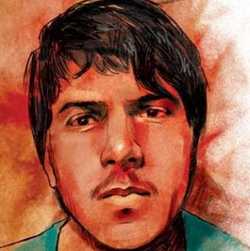
Kasab tried to end life in jail, sought forgiveness for 26/11: R R Patil

November 2, 2013

KasabMumbai, Nov 2: Ajmal Kasab, the sole surviving gunman from 26/11 who was hanged in November last year, had made an unsuccessful attempt to end his life inside the Arthur Road Jail premises and, in his last moments, asked for forgiveness for his 'mistake', home minister R R Patil has revealed in an interview in the Diwali annual of Maharashtra Times, a TOI group publication.

"Kasab had quirky habits. He would pace up and down the (prison) cell at night and sleep all day. He had a foul mouth, would turn violent without reason and would show his judo skills to security personnel guarding him. He once tore the bed sheet given to him and tried to strangulate himself with the help of the torn cloth. Our security personnel, however, snatched the cloth," Patil said.

The home minister said jail authorities had told him that the terrorist, who was said to have shown no remorse earlier, shuddered when he was being escorted to the gallows at Pune's Yerawada jail.

"His walk turned wobbly and he begged for mercy. His last words sought forgiveness. He said, 'Mujhe maaf kar do, meri chhoti behene hain, dobara aisi galti nahin hogi (forgive me, I have kid sisters back home, I will never repeat the mistake),' Patil said.

This is the first time Patil has given out details about Kasab's stay in prison and his subsequent hanging on November 21, 2012.

On Kasab's foul temper, Patil said, "He would charge angrily at the staff, so while entering his cell, police officials had to wear a 'supporter' as a safety measure."

Saying that the operation of executing the death sentence was called " Operation X" by the home department, Patil pointed out that in order to maintain the secrecy of the operation, police officers who escorted Kasab from Mumbai to the Pune jail were asked to deposit their cell phones with jail authorities in Mumbai.

Comments

Add new comment

  • Coastaldigest.com reserves the right to delete or block any comments.
  • Coastaldigset.com is not responsible for its readers’ comments.
  • Comments that are abusive, incendiary or irrelevant are strictly prohibited.
  • Please use a genuine email ID and provide your name to avoid reject.
News Network
January 24,2020

New Delhi, Jan 24: Although India's Ujjwala programme encouraged adoption of liquefied petroleum gas (LPG) for cooking among the poor, households availing the scheme have not shifted away from using highly polluting fuels like firewood, a study reveals.

The researchers, including those from the University of British Columbia (UBC) in Canada, found that additional incentives to encourage regular use of cooking gas are necessary for a complete transition to clean cooking fuel among poor rural households.

They noted that about 2.9 billion people across Asia, Africa, and Latin America burn solid fuels like firewood to meet their cooking energy needs.

This has significant negative implications for public health, the environment, and societal development, according to the researchers.

Through the Pradhan Mantri Ujjwala Yojana (PMUY), India has provided capital cost subsidies to poor women to adopt a clean-burning cooking fuel or LPG.

The researchers explained that within the first 40 months of the scheme, more than 80 million households obtained LPG stoves.

However, the full benefits of LPG adoption depend on near complete replacement of polluting fuels with LPG, according to a research-based policy brief published in the journal Nature Energy.

The scientists said this cannot be assumed solely on the basis of LPG presence in the household.

"Our research shows that Ujjwala was able to attract new consumers rapidly, but those consumers did not start using LPG on a regular basis," Abhishek Kar, a postdoc at Columbia University in the US, told PTI.

The study analysed LPG sales data for over 25,000 consumers, including PMUY beneficiaries, as well as general rural LPG consumers in Koppal district of Karnataka.

The scientists employed data covering all LPG purchases of PMUY beneficiaries through their first year in the programme.

They also assessed the general rural population's purchases during their first five years as consumers to assess the effect of experience on use.

The findings estimate that an average rural family needs to purchase five 14.2 kilogramme-cylinders annually to meet half of their cooking needs.

However, the study said just seven per cent of PMUY beneficiaries in Koppal purchased five or more cylinders annually, suggesting that the beneficiaries seldom use LPG.

The general (nonPMUY) consumers in this region use on average two times more LPG cylinders than PMUY beneficiaries, the researchers noted.

Yet, only 45 per cent of nonPMUY consumers use five or more cylinders per year -- even after several years of experience with LPG, they said.

The team assessed price and seasonal factors affecting LPG use among the general population over a three-year period.

It found that LPG consumers are sensitive to price and seasonality -- LPG cylinder refill rates are lower in the summer when agricultural activity is limited, and cash is scarce.

"There was no scheme incentives to promote use, except general LPG subsidies which is available to all, including the urban middle class," said Kar, who was a Ph.D. scholar at UBC when the research was published.

"If there is no additional income, what cost would a poor family on an already tight budget cut to pay for an extra expense on a regular basis.

"Ujjwala has started the scheme of 5 kg-cylinder in response, but the impact of that on LPG sales is still publicly unknown," he said.

These findings, the researchers noted, suggest the need for additional measures to promote regular LPG use for all rural populations.

Although the finding come from a single district in Southern India, it may also apply to other areas with similar socio-economic conditions, they said.

A more expansive evaluation of PMUY would help design targeted incentives to transform infrequent users to regular users, according to the researchers.


Comments

Add new comment

  • Coastaldigest.com reserves the right to delete or block any comments.
  • Coastaldigset.com is not responsible for its readers’ comments.
  • Comments that are abusive, incendiary or irrelevant are strictly prohibited.
  • Please use a genuine email ID and provide your name to avoid reject.
News Network
July 10,2020

New Delhi, July 10: Hours before gangster Vikas Dubey was killed in an alleged police encounter on Friday, a plea was filed in the Supreme Court demanding urgent listing for action into his "possible killing" by Uttar Pradesh Police.

Advocate Ghanshyam Upadhyay had apprehended in his plea that there is a high possibility that Dubey will also be killed in a 'fake' encounter after his arrest from Ujjain in Madhya Pradesh a day ago.

Upadhyay claimed that the UP Police was expected to "concoct the same story of encounter" for Dubey like it did when four of his associates were killed after the 2 July incident.

Dubey was the primary accused in the killing of eight policemen in Kanpur on July 2. He was arrested from Ujjain on Thursday. He was killed in a police encounter, when he allegedly tried to flee on Friday morning.

"During the hunt for Dubey and co-accused, five of his accused aides were arrested/caught and then killed by the police in the name of encounter...Thus, there is every possibility that even Dubey shall be killed by Uttar Pradesh Police like other co-accused once his custody is obtained," Upadhyay feared.

He submitted that the killing of the accused by the police in the name of encounter no matter how heinous the crime was "against the rule of law and serious violation of human rights and nothing sort of Talibanisation of the country". Upadhyay sought hearing in the matter on Friday itself, citing extreme urgency.

Comments

Add new comment

  • Coastaldigest.com reserves the right to delete or block any comments.
  • Coastaldigset.com is not responsible for its readers’ comments.
  • Comments that are abusive, incendiary or irrelevant are strictly prohibited.
  • Please use a genuine email ID and provide your name to avoid reject.
Agencies
March 9,2020

Mumbai, Mar 9: The mayhem in domestic stock markets deepened with the BSE Sensex falling over 2,400 points and the Nifty50 trading below 10,400 points.

The plunge in the domestic indices was in line with the global markets on persistent fears of economic impact of the coronavirus epidemic.

Stocks of Reliance Industries registered the biggest fall in over 10 years as it fell to Rs 1,094.95 per share. At 1.34 p.m., it was trading at Rs 1,100, lower by Rs 170.05 or 13.39 per cent from its previous close. The stock fell most since October 2008.

The benchmark index of BSE Sensex was trading at 35,232.67 points, lower by 2,343.95 points or 6.24% from the previous close of 37,576.62 points. 

It had opened at the intra-day high of 36,950.20 and has so far touched a low of 35,109.18.

The Nifty50 on the National Stock Exchange was trading at 10,314.25 points, lower by 675.20 points or 6.14% from the previous close. 

It was a sell-off across sectors, led by financial, metal, energy and IT stocks - which weighed on the markets.

Further, crude oil prices also slumped around 30% on Monday as Organization of Petroleum Exporting Countries (OEPC) failed to agree on an output cut deal, eventually causing Saudi Arabia to cut its prices as it is likely to increase its production. Saudi Arabia's stance has already raised concerns of an all-out price war.

Brent crude futures are currently trading around $34 per barrel.

On Saturday, Saudi Arabia announced massive discounts to its official selling prices for April, and the nation is reportedly preparing to increase its production above the 10 million barrel per day mark, according to reports.

As per analysts, the oil market witnessed the worst price fall on Monday since the 1991 Gulf War.

Comments

Add new comment

  • Coastaldigest.com reserves the right to delete or block any comments.
  • Coastaldigset.com is not responsible for its readers’ comments.
  • Comments that are abusive, incendiary or irrelevant are strictly prohibited.
  • Please use a genuine email ID and provide your name to avoid reject.