



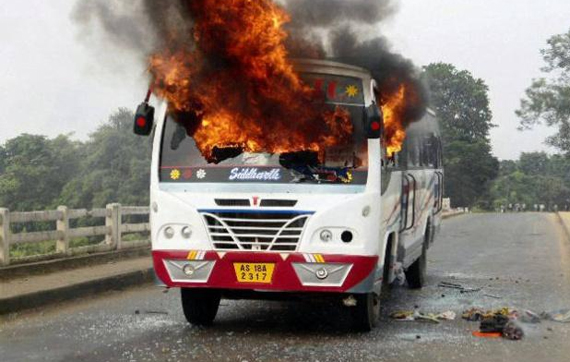
Seven killed in militant attack in Assam

November 4, 2013

Assam_attack

Guwahati, Nov 4: The death toll in the attack by suspected Garo National Liberation Army insurgents on a group of people gambling on the occasion of Diwali in Assam’s Goalpara district has risen to seven.

“Six persons were brought to the Gauhati Medical College Hospital and one of them was brought dead. One seriously injured has been operated upon and another four injured are undergoing treatment”, Hospital Superintendent R Talukdar said on Monday.

Three other wounded were admitted to Goalpara Civil Hospital and one in a private hospital, officials said.

Armed with automatic weapons, suspected Garo National Liberation Army insurgents from across Meghalaya had on Sunday night indiscriminately opened fire upon a group of people gambling on the occasion of Diwali at remote Gendamari, under Aagia Police Station.

Six persons were gunned down on the spot, while 10 others were seriously injured with one of them succumbing to his wounds on way to hospital, they said.

Those killed on the spot were identified as Bholanath Rabha, Amarendra Rabha, Jayanta Rabha, Puran Rabha, Kalpanath Rabha and Lulu Rabha.

Security measures have been intensified in the district following the incident, the sources added.

Goalpara district has been witnessing violence since October 20 last with protests against the upcoming Rabha Hasong Autonomous Council elections between November 13 and 25 demanding exclusion of non Rabha areas from the Council.

Sources ruled out that last night’s incident was connected with the Council elections.

Proscribed GNLA based in the Garo hills jungles of Meghalaya, adjacent to Goalpara district, has been fighting for a separate state since 2009 indulging in killings, attacks on security forces and civilians, blasts, kidnappings and extortions.

Comments

Add new comment

  • Coastaldigest.com reserves the right to delete or block any comments.
  • Coastaldigset.com is not responsible for its readers’ comments.
  • Comments that are abusive, incendiary or irrelevant are strictly prohibited.
  • Please use a genuine email ID and provide your name to avoid reject.
News Network
January 18,2020

New Delhi, Jan 18: Lieutenant Governor (LG) Anil Baijal has granted the power of detaining authority to the Delhi Police Commissioner under the National Security Act (NSA), according to a notification. The NSA allows preventive detention of an individual for months if the authorities feel that the individual is a threat to the national security, and law and order, sources said.

In exercise of the powers conferred by sub-section (3) of section 3, read with clause (c) of Section 2 of the National Security Act, 1980, the Lt Governor is pleased to direct that during the period January 19 to April 18, the Delhi Police Commissioner may also exercise the powers of detaining authority under sub-section (2) of the section 3 of the aforesaid Act, the notification stated.

The notification has been issued on January 10 following the approval of the LG.

It comes at a time when the national capital has been witnessing a number of protests against the Citizenship Amendment Act (CAA) and the National Register of Citizens (NRC).

However, the Delhi Police said it is a routine order that has been issued in every quarter and has nothing to do with the current situation.

Comments

Add new comment

  • Coastaldigest.com reserves the right to delete or block any comments.
  • Coastaldigset.com is not responsible for its readers’ comments.
  • Comments that are abusive, incendiary or irrelevant are strictly prohibited.
  • Please use a genuine email ID and provide your name to avoid reject.
News Network
June 8,2020

New Delhi, Jun 8: Delhi Chief Minister Arvind Kejriwal has announced that malls, restaurants and religious places in the national capital would open from Monday after more than two months since the coronavirus-induced lockdown was imposed, but banquet halls and hotels would remain closed.

At an online briefing on Sunday, Kejriwal said hotels and banquet halls might be converted into hospitals in the coming days to treat coronavirus patients and therefore, they would remain shut.

"Malls, restaurants and religious places will be opening from Monday in Delhi in accordance with the Centre's guidelines," he said.

The city government will comply with the instructions of the Centre and its experts like maintaining social distancing and wearing of masks at these places, Kejriwal said.

"In view of the rising number of coronavirus cases, we might attach hotels and banquet halls with hospitals and convert them into hospitals. Hotels and banquet halls will not be opened for now," he said.

The Centre had said on May 30 that "Unlock-1" would be initiated in the country from June 8 and the lockdown would be relaxed to a great extent.

The Delhi government also issued an order allowing opening of restaurants, shopping malls and places of worship except in the COVID-19 containment zones, "subject to compliance with the Standard Operating Procedure (SOP) issued by the Ministry of Health and Family Welfare".

Kejriwal urged the elderly people, who are at a higher risk of contracting the coronavirus, to confine themselves in a room and not to interact with even the family members in order to protect themselves.

Delhi has so far registered over 27,500 coronavirus cases, including 761 deaths.

Comments

Add new comment

  • Coastaldigest.com reserves the right to delete or block any comments.
  • Coastaldigset.com is not responsible for its readers’ comments.
  • Comments that are abusive, incendiary or irrelevant are strictly prohibited.
  • Please use a genuine email ID and provide your name to avoid reject.
News Network
June 13,2020

New Delhi, Jun 13: About 56 per cent of children were found to have no access to smartphones which have emerged as essential tools for online learning during the coronavirus-induced lockdown, according to a new study that surveyed 42,831 students at various school levels.

The study ''Scenario amidst COVID 19 - Onground Situations and Possible Solutions'' was conducted by child rights NGO Smile Foundation with an aim of analysing the access to technology.

The findings of the study showed that 43.99 per cent of surveyed children have access to smartphones and another 43.99 per cent of students have access to basic phones while 12.02 per cent do not have access to either smartphones or basic phones.

A total of 56.01 per cent children were found to have no access to smartphones, the study said.

"Concerning television, it was noted that while 68.99 per cent have access to TV, a major chunk of 31.01 per cent does not. Hence suggesting that using smartphone interventions for enhancing learning outcomes is not the only solution," it said.

At the primary level of education (class 1 to 5) 19,576 children were surveyed while at upper primary level (class 6 to 8) 12,277 children were surveyed. At secondary level of education (class 9 to 10) 5,537 children were surveyed and at higher secondary level (class 11 to 12) 3,216 children were surveyed.

The survey based on which the study was conducted used two approaches - over the telephone wherein the NGO reached out to the children whose database it already had -- students enrolled in various education centres of the NGO -- and second was through community mobilization wherein community workers went door to door to get answers.

The survey was conducted in 23 states, including Delhi, Gujarat, Maharashtra, Karnataka, Tamil Nadu, West Bengal, Andhra Pradesh, Telangana, Uttar Pradesh, Haryana, over a period of 12 days from April 16 to April 28.

The lockdown induced by the COVID-19 pandemic in March prompted schools and colleges to move to the virtual world for teaching and learning activities. However, many experts say the digital divide in the country may turn online classes into an operational nightmare.

As per official statistics, there are over 35 crore students in the country. However, it is not clear as to how many of them have access to digital devices and Internet.

Santanu Mishra, co-founder and executive trustee, Smile Foundation, said the findings clearly show that the digital divide is a real challenge, and multiple approaches need to be implemented to cater to all across the nation.

"As an exercise before we start any programme, we do a baseline study to understand the on-ground challenges so that our programmes can bring in real work and real change. With the onset of the pandemic, following indefinite school closures, it is more important than ever to understand the situation and how can we ensure that children are given quality education. Through this, we understand that customized modules need to be built in accordance with the channel of communication," he said.  

Comments

Add new comment

  • Coastaldigest.com reserves the right to delete or block any comments.
  • Coastaldigset.com is not responsible for its readers’ comments.
  • Comments that are abusive, incendiary or irrelevant are strictly prohibited.
  • Please use a genuine email ID and provide your name to avoid reject.