



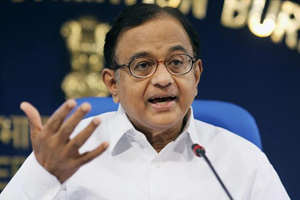
Narendra Modi not propagating BJP but RSS ideology, says P Chidambaram

November 6, 2013

Narendra_ModiNew Delhi, Nov 6: Finance Minister P Chidambaram has warned that Gujarat Chief Ministerial and Bharatiya Janata Party Prime Ministerial candidate Nadrendra Modi is propagating dangerous RSS ideology. In an interview with Network18, Chidambaram claimed the BJP is making the mistake of making Narendra Modi larger than the party.

"The BJP has projected a person larger than the party, they'll realise this in the near future. It's a grave mistake. You can't project a person larger than party in a Parliamentary democracy. The RSS is fully behind this projection. So what is being propagated by Mr Modi today is not BJP's ideology but it is the ideology of the RSS. He is the chosen one of the RSS," Chidambaram said.

When asked whether the Congress has lost the plot, Chidambaram said, "This party has a long history of serving the people. We may have made mistakes but who hasn't made mistakes. Over 100 years, this party has made mistakes. Even during freedom struggle mistakes were made, but they were corrected. I don't think you can wish away Congress in near future."

Earlier on Monday, Jammu and Kashmir Chief Minister Omar Abdullah had admitted that the influence of Modi cannot be ignored. He, however, said that the term 'Modi wave' is an exaggeration. "As far as Modi wave is concerned, it is a bit of an exaggeration also. It would be wrong on our part to deny any influence of Modi in the election, but I wouldn't go as far as saying there is a wave," Omar said.

Narendra Modi is the most preferred choice for the post of Prime Minister in the four Assembly election-bound states - Madhya Pradesh, Chhattisgarh, Delhi and Rajasthan. A total of 35 per cent voters want him as the PM as against 17 per cent support for Congress Vive President Rahul Gandhi as the next prime minister.

When a CNN-IBN, The Week and CSDS survey in Madhya Pradesh, Chhattisgarh, Delhi and Rajasthan asked an open ended question without giving choices Narendra Modi came first. Rahul Gandhi came second followed by his mother and the Congress President Sonia Gandhi with 5 per cent popular support.

The incumbent Prime Minister Manmohan Singh equaled Sonia Gandhi with the same 5 per cent support. While the BSP supremo Mayawati got 2 per cent votes, the BJP patriarch LK Advani, who reluctantly forfeited his claim in favour of Modi, got just 1 per cent support.

The survey was conducted in only four Assembly elections bound states of Delhi, Rajasthan, Madhya Pradesh and Chhattisgarh. The fifth poll bound state of Mizoram was not included in the survey. Modi is way ahead of Rahul Gandhi in Delhi and Rajasthan, but the gap narrows in Madhya Pradesh and Chhattisgarh. In the national capital of Delhi, Modi has got 42 per cent support as against Rahul Gandhi's 15 per cent. In Rajasthan, Modi has got 40 per cent of the support as against Rahul Gandhi's 19 per cent.

When compared to CNN-IBN's July tracker, Modi's popularity has gone up in all four states. He was not named by the BJP as its PM nominee in July but he was the most preferred choice of 26 per cent in July. Rahul Gandhi's popularity has also seen a marginal increase of 2 per cent between July and October - 2013. In July, our sample size was also smaller in all four states.

Comments

Add new comment

  • Coastaldigest.com reserves the right to delete or block any comments.
  • Coastaldigset.com is not responsible for its readers’ comments.
  • Comments that are abusive, incendiary or irrelevant are strictly prohibited.
  • Please use a genuine email ID and provide your name to avoid reject.
News Network
March 5,2020

Lucknow, Mar 5: Uttar Pradesh chief minister Yogi Adityanath said last night that the role of teachers would come under the scanner when "anti-India" slogans are raised at universities and institutions of higher education.

"When anti-India slogans are raised at institutions of higher education, we should be prepared to ask why this type of distortion occurrs among our students?" he said at a programme organised by the Basic Shiksha Parishad in Lucknow.

"We begin our work with pledge for the country's unity and integrity and today slogans are raised for the division of the nation. In such a situation, questions are raised over the role of teachers who are considered equal to god in society," he said.

"Who all are involved in this sin and chaos? Governments can provide resources, but the one who has given them basic education, who has given them secondary education and who has led them to that place, all of them should evaluate their actions today," the chief minister said.

Speaking about the condition of education in the state when his government came to power three years ago, he said there was an atmosphere of chaos and anarchy in the state and the condition of basic education was very bad.

"The worst problem was that of proxy teachers. Our government started the process of prohibiting proxy teachers in the first phase," he said.

Adityanath said that a teacher is not just a government servant, but the fate of the nation. He said teachers should learn from Chanakya.

Had Chanakya confined himself to Nalanda University, he would not have been able to make India a superpower of the world during that period. Teachers will have to prepare themselves according to the challenges and need of society, he added.

Comments

Add new comment

  • Coastaldigest.com reserves the right to delete or block any comments.
  • Coastaldigset.com is not responsible for its readers’ comments.
  • Comments that are abusive, incendiary or irrelevant are strictly prohibited.
  • Please use a genuine email ID and provide your name to avoid reject.
coastaldigest.com web desk
June 16,2020

New Delhi, Jun 16: Despite Prime Minister Narendra Modi led government’s attempt to downplay the border dispute with China, matters have heated up unprecedentedly along the Line of Actual Control (LAC)- the effective Sino-India border in Eastern Ladakh. 

The country has lost three precious lives – an army officer and two soldiers. The last time blood was spilled on the LAC, before the latest episode, was 45 years ago when the Chinese ambushed an Assam Rifles patrol in Tulung La.

India had lost four soldiers on October 20, 1975 in Tulung La, the last time bullets were fired on the India-China border though both the countries witnessed bitter stand-offs later at Sumdorong Chu valley in 1987, Depsang in 2013, Chumar in 2014 and Doklam in 2017.

Between 1962 and 1975, the biggest clash between India and China took place in Nathu La pass in 1967 when reports suggest that around 80 Indian soldiers were killed and many more Chinese personnel.

While three soldiers, including a Commanding Officer, were killed in the latest episode in Galwan Valley, the government describes it as a "violent clash" and does not mention opening fire.

New Delhi described the locality where the 1975 incident took place as "well within" its territory only to be rebuffed by Beijing as "sheer reversal of black and white and confusion of right and wrong".

The Ministry of External Affairs had then said that the Chinese had crossed the LAC and ambushed the soldiers while Beijing claimed the Indians entered their territory and did not return despite warnings.

The Indian government maintained that the ambush on the Assam Rifles' patrol in 1975 took place "500 metres south of Tulung" on the border between India and Tibet and "therefore in Indian territory". It said Chinese soldiers "penetrating" Indian territory implied a "change in China's position" on the border question but the Chinese denied this and blamed India for the incident.

The US diplomatic cables quoted an Indian military intelligence officer saying that the Chinese had erected stone walls on the Indian side of Tulung La and from these positions fired several hundred rounds at the Indian patrol.

"Four of the Indians had gone into a leading position while two (the ones who escaped) remained behind. The senior military intelligence officer emphasised that the soldiers on the Indian patrol were from the area and had patrolled that same region many times before," the cable said.

One of the US cables showed that former US Secretary of State and National Security Adviser Henry Kissinger sought details of the October 1975 clash "without approaching the host governments on actual location of October 20 incident". He also wanted to know what ground rules were followed regarding the proximity of LAC by border patrols.

A cable sent from the US mission in India on November 4, 1975 appeared to have doubts about the Chinese account saying it was "highly defensive".

"Given the unsettled situation on the sub-continent, particularly in Bangladesh, both Chinese and Indian authorities have authorised stepped up patrols along the disputed border. The clash may well have ensued when two such patrols unexpectedly encountered each other," it said.

Another cable from China on the same day quoted another October 1974 cable, which spoke about Chinese officials being concerned for long that "some hotheaded person on the PRC (People's Republic of China) might provoke an incident that could lead to renewed Sino-Indian hostilities. It went on to say that this clash suggested that "such concerns and apprehensions are not unwarranted".

According to the United States diplomatic cables, Chinese Foreign Ministry on November 3, 1975 disputed the statement of the MEA spokesperson, who said the incident took place inside Indian territory.

The Chinese had said "sheer reversal of black and white and confusion of right and wrong". In its version of the 1975 incident, they said Indian troops crossed the LAC at 1:30 PM at Tulung Pass on the Eastern Sector and "intruded" into their territory when personnel at the Civilian Checkpost at Chuna in Tibet warned them to withdraw.

Ignoring this, they claimed, Indian soldiers made "continual provocation and even opened fire at the Chinese civilian checkpost personnel, posing a grave threat to the life of the latter. The Chinese civilian checkpost personnel were obliged to fire back in self defence."

The Chinese Foreign Ministry spokesperson had also said they told the Indian side that they could collect the bodies "anytime" and on October 28, collected the bodies, weapons and ammunition and "signed a receipt".

The US cables from the then USSR suggested that the official media carried reports from Delhi on the October 1975 incident and they cited only Indian accounts of the incident "ridiculing alleged Chinese claims that the Indians crossed the line and opened fire first".

Comments

Add new comment

  • Coastaldigest.com reserves the right to delete or block any comments.
  • Coastaldigset.com is not responsible for its readers’ comments.
  • Comments that are abusive, incendiary or irrelevant are strictly prohibited.
  • Please use a genuine email ID and provide your name to avoid reject.
News Network
July 16,2020

New Delhi, Jul 16: The Rajasthan High Court will hear Thursday afternoon a petition filed on behalf of the Sachin Pilot camp, challenging a move to disqualify dissident MLAs from the state assembly.

The plea against the disqualification notices sent from the Speaker’s office to Pilot and 18 other Congress MLAs will be heard by Justice Satish Chandra Sharma.

The 19 MLAs were sent notices Tuesday by the Speaker after the Congress complained that the MLAs had defied a party whip to attend two Congress Legislature Party meetings. 

Comments

Add new comment

  • Coastaldigest.com reserves the right to delete or block any comments.
  • Coastaldigset.com is not responsible for its readers’ comments.
  • Comments that are abusive, incendiary or irrelevant are strictly prohibited.
  • Please use a genuine email ID and provide your name to avoid reject.