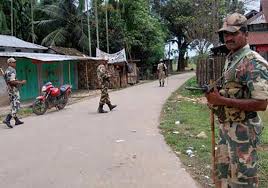
Three militants killed in Manipur

November 13, 2013

ManipurImphal, Nov 13: Three militants of Zeliangrong United Front have been killed in an exchange of fire with National Socialist Council of Nagaland-Isac and Muivah (NSCN-IM) cadre in interior Tamenglong district of Manipur, police said on Wednesday.

Heavily-armed militants attacked a group of NSCN-IM cadre at Bhalok village late last evening by exploding powerful bombs, followed by a fierce exchange of fire between them in the hill village, the police said.

During the encounter that lasted over five hours, three militants of ZUF were killed and some other militants belonging to the NSNCN-IM were injured, the police said.

Official reports from Tamenglong district said an injured NSCN-IM cadre was taken to Imphal while some others who sustained minor injuries left the spot.

Two small arms were recovered from the spot, the reports said.

Both ZUF and NSCN-IM militants have been attacking each other in the past few years over the control of Tamenglong district bordering Nagaland, the reports said.

Comments

Add new comment

  • Coastaldigest.com reserves the right to delete or block any comments.
  • Coastaldigset.com is not responsible for its readers’ comments.
  • Comments that are abusive, incendiary or irrelevant are strictly prohibited.
  • Please use a genuine email ID and provide your name to avoid reject.
News Network
May 15,2020

New Delhi, May 15: A group of doctors from the AIIMS, Raipur has recommended restrictions on the use of mobile phones in healthcare institutions amid the COVID-19 pandemic, warning that such devices can be a potential carrier of the virus and lead to infection among healthcare workers.

In a commentary published in the BMJ Global Health journal, the doctors stated that mobile phone surfaces are a peculiar 'high-risk' surface, which can directly come in contact with the face or mouth, even if hands are properly washed and one study indicates that some healthcare workers use phones every 15 minutes to two hours.

Though there have been many significant guidelines from various health organisations like the WHO and CDC focusing on prevention and control of disease, the commentary highlighted "there is no mention of or focus on mobile phones in these guidelines, including the WHO infection control and prevention guidelines, which recommends the use of handwashing".

In healthcare facilities, phones are used to communicate with other health care workers, look up recent medical guidelines, research drug interactions, understand adverse events and side effects, conduct telemedicine appointments and track patients among others, stated the document.

The document has been authored by Dr Vineet Kumar Pathak, Dr Sunil Kumar Panigrahi, Dr M Mohan Kumar, Dr Utsav Raj and Dr Karpaga Priya P from the Department of Community and Family Medicine.

"In their tendency to come in direct contact with the face, nose or eyes in healthcare settings, mobile phones are perhaps second only to masks, caps or goggles," the authors said.

"However, they are neither disposable nor washable like these other three, thus warranting disinfection. Mobile phones can effectively negate hand hygiene... There is growing evidence that mobile phones are a potential vector for pathogenic organisms," they said.

It is the need of the hour to address proper hygienic use of mobile phones in healthcare settings. In a study in India, almost 100 per cent of health workers of a tertiary care hospital used mobile phones in the hospital, but only 10 per cent of them had at any time wiped their mobile phones clean, the commentary published on April 22 said.

"The safest thing to do is to consider your phone as an extension of your hand, so remember you are transferring whatever is on your phone to your hand," Dr Pathak said.

Amidst the ongoing pandemic, two biggest mobile phone companies have uploaded their user support guidelines, saying that 70 pc isopropyl alcohol or Clorox Disinfecting Wipes can be used to gently wipe the exterior surface of phones in switched-off mode.

However, in doing so, the use of bleach or entry of moisture through any of the openings must be avoided, and any harsh chemical may damage the oleophobic screen, leading to damage in the touch screen sensitivity of the phone, the article stated.

Mobile phones are one of the most highly touched surfaces according to the Centers for Disease Control and Prevention (CDC), along with counters, tabletops, doorknobs, bathroom fixtures, toilets, keyboards, tablets and bedside tables.

The doctors recommended restriction on mobile phone usage in healthcare settings like hospital wards, ICUs and operation theatres, while advocating the use of headphones to prevent contact with the face while talking.

There should be no sharing of mobile phones, headphones or headsets of any kind. In addition, where available, the use of interdepartmental intercom facility may be promoted.

"Although hand hygiene and mobile phone use by a person are not mutually exclusive, it is high time to acknowledge the potential role of mobile phones in disease transmission cascade and to take evidence-based appropriate actions. This is especially important, given the ongoing COVID-19 pandemic," the authors said.

They said it is necessary for government agencies and the WHO to generate public awareness and to formulate suitable information, education and communication material on mobile phone hygiene, especially in healthcare settings.

AIIMS, New Delhi, Resident Doctors' Association (RDA) General Secretary, Dr Srinivas Rajkumar T said even outside health care settings, people should pay special attention to the usage of mobile phones as they carry them to all places.

"Phone and computer peripherals like keyboard, mouse, etc. should be covered with transparent plastic covers which can be cleaned without interfering with their function. Cleaning hands by soap or alcohol-based hand sanitizer before and after contact with phone and between contact with other surfaces can decrease the risk of potential transmission.

"Using a handsfree headset, dedicated operator/assistant per ward handling the communication via common line in hospitals while on duty can enable communication without compromising safety," Dr Srinivas said.


Comments

Add new comment

  • Coastaldigest.com reserves the right to delete or block any comments.
  • Coastaldigset.com is not responsible for its readers’ comments.
  • Comments that are abusive, incendiary or irrelevant are strictly prohibited.
  • Please use a genuine email ID and provide your name to avoid reject.
Agencies
May 17,2020

New Delhi, May 17: With the highest-ever spike of close to 5,000 cases in the past 24 hours, the COVID-19 count in India has crossed 90,000 on Sunday.

With an increase of 4,987 COVID-19 cases being reported in the last 24 hours, the count has reached 90,927, according to the Union Ministry of Health and Family Welfare.

The total number of active cases in the country stands at 53,946 today, while 2,872 deaths have been recorded due to the infection so far, with one patient having migrated. 120 deaths were reported in the last 24 hours.

However, on the positive side, close to 4,000 patients have also been cured and discharged in the past 24 hours, taking the tally of cured patients to 34,108.

With 30,706 confirmed cases, Maharashtra remains the worst-affected by the infection in the country.

It is followed by Gujarat and Tamil Nadu, with 10,988 and 10,585 cases, respectively.
The national capital, with 9,333 cases, is also one of the regions which is badly affected by the infection.

Comments

Add new comment

  • Coastaldigest.com reserves the right to delete or block any comments.
  • Coastaldigset.com is not responsible for its readers’ comments.
  • Comments that are abusive, incendiary or irrelevant are strictly prohibited.
  • Please use a genuine email ID and provide your name to avoid reject.
News Network
April 5,2020

New Delhi, April 5: People were seen buying diyas and candles across the country to light them at 9 p.m. on Sunday to fight the "darkness of coronavirus" as requested by Prime Minister Narendra Modi.

Although the country is under a lockdown and all the shops barring those selling essential items are shut, but a number of makeshift roadside shops and carts have cropped up selling earthen lamps or diyas at various places.

The earthen lamps, along with other 'puja samgari', are also sold near various temples. Those shops also opened on Sunday.

Gatherings at the temples and other religious places too are barred.
Those who did not find diyas in their localities contended with candles available at the local general stores.

Prime Minister Narendra Modi had on April 3 appealed to people in a televised address to light diyas and candles on April 5 at 9 pm to fight the darkness spread by coronavirus pandemic.

"Friends, amidst the darkness spread by the corona pandemic, we must continuously progress towards light and hope. We must defeat the deep darkness of the crisis by spreading the glory of light in all four directions," said the Prime Minister in a video message.

"And that is why, this Sunday, on April 5, we must all together, challenge the darkness spread by the corona crisis, introducing it to the power of light. On this day, we must awaken the superpower of 130 crore Indians. We must take the super resolve of 130 crore Indians to even greater heights," Modi said.

He asked the people to turn off all the lights in their homes and stand at doors or balconies and light candles or diyas, torches or mobile flashlights for 9 minutes on April 5.

"In that light, in that lustre, in that radiance, let us resolve in our minds that we are not alone, that no one is alone! 130 crore Indians are committed, through a common resolve!" he said.
PM Modi's call to light diyas, torches or mobile flashlights amid the lockdown has proved to be a boon for shopkeepers selling diyas and candles.

"Sales of diyas have increased to 50 per cent and we also got orders. It has happened because of Modi ji's appeal. We are with him in this," Ram Ravi Kumar, a shopkeeper in Delhi told news agency.

Vikas Kumar, a resident of Patna, said, "I have bought 50 diyas for today. PM Modi had said that people have to light the diyas for nine minutes after switching off light at home."
Modi has asked citizens to not assemble anywhere while participating in this programme and emphasised on the importance of social distancing to prevent coronavirus spread.

Meanwhile, the number of positive cases of coronavirus in the country continues to surge. As per the Ministry of Health and Family Welfare, the total number of confirmed COVID-19 cases is 3,374 with 79 deaths.

Comments

Add new comment

  • Coastaldigest.com reserves the right to delete or block any comments.
  • Coastaldigset.com is not responsible for its readers’ comments.
  • Comments that are abusive, incendiary or irrelevant are strictly prohibited.
  • Please use a genuine email ID and provide your name to avoid reject.