



Meticulous planning key to success in Olympics, says Poonia

July 8, 2012

poonia


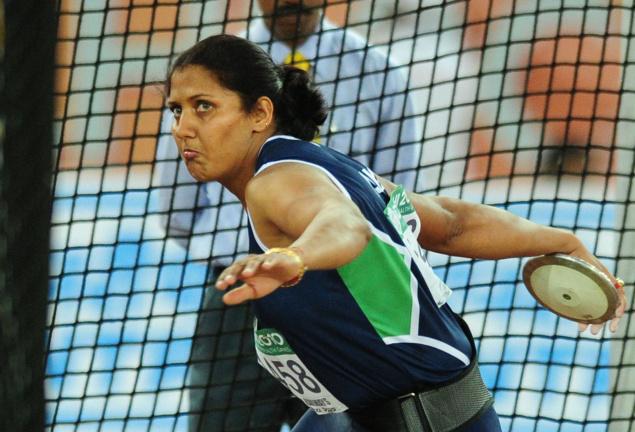
New Delhi, July 8: Winning a medal in the Olympics is a "lifetime dream" for India's top discus thrower Krishna Poonia, who is "meticulously planning" her every move to brighten her podium chances in London.

Fully aware of the pressure associated with a mega-event like the Olympics, Poonia plans to enter the Games Village as late as possible to keep herself in the training mode ahead of the actual competition, which will be held on August 3 and 4 at the showpiece London Olympic Stadium.

"Winning an Olympic medal is a lifetime dream. It's all about meticulous planning, from where to train to when to enter the Games Village," she told PTI from Basildon, at the outskirts of London, where she is training.

"I am here in London much before any Indian athlete but I don't want to be in the Olympics mode yet because of the pressure associated with it. I want to enter the Village as late as possible," she added.

Poonia hurled the discus to her personal best of 64.76m at Wailuku, Hawai Islands in the United States in May but she knows in order to win a medal in London she will have to clear the 65m mark.

"I have to cross 65m if I have to have any chance of a medal in London. I am doing above 65m during training," said the 30-year-old Commonwealth Games gold medallist.


"There is pressure in all international competitions and an athlete will have to cope with it. But Olympics is something different, it's the biggest stage. So pressure will be huge and I want to avoid pressure as much as possible," said Poonia, who in 2010 became the first Indian woman to win an individual gold in Commonwealth Games in New Delhi.


Poonia is at number nine in the latest IAAF rankings, and all eight ahead of her have above 65m personal best, with Germany's Nadine Muller leading the chart with 68.89m.


The Indian said she had been undergoing yoga and other mental exercises during her training in the United States under 1976 Olympic champion Mac Wilkins so that she concentrates on her throw during the Olympics.

"Concentration is the most important thing to get the distance. I do yoga especially breathing exercises and meditation in the United Sates (at Portland where she had a three-month training). I also had regular discussion with Virender (her husband-cum-coach) and Mac Wilkins (at the training centre at Portland in US)," she said.


She, however, keeps away from following what the other season leaders were doing so that she does not feel the pressure.

"I don't want to follow what Nadine Muller or Sandra Perkovic or Stephanie Brown Trafton (Beijing Games gold medallist from United Sates) are doing. That will put pressure on me. I want to concentrate on my strength," she said.

"I don't want to put myself under pressure. I don't want to think that I can become the first Indian track and field athlete to win an Olympic medal. People may have expectations after my Commonwealth Games feat but for me I will be happy if I give my 100 per cent," she added.



Comments

Add new comment

  • Coastaldigest.com reserves the right to delete or block any comments.
  • Coastaldigset.com is not responsible for its readers’ comments.
  • Comments that are abusive, incendiary or irrelevant are strictly prohibited.
  • Please use a genuine email ID and provide your name to avoid reject.
News Network
June 13,2020

Mumbai, Jun 13: Vasant Raiji, who was India's oldest first-class cricketer at 100, died in Mumbai in the wee hours of Saturday.

Raiji was 100 years old and is survived by his wife and two daughters.

"He (Raiji) passed away at 2.20 am in his sleep at his residence in Walkeshwar in South Mumbai due to old-age," his son-in-law Sudarshan Nanavati told PTI.

Raiji, a right-handed batsman, played nine first-class matches in the 1940s, scoring 277 runs with 68 being his highest score.

He made his debut for a Cricket Club of India team that played Central Provinces and Berar in Nagpur in 1939.

His Mumbai debut happened in 1941 when the team played Western India under the leadership of Vijay Merchant.

Raiji, also a cricket historian and chartered accountant, was 13 when India played its first Test match at the Bombay Gymkhana in South Mumbai.

Cricket icon Sachin Tendulkar and former Australian skipper Steve Waugh had paid a courtesy visit to Raiji at his residence in January when he had turned 100.

It has been learnt that the cremation will take place at the Chandanwadi crematorium in South Mumbai on Saturday afternoon.

Comments

Add new comment

  • Coastaldigest.com reserves the right to delete or block any comments.
  • Coastaldigset.com is not responsible for its readers’ comments.
  • Comments that are abusive, incendiary or irrelevant are strictly prohibited.
  • Please use a genuine email ID and provide your name to avoid reject.
News Network
January 20,2020

Jan 20: Both Steve Smith and Rohit Sharma made sparkling centuries in Bengaluru, but it was the Indian who finished on the winning side, leading his team to a 2-1 series win.

Smith, having run out his captain Aaron Finch early on, dug in to bring up his ninth ODI century, his 131 off 132 balls setting India a target of 287 on Sunday, 19 January. Continuing the dazzling display of batting at the M Chinnaswamy stadium, Rohit struck 119 in 128 balls, and skipper Virat Kohli chipped in with 89, as the hosts chased down the target with seven wickets to spare in 47.3 overs.

With Shikhar Dhawan hurting his shoulder in the fifth over of the day and sidelined for the rest of the match, Rohit was reunited with KL Rahul – who had a chance to open the innings after coming in at No.3 and No.5 in the first two matches, while also standing in as wicket-keeper. The vice-captain was on the ball right away, dominating the scoring as India raced to 61/0 in the first 10 overs.

The introduction of spin gave Australia a vital breakthrough: Ashton Agar trapped Rahul in front on review, and although the new pair of Rohit and Kohli weren't unduly troubled, the run-rate slowed down. Josh Hazlewood, playing his first ODI in India and his first match in the format in 14 months, was especially miserly, conceding just 10 runs in his first five overs.

But, having settled in, the duo built a useful partnership of 137 and gave themselves the chance to hit out with wickets in hand. The part-time bowling of Finch and Marnus Labuschagne was punished, Rohit lapping up the short balls and sending them soaring into the stands. His century, his eighth against Australia, came with a single to third man.

Zampa finally got the breakthrough, having him caught in the deep going for another big one. But with Kohli having loosened his arms with a couple of beautiful fours off Pat Cummins to go past his half-century, India remained on course.

The skipper missed out on a hundred, but with Shreyas Iyer too clearing the ropes, there were no hurdles as India wrapped up an entertaining series win.

Earlier, the Indian bowlers struggled to find their lines after Australia chose to bat, but Australia weren't able to fully capitalise. David Warner was thrown by the movement to nick Mohammed Shami to the wicket-keeper, while Finch was caught short after Smith pulled out of a run, to leave the hosts at 46/2.

Labuschagne and Smith, though, combined for another special partnership, going at a brisk rate and showing delectable timing against spin. They had guided their side to 173 in the 32nd over when the a sharp piece of fielding from the home captain and strong bowling pulled things back.

Kohli, at cover, plucked a drive from Labuschagne soon after the batsman had reached his maiden fifty. Ravindra Jadeja had his second of the over when the experiment to send Mitchell Starc at No.5 lasted just three balls.

Alex Carey gave Smith company as he brought up a well-earned century, having fallen just short the previous game. The former skipper stepped up the scoring once he crossed three figures, a wristy helicopter six over deep square leg the highlight of his innings. But, excellent death bowling by Shami, who finished with four wickets, ensured the tourists were kept to under 300 – a total that proved below par.

Comments

Add new comment

  • Coastaldigest.com reserves the right to delete or block any comments.
  • Coastaldigset.com is not responsible for its readers’ comments.
  • Comments that are abusive, incendiary or irrelevant are strictly prohibited.
  • Please use a genuine email ID and provide your name to avoid reject.
News Network
May 10,2020

New Delhi, May 10: Former Australia captain Ian Chappell has proposed radical changes in the LBW laws, stating that a batsman should be given out leg before as long as the ball is hitting the stumps irrespective of the spot of its landing and impact.

Chappell also said captains should agree on one way of working up the ball which will encourage swing bowling, even as the ICC is considering the use of artificial substances to shine the ball instead of sweat and saliva in post-COVID-19 scenario.

"The new lbw law should simply say: 'Any delivery that strikes the pad without first hitting the bat and, in the umpire's opinion, would go on to hit the stumps is out regardless of whether or not a shot is attempted'," he wrote in a column for ESPNcricinfo.

"Forget where the ball pitches and whether it strikes the pad outside the line or not; if it's going to hit the stumps, it's out."

The 76-year-old said the change in lbw law would attract expected criticism from the batsmen but it would make the game more fair.

"There will be screams of horror - particularly from pampered batsmen - but there are numerous positives this change would bring to the game. Most important is fairness.

"If a bowler is prepared to attack the stumps regularly, the batsman should only be able to protect his wicket with the bat. The pads are there to save the batsman from injury not dismissal.

"It would also force batsmen to seek an attacking method to combat a wristspinner pitching in the rough outside the right-hander's leg stump," said Chappell.

He cited Sachin Tendulkar's example on how he negotiated Shane Warne's round the wicket tactic during the 1997-98 Test series in India.

"Contrast Sachin Tendulkar's aggressive and successful approach to Shane Warne coming round the wicket in Chennai in 1997-98 with a batsman who kicks away deliveries pitching in the rough and turning in toward the stumps. Which would you rather watch?

"The current law encourages "pad play" to balls pitching outside leg while this change would force them to use their bat. The change would reward bowlers who attack the stumps and decrease the need for negative wide deliveries to a packed off-side field," he said.

Chappell said his proposed change to the lbw law would also cut down "frivolous" DRS challenges.

"This change to the lbw law would also simplify umpiring and result in fewer frivolous DRS challenges. Consequently, it would speed up a game that has slowed drastically in recent times.

"It would also make four-day Tests an even more viable proposition as mind-numbing huge first-innings totals would be virtually non-existent."

On the substitute of shining the ball without sweat and saliva, Chappell said international captains should find out a way of working up the ball.

"With ball-tampering always a hot topic, in the past I've suggested that administrators ask international captains to construct a list (i.e. the use of natural substances) detailing the things bowlers feel will help them to swing the ball.

"From this list, the administrators should deem one method to be legal with all others being punishable as illegal," the cricketer-turned-commentator added.

Comments

Add new comment

  • Coastaldigest.com reserves the right to delete or block any comments.
  • Coastaldigset.com is not responsible for its readers’ comments.
  • Comments that are abusive, incendiary or irrelevant are strictly prohibited.
  • Please use a genuine email ID and provide your name to avoid reject.