



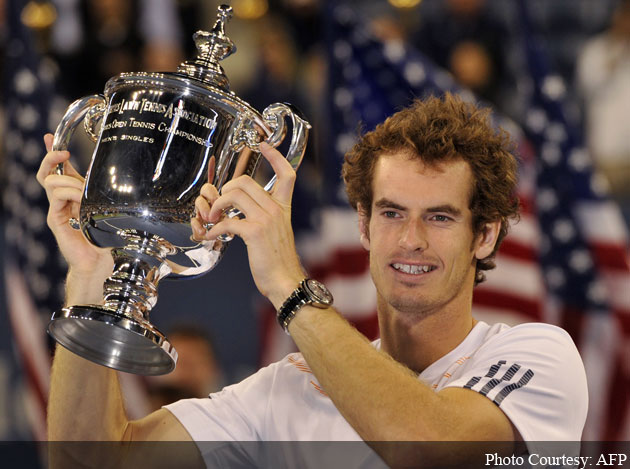
Andy Murray wins US Open 2012 to end Britain's 76-year long wait

September 11, 2012

murraywins

New York, September 11: As he stood on the precipice of history, three games from becoming the first British man to win a Grand Slam tournament since 1936, Andy Murray scowled.

His expression matched the windy weather for this United States Open finals on Monday night, the nearly five hours that it lasted and the weight of seven decades worth of expectations placed on Murray the minute his career began.

Murray complained his legs felt like jelly. Novak Djokovic, the defending champion, kept coming, his shoes squeaking, until after 306 points each man had won exactly half. Murray stared down fatigue and history and wind and doubt, elevating his game to a place it had never been before.

When the match ended, after Djokovic's return sailed long, Murray covered his face with this hands, his wild 7-6 (10), 7-5, 2-6, 3-6, 6-2 triumph complete.

Djokovic met Murray at the net. They hugged. Murray walked from their embrace in a daze, with one hand or both hands covering his mouth. It was as if he could not believe what happened, like the emotions were too fresh, too raw.

The crowd at Arthur Ashe Stadium rose and roared for Murray, the perennial loser turned sentimental favorite turned, finally, into a Grand Slam winner. It was past 2 a.m. in Scotland, Murray's home country, where surely the celebration raged, bagpipes playing well into the night.

"I don't know how I came through in the end," Murray said in a television interview on court. "I just managed to get through."

Murray, the latest, greatest hope of a nation had known the statistics as well as anyone, knew the length of the drought and his own failure in four previous Grand Slam finals, including at Wimbledon earlier this summer. He knew his coach, Ivan Lendl, also lost his first four major championship finals and still ended up with eight Slam singles trophies.

Murray had provided his homeland with an emphatic exclamation point in his magical summer: runner-up at Wimbledon, Olympic gold medalist and now United States Open champ.

"I want to congratulate Andy for his first Grand Slam," Djokovic said during the post-match ceremony. "He absolutely deserves it."

The final, the first major tournament final without Roger Federer or Rafael Nadal since Djokovic and Murray played for the Australian Open championship in 2011, pitted old rivals, both 25 years old, born one week apart. They first played each other at age 11.

Djokovic said Murray won that first contest. Djokovic, though, triumphed in their first two Grand Slam tournaments. Murray, though, emerged victorious in their most recent meeting, in the semifinals of the Olympics, a tournament Murray ultimately won.

Even though he led their personal rivalry, 8-6, Djokovic said of their latest meeting "there is no clear favorite."

At the outset, on another wind-whipped afternoon in Queens, one that felt more like British Open weather, the conditions appeared to favor Murray. After all, he played the semifinals Saturday against Tomas Berdych under the most extreme conditions of his career, while Djokovic stumbled in the same wind tunnel against David Ferrer only to regain his footing when play resumed on Sunday.

In the finals, the wind again a factor, neither player found rhythm early. In fact, for the first five games, whichever player hit with the wind at his back lost. One rally consisted of 54 shots, many of them sliced back or pushed over the net.

The first set tiebreak unfolded the same way the match did, unpredictably, back and forth, up and down. Murray trailed initially, only to scratch his way ahead, and he managed not only one set point but six.

Each set point proved its own adventure. On one, Murray short-armed a backhand approach shot into the net. On another, he badly shanked a forehand. On the final one, he seemed displeased with a let call, then unleashed a furious serve that Djokovic failed to return.

The first set lasted nearly 90 minutes. Murray won the set, 7-6 and the tiebreak, 12-10.

That seemed to rattle Djokovic, who started the second set with a flurry of unforced errors that prompted several conversations - with himself. Murray broke Djokovic in the first game and broke him again in the third and before Djokovic could blink, Murray led, 4-0.

All of Great Britain - along with the pro-Murray crowd at Arthur Ashe Stadium - could dare to dream at that point. The last time a British man won a Grand Slam tournament, Fred Perry was the champion, not the name behind a clothing line, in 1936.

Straight Sets

The drought would not end swiftly, or easily, or without much consternation for Murray hopefuls. Before the match concluded, Murray added greatly to the British angst. Djokovic crept back into the contest, just when his chances seemed most dim. His lob over Murray's head tied the second set score at 5-5.

Again, Murray recovered. Again, he pelted Djokovic with a smorgasbord of shots - topspin forehands and sliced backhands, with net charges and drop shots. On set point, Djokovic missed a forehand wide.

Murray did not dare let out too much emotion, even if every person in the building could feel the history within his grasp. In his previous four Grand Slam finals, Murray won one set. Not one set in each match. One set, period. Here, he led two sets to none.

A nation held its breath.

Throughout the past two weeks, when Djokovic cruised into the semifinals without losing a set, Murray advanced on shakier footing. He looked unbeatable in some matches, very beatable in others.

Regardless, he continued to insist that his Olympic victory relieved an enormous amount of pressure from his shoulders, from years of questions about his failure to win a Slam. He acknowledged he "maybe had less doubts about myself and my place in the game" afterward. His last goal: to win a major tournament.

The stars seemed to align in New York. Nadal withdrew before the Open started, citing a knee injury. And while Murray fell in Federer's half of the bracket, Berdych upset Federer in the quarterfinals. Only Djokovic stood in Murray's way, and even Djokovic said Murray increased his aggression over the summer, became "one of the most complete players in the world."

In the third set, when Murray seemed on the verge of a complete victory, Djokovic, like a sleeping bear poked with a stick, awakened. He evened the set at 1-1 with a backhand volley drop shot winner, and he celebrated so loudly, screamed for so long, it seemed like he had won the match.

That energy carried over. Djokovic changed shoes. Murray complained his legs felt like jelly. Djokovic blitzed Murray and captured the set, 6-2, with an overhead smash.

Djokovic won the first game of the fourth set, too, and it was clear momentum had shifted in his direction. "Jelly!" Murray screamed again, and soon enough "jelly" was trending on Twitter, worldwide.

In the fourth set, the pace increased, the rallies lasted longer, and the Open crowd continued to rise to its feet, celebrating the level of play with standing ovations. Murray kept it close. Down a service break, at 3-2, he again put one shot so far out of Djokovic's reach that Djokovic ended up on the ground. ESPN added another tally to its "knockdown" counter, which surely pleased Murray, an avid boxing fan.

Still, Djokovic held on to win that game and the fourth set, 6-3, too. Murray, meanwhile, continued to complain about his legs and how they failed him.

After four sets and four hours, the two were deadlocked, which set the stage for the final set dramatics.



Comments

Add new comment

  • Coastaldigest.com reserves the right to delete or block any comments.
  • Coastaldigset.com is not responsible for its readers’ comments.
  • Comments that are abusive, incendiary or irrelevant are strictly prohibited.
  • Please use a genuine email ID and provide your name to avoid reject.
News Network
June 2,2020

New Delhi, Jun 2: Manchester United's Paul Pogba on Monday paid tribute to George Floyd, stressing that violent acts of racism can no longer be tolerated and they have to stop.

Pogba took to Instagram to write: "During the past few days I have thought a lot about how to express my feelings about what happened in Minneapolis. I felt anger, pity, hatred, indignation, pain, sadness."

"Sadness for George and for all black people who suffer from racism Every day! Whether in football, at work, at school, Anywhere! This has to stop, once and for all! Not tomorrow or the next day, it has to end today! Violent acts of racism can no longer be tolerated," he added.

Protests erupted in Minneapolis and other US cities on Tuesday after Floyd, an African-American man, died following his arrest by the four officers.

A viral video showed a police officer, Derek Chauvin, pinning 46-year-old Floyd to the ground with his knee on his neck for nearly eight minutes. Floyd died at a local hospital shortly thereafter.

The four police officers were fired. Chauvin was also charged with murder and manslaughter, according to Hennepin County Attorney Mike Freeman.

Comments

zaki ahmed
 - 
Wednesday, 3 Jun 2020

This photograph in the above mentioned article is of Floyd Mayweather Jr , the world welterweight & super heavy weight champion & wrongly menitoned as Pogba .

Add new comment

  • Coastaldigest.com reserves the right to delete or block any comments.
  • Coastaldigset.com is not responsible for its readers’ comments.
  • Comments that are abusive, incendiary or irrelevant are strictly prohibited.
  • Please use a genuine email ID and provide your name to avoid reject.
Agencies
January 19,2020

Bengaluru, Jan 19: Opening batsman Rohit Sharma on Sunday became the third-fastest batsman to register 9,000 runs in the 50-over format.

He achieved the feat in the ongoing third ODI against Australia here at the M.Chinnaswamy Stadium.

Only Virat Kohli and AB de Villiers have achieved the feat faster than Rohit.

Sharma brought up the milestone in the first over of the Indian innings as he clipped Mitchell Starc away for a single.

With this, the right-handed batsman has become just the sixth Indian to achieve the milestone.

Apart from Sharma, Virat Kohli, MS Dhoni, Sourav Ganguly, Rahul Dravid, and Sachin Tendulkar have more than 9,000 runs in the 50-over format.

Overall, 20 batsmen have more than 9,000 ODI runs to their name.

In the match between India and Australia, the former won the toss and elected to bat first.

Steve Smith played a knock of 131 runs to propel Australia to 286/9 in the allotted fifty overs.


Comments

Add new comment

  • Coastaldigest.com reserves the right to delete or block any comments.
  • Coastaldigset.com is not responsible for its readers’ comments.
  • Comments that are abusive, incendiary or irrelevant are strictly prohibited.
  • Please use a genuine email ID and provide your name to avoid reject.
News Network
June 1,2020

Jun 1: Premier India pacer Jasprit Bumrah won't miss the hugs and high-fives as part of a wicket celebration but he will certainly miss applying saliva on the ball and feels an alternative should be provided to maintain the red cherry.

The ICC Cricket Committee, led by former India captain Anil Kumble, recommended a ban on using saliva on the ball as an interim measure to deal with the COVID-19 pandemic. However, the Committee did not allow the use of artificial substances as a substitute move.

The new rule makes life tougher for the bowlers and Bumrah, like many former and current fast bowlers, feels there ought to be an alternative.

"I was not much of a hugger anyway and not a high-five person as well, so that doesn't trouble me a lot. The only thing that interests me is the saliva bit," said Bumrah in a chat with Ian Bishop and Shaun Pollock on ICC's video series 'Inside Out'.

"I don't know what guidelines we'll have to follow when we come back, but I feel there should be an alternative," he added.

Bumrah said not being able to use saliva makes the game more batsman-friendly.

"If the ball is not well maintained, it's difficult for the bowlers. The grounds are getting shorter and shorter, the wickets are becoming flattered and flatter.

"So we need something, some alternative for the bowlers to maintain the ball so that it can do something - maybe reverse in the end or conventional swing."

When former West Indian pacer Bishop pointed out that the conditions have been favorable to the fast bowlers over the last couple of years, Bumrah nodded in agreement.

"In Test match cricket, yes. That is why it's my favorite format because we have something over there. But in one-day cricket and T20 cricket… one-day cricket there are two new balls, so it hardly reverses at the end.

"We played in New Zealand, the ground (boundary) was 50 metres. So even if you are not looking to hit a six, it will go for six. In Test matches I have no problem, I'm very happy with the way things are going."

He finds it amusing that the batsmen keep complaining about the swinging ball.

"Whenever you play, I've heard the batsmen - not in our team, everywhere - complaining the ball is swinging. But the ball is supposed to swing! The ball is supposed to do something! We are not here just to give throwdowns, isn't it? (laughter)

"This is what I tell batsmen all the time. In one-day cricket, when did the ball reverse last, I don't know. Nowadays the new ball doesn't swing a lot as well. So whenever I see batsmen say the ball is swinging or seaming and that is why I got out - the ball is supposed to do that.

"Because it doesn't happen so much in the other formats, it's a new thing for the batsmen when the ball is swinging or seaming," said the 26-year-old.

The Ahmedabad-born pacer finds himself in an unusual position as he has not bowled for over two months due to the lockdown imposed in the wake of the coronavirus outbreak.

When India will play next is not clear yet and Bumrah said he is not sure about how his body will hold up when he returns to action.

"I really don't know how your body reacts when you don't bowl for two months, three months. I'm trying to keep up with training so that as soon as the grounds open up, the body is in decent shape.

"I've been training almost six days a week but I've not bowled for a long period of time so I don't know how the body will react when I bowl the first ball.

"I'm looking at it as a way to renew your own body. We'll never get such a break again, so even if you have a small niggle here and there, you can be a refreshed person when you come back. You can prolong your career," he said.

Bumrah has risen rapidly in international cricket despite experts having reservations about his longevity due to his unorthodox action.

The gritty fast bowler sees similarities in his career graph to Swedish football star Zlatan Ibrahimovic.

"Our personalities are different. But the story I could relate to is that not many people thought he would make it big. There was a similar case with me growing up as well.

"Wherever I went, it was the general feedback from people that 'this guy would not do anything, he would not be a top-rated bowler, he won't be able to play for a long period of time with this kind of action'.

"So, having the self-belief is important and the only validation that is required is your own validation. I saw that in his (Ibrahimovic's) story, so that's the thing I could relate to," added Bumrah.

Comments

Add new comment

  • Coastaldigest.com reserves the right to delete or block any comments.
  • Coastaldigset.com is not responsible for its readers’ comments.
  • Comments that are abusive, incendiary or irrelevant are strictly prohibited.
  • Please use a genuine email ID and provide your name to avoid reject.