


England need to conquer fear of spin

November 23, 2012

cook23112012

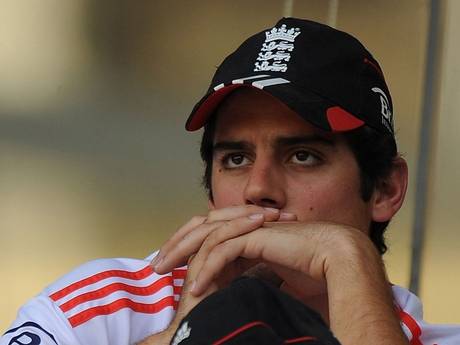
Mumbai, November 23: A lot of things have changed about English cricket in recent years. They don't always end up losing to Australia anymore; won an ICC trophy in 2009; became the World's No. 1 Test team for a brief period last year and their life doesn't revolve just around the Ashes like it used to.

In fact, captain Alastair Cook -- the choir boy turned prolific run-getter -- insists that the team's dressing room music isn't just Johnny Cash anymore either, but modern-day commercial. Their tastes seem to have really changed.

What hasn't changed about English cricket though is the uncanny way in which they manage to bury themselves under extreme pressure when you threaten them with spin. Decades of having toured the Indian subcontinent has made no difference whatsoever. You give them a turning track -- or even talk about one, like MS Dhoni has -- and they give it away.

It showed in Ahmedabad and it looks likely that it'll show again in Mumbai. Dhoni's much discussed 'demand' that the curator at Wankhede better serve his team a track that turns from the first over may not necessarily see R Ashwin or Pragyan Ojha taking the new ball.

But even if Zaheer Khan does, England's mind may be on the first change. Mentally, India have a great advantage here as the second of the four-Test series begins on Friday.

From the dryness of the surface to the exact length of each blade of grass on the pitch, how soon it starts getting rougher and how much of an exact deviation do Ashwin or Ojha get will occupy England's mind more than anything else. To Dhoni's credit, he's given them this headache already.

In fact, it's not just a turning wicket that the Indian skipper has demanded. The track also needs to have bounce and the ball has to move quicker off the pitch. That's quite a handful indeed. Asked about his opinion of the Wankhede wicket, where India have played only one Test post the stadium renovation, Dhoni promptly declared: "If this pitch also does not help our spinners, then I will again come and criticise it."

Umesh Yadav out of Test; Stuart Broad taken ill

Dhoni asserted that India will play only two spinners here. The only replacement in the squad, in fact, will be Ishant Sharma or Ashok Dinda replacing pacer Umesh Yadav, who is down with a back injury. Similarly for England, paceman Stuart Broad has taken ill and did not practise on Thursday. Left-arm spinner Monty Panesar can come in for either Samit Patel or Broad. That could be the only change other than Jonny Bairstow replacing Ian Bell.


Comments

Add new comment

  • Coastaldigest.com reserves the right to delete or block any comments.
  • Coastaldigset.com is not responsible for its readers’ comments.
  • Comments that are abusive, incendiary or irrelevant are strictly prohibited.
  • Please use a genuine email ID and provide your name to avoid reject.
Agencies
July 31,2020

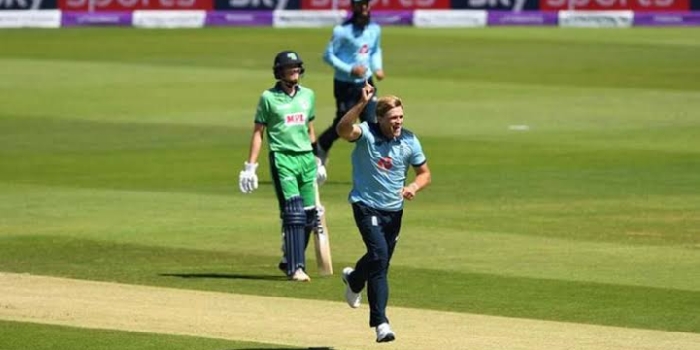
Hampshire, Jul 31: David Willey's maiden five-wicket haul guided England to a six-wicket victory over Ireland in the first ODI here on Friday.

With this win, the hosts have taken a 1-0 lead in the three-match ODI series.

Chasing a small target of 173 runs, England got off to a bad start as opener Jonny Bairstow was given LBW in the third over, bowled by Andy McBrine. Jason Roy was then joined by James Vince and the duo added 22 runs on the board before the former was dismissed.

Craig Young then got hold of Vince, who was caught behind after scoring 25 runs. Sam Billings and Tom Banton then took the charge of the chase but the latter too was caught behind which ended his 11-run innings.

Banton's dismissal brought skipper Eoin Morgan on the field. Billings and Morgan played stunning innings and kept scoring boundaries. Morgan struck a scintillating six on the last bowl of the 28th over to take England over the line. Morgan scored 36 runs while Billings played a knock of 67 runs.

Earlier, after being asked to bat first, Ireland witnessed a poor start as Paul Stirling was dismissed in the very first over of the innings, bowled by Willey. Andy Balbirnie then joined Gareth Delany but Willey struck again in his next over, removing Balbirnie.

Delany then played furiously and smashed three consecutive boundaries to Saqib Mahmood in the fourth over. However, the fall of wickets did not stop as England took three wickets in quick succession. Mahmood bowled Harry Tector while Delany and Lorcan Tucker were sent back to the pavilion by Willey.

Kevin O'Brien and Curtis Campher then took the charge and played cautiously, taking their struggling side over the 50-run mark. Adil Rashid got hold of O'Brien (22) in the 22nd over before Simranjit Singh was run out in the same over.

Andy McBrine was the next batsman and he played brilliantly along with Campher, who went on to complete his half-century. Both formed a 66-run partnership before McBrine (40) was dismissed by Tom Curran.

Campher remained unbeaten on 59 but failed to find a partner as England bundled out Ireland on 172 runs.

The second ODI between both teams will be played on Saturday.

Comments

Add new comment

  • Coastaldigest.com reserves the right to delete or block any comments.
  • Coastaldigset.com is not responsible for its readers’ comments.
  • Comments that are abusive, incendiary or irrelevant are strictly prohibited.
  • Please use a genuine email ID and provide your name to avoid reject.
Agencies
April 2,2020

Lausanne, Apr 2: The postponement of the Tokyo Olympics and the shutdown of the sporting calendar because of the coronavirus pandemic are going to hit international sports federations hard financially.

Many sports that are part of the Games depend heavily on the payouts every four years from the International Olympic Committee (IOC).

"The situation is tense and very gloomy. An assessment will be made, but clearly some posts are under threat," said an official of a major international federation.

The 28 international federations (IF) of the sports that were due to be present at the Tokyo Olympics, would have received substantial sums from the IOC.

However, the postponement of the Games until 2021 could lead to a freeze of their payment.

"We have a lot of IF with substantial reserves, but others work on a different business model, they have income from major events which are suspended, which can be a problem for the cashflow if they don't have enough reserves," said Andrew Ryan, director general of the Association of International Olympic Summer Sports Federations (ASOIF), which is responsible for distributing this money.

The five additions to the Tokyo Games programme - karate, surfing, skateboarding, climbing and baseball/softball - are not eligible.

The Olympic payout totalled 520 million after the Rio Games, four years ago.

"The Olympic money could be less than for Rio 2016," Ryan warned before adding: "My advice is to budget the same as in Rio".

The federations receive money on a sliding scale determined by their audience and size.

The three largest (athletics, swimming and gymnastics) can expect approximately 40 million.

For the second tier, made up of cycling, basketball, volleyball, football and tennis, the sum is 25 million.

For group three, which contains eight sports, including boxing, rowing, judo and table tennis, it is 17 million.

The nine sports in the next level (including sailing, canoing and fencing) receive 12 million.

For the three in the last category (rugby, golf, modern pentathlon) the payout is 7 million.

For the largest associations, such as football's FIFA which has a 1.5 billion nest egg, or basketball body FIBA which has CHF 44.4 million (42 million euros) in reserves, IOC aid represents a small proportion of their income.

For others, it is vital.

"Some IF probably don't have the cashflow to survive one year," said Ryan.

For most federations, the postponement of the Olympic Games has a domino effect, forcing them to reschedule their own money-earning competitions.

"The revenues from these events will eventually come in," said Ryan. "But this impacts the cashflow." World Athletics has already postponed the 2021 World Championships in Eugene, Oregon to 2022.

The International Swimming Federation (FINA) will have to do the same for its World Championships scheduled for next summer in Fukuoka, Japan, when they would probably clash with the Tokyo Games.

"One edition of the World Championships means for us 10 million in revenues," said one sports federation official, speaking on condition of anonymity.

"If this income is postponed, totally or partially, for a year, we will face major problems, especially if the IOC money, originally expected in September, is not paid out."

The Singapore-based International Table Tennis Federation has already taken steps, with "the Executive Committee agreeing to reduce their expenses and senior staff offering to take a salary reduction," said marketing director Matt Pound, but, he added,"further cuts will take place if needed."

- 'Significant loss of revenue' -

The ITTF has suspended all its competitions until June and that is costly.

Kim Andersen, the Danish president of London-based World Sailing, said commercial revenues are not immune.

"The IOC will eventually pay out its aid, but what weighs most heavily is the uncertainty about whether our competitions will be held and whether our sponsors will be maintained," he said.

The IOC is not prepared to go into details of what it plans.

"It is not possible at this stage to assess the overall impact" of the postponement of the Tokyo Olympics, an official told AFP.

"It depends on a number of variables that are currently being studied." According to an official of one federation: "the IOC will discuss on a case-by-case basis, sport by sport".

Another option is for the federations to ask for a share of the public aid set up to deal with the coronavirus crisis, in Switzerland, where 22 ASOIF members are based and also in the United Kingdom, home of World Sailing.

"Can sports federations benefit from federal aid? The answer is yes, in principle," Philippe Leuba, State Councillor of the canton of Vaud, in charge of the economy and sport, told.

Comments

Add new comment

  • Coastaldigest.com reserves the right to delete or block any comments.
  • Coastaldigset.com is not responsible for its readers’ comments.
  • Comments that are abusive, incendiary or irrelevant are strictly prohibited.
  • Please use a genuine email ID and provide your name to avoid reject.
Agencies
March 15,2020

Chennai, Mar 15: Wicket-keeper batsman MS Dhoni has left the Chennai Super Kings (CSK) training camp following the postponement of the Indian Premier League (IPL) amidst the coronavirus scare.

The former India skipper had joined the CSK's camp earlier this month in order to practice for the upcoming IPL season.

CSK's official handle tweeted a video of Dhoni and captioned the post as: "It has become your home sir!" Keep whistling, as #Thala Dhoni bids a short adieu to #AnbuDen".

Thirty-eight-year-old Dhoni has been currently enjoying some time away from the game. He last played competitive cricket during the 2019 World Cup.

Dhoni had to face criticism for his slow batting approach during India's matches in the tournament.

Earlier this year, Dhoni did not find a place for himself in the BCCI's centrally contracted players list.

BCCI had released the list of central contract list of players for the period from October 2019 to September 2020.

On Friday, BCCI decided to postpone the IPL until April 15 as a precautionary measure against the coronavirus pandemic.

On Saturday, all the IPL franchises met in Mumbai to discuss as to how to go on with the tournament in the future.

Comments

Add new comment

  • Coastaldigest.com reserves the right to delete or block any comments.
  • Coastaldigset.com is not responsible for its readers’ comments.
  • Comments that are abusive, incendiary or irrelevant are strictly prohibited.
  • Please use a genuine email ID and provide your name to avoid reject.