



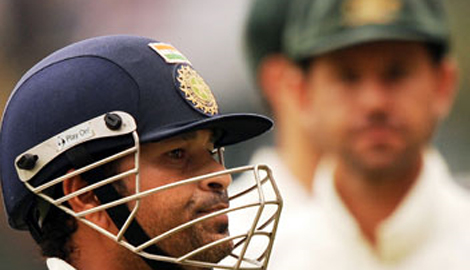
Tendulkar the villain, and Ponting the hero

December 5, 2012

sachin_Pont

I'm no statistician. On the contrary, I go cross-eyed, my head spins like a top and I'm overcome by panic each time I'm confronted with a page peppered generously with numbers. This unfortunate phenomenon has everything to do with my rocky and ill-fated relationship with arithmetic since my teens. But every once in a while, even with the odds stacked against me, I'm compelled to flirt with numbers. So here goes.

90,284 balls faced in international cricket. 61,070 runs in Tests and one-dayers. 14,924 days worth of international cricket experience. 1198 Test matches and one-day games over 23 years. 171 centuries. That's the combined mind-boggling, emotionally overwhelming and awe-inspiring worth of Sachin Tendulkar and Ricky Ponting. And the numbers are just part of a story that is still being scripted. (Also read: Test rankings - India's best batsman is 18th best)

Any discussion on batting greats and consummate batsmanship of the modern era will perforce involve Tendulkar and Ponting, by sheer dint of their skill, talent, class and prolificacy. As dissimilar as they are in style and approach, those names, Tendulkar and Ponting, will frequently be uttered in the same breath. But I digress. My interest as far as this piece is concerned is to look beyond the runs and records, and focus instead on how their portrayals and perceptions have evolved in each other's countries, in the media and among the cricket-loving public, since they began their tryst with cricketing fame.

His predecessor was easily the most respected and adored overseas cricketer in India but unlike Steve Waugh, there was no love lost for the man who was to become Australia's most successful captain. Ponting was neither an Indophile nor a philanthropist. What began with a much-publicised brawl in a Kolkata nightclub on his second tour of India in 1998 was followed by many such episodes of so-called boorish behaviour – ignoring fans in a Chennai hotel lobby, spouting expletives at a concerned Javagal Srinath enquiring innocently after him, shunting then BCCI president Sharad Pawar off stage during the 2006 Champions Trophy post-match presentation and the most damaging among them all: Monkeygate.

In India, for a large part of his 17-year career, Ponting was unwittingly the face of the 'Ugly Australian'. And the late Peter Roebuck's scathing indictment of his leadership during the Sydney Test in 2008, where he called for the captain's sacking and branded the Australian team a 'pack of wild dogs', was just the fodder the Indian media and an incensed cricket-loving nation needed in the aftermath of a controversial game that did not go India's way. Ponting was skewered on national television and across newsprint. And there was even more reason to attack him when an Australian paper, and one as reputed as the Sydney Morning Herald, was openly doing the same.

Contrary to this arrogant and loutish reputation that preceded Ponting in India, I always found him thoroughly polite and professional over the eight-odd years I interacted with him. I'll go so far as to say he was a welcome contrast to several Indian cricketers, who love throwing their weight around even if they've scored just 13 of Ponting's 13,378 Test runs.

Ponting was most apologetic after the Sydney Test when he could not do his scheduled interview with me because Cricket Australia intervened and decided it was in the team's best interest if the captain lay low for a few days given how vitiated and charged the atmosphere was at the time. He more than made up for his disappearance in Sydney with a very forthright interview before the next Test in Perth on how tough it was for him as a leader to cope with the drama, the accusations and the crucifixion. Later in the year, when Australia lost the Test series in India 2-0, he was honest enough to admit his team was returning home "with their tail between their legs".

So it's refreshing, and a touch amusing, after years of biting criticism directed at Ponting, to see this outpouring of positive emotion by way of verbose pieces, televised eulogies and twitter tributes among fans and the media in the country now that he has bid cricket goodbye. It is ironic to read and hear the suggestions in the Indian media of how Tendulkar should take a cue from Ponting on timing his retirement. Contrast this with Tendulkar's declining reputation in Australia, and it makes for a fascinating study. From 'boy-God' and 'cricket's saint' to 'sore liar' and 'bad sport', the Tendulkar name has been tarnished.

It is hard to fathom that a sports-obsessed nation so enamoured by the batting prodigy ever since Don Bradman declared in a television interview, "This fella is playing much the same as I used to play", has now fallen out of love with him. They respected VVS Laxman's talent and Rahul Dravid's grit, but they loved Tendulkar like their own. One of my most abiding and treasured cricketing memories involves India's 2007-08 tour of Australia: Tendulkar got a standing ovation at every ground he walked on to. Most Australians were distraught at the possibility that they may never get to watch him bat in Australia again.

All of this changed with the Monkeygate scandal, where it was perceived he had lied under oath to protect Harbhajan Singh, his teammate and friend. This view gained currency when Adam Gilchrist's book, True Colours, branded Tendulkar a 'poor sport' for his role in defending Harbhajan, as well as his unsporting behaviour whenever India suffered humiliating losses. Gilchrist was quick to clarify that the quotes were taken out of context, but the damage was done.

Tendulkar's indifferent form in his last two Tests on Australian soil earlier this year, his deliberate evasion of the media through the two-month tour (perhaps to avoid the spotlight on his quest for the elusive 100th ton), India's wretched form through the Tests and one-day matches, and the negative sentiment around a feckless team as it fumbled through disastrous tours of England and Australia all probably contributed to Tendulkar falling out of favour with the Aussie folk.

Proof of this anti-Tendulkar attitude was on display with the crescendo of discontent that made its way to the newspapers and social media when Julia Gillard, the Australian Prime minister, declared that Tendulkar would be conferred with the Member of the Order of Australia award (AM) a couple of months ago.

The announcement was followed by an uproar on twitter, polls in Australian papers on whether he deserved the honour, and several critical pieces on a move by Gillard that was seen as "currying cheap favour" especially because Australian cricketing legends like Richie Benaud and Shane Warne had been overlooked. For a man who is worshipped, respected and loved immensely in almost every cricket-playing nation, Tendulkar will hope that the land of Bradman and several of his happy hunting grounds goes back to its first impressions rather than the final ones.



Comments

Add new comment

  • Coastaldigest.com reserves the right to delete or block any comments.
  • Coastaldigset.com is not responsible for its readers’ comments.
  • Comments that are abusive, incendiary or irrelevant are strictly prohibited.
  • Please use a genuine email ID and provide your name to avoid reject.
Agencies
January 11,2020

London, Jan 11: Former cricketer Sachin Tendulkar's famous lap around the Wankhede Stadium after the World Cup 2011 win has been nominated in Laureas's list for the most inspiring sporting event in the last twenty years.

The moment featuring Tendulkar has been described as "Carried on the shoulders by a nation".

On his sixth attempt at the World Cup and with India not having won the competition since 1983, Tendulkar finally became a part of the team that lifted the coveted trophy. Carried on the shoulders of the Indian team, he made a lap of honour, shedding tears of joy after the victory was sealed in his home city.

The 2011 World Cup was also the first time, in which a host nation ended up winning the trophy.

Apart from Tendulkar, England's Andrew Flintoff is the only other cricketer to feature in the list. In 2005, England managed to defeat Australia in an Ashes Test, but Flintoff chose to first shake hands with Brett Lee rather than celebrate with his side.

Matthias Steiner (weightlifting), Natalie du Toit (swimming), Sky Brown (skateboarding), Alistair and Jonathan Brownlee (triathlon), Xia Boyu (mountaineering) have been nominated in the list.

Female tennis stars also feature in the list for coming up with an equal play, equal pay campaign. After pressure from Venus Williams and others, Wimbledon announced that female tennis players would receive prize money equal to the men's.

German international footballer Miroslav Klose was playing for Lazio in Italy's Serie A in 2012 against Napoli when he rose for a ball in the early moments of the game.

The ball came spiraling off his hand and skirted into the back of the net and a goal was awarded. While most players would carry on as if nothing had happened, Klose was honest with the referee and admitted that he handled the ball.

As a result, he also finds a place on the list.

The Laureus Sporting Moment Award celebrates the moments where the sport has unified people in the most extraordinary way.

This campaign has shortlisted 20 sporting stories from the last 20 years that have left their mark on the world.

The winner will be decided on the basis of public voting. It has already started, and the final date to cast the vote is February 16.

Finally, the result will be declared on February 17.
With three knock-out rounds, the top-20 moments will be whittled down to ten then five, with the top-five moments going head-to-head.

Comments

Add new comment

  • Coastaldigest.com reserves the right to delete or block any comments.
  • Coastaldigset.com is not responsible for its readers’ comments.
  • Comments that are abusive, incendiary or irrelevant are strictly prohibited.
  • Please use a genuine email ID and provide your name to avoid reject.
News Network
May 8,2020

New Delhi, May 8: India skipper Virat Kohli believes cricket in empty stadiums is a real possibility in post COVID-19 world and though it is unlikely to have a bearing on the intensity of players, he feels the magic would certainly go missing.

Cricket Boards across the globe are exploring the option of resuming the sport in empty stadiums. There is speculation that fans could be kept away from stadiums in a bid to salvage the T20 World Cup in Australia, which is currently under threat due to the global health crisis.

"It's quite a possible situation, it might happen, I honestly don't know how everyone is going to take that because we all are used to playing in front of so many passionate fans," Kohli said in Star Sports' show 'Cricket Connected'.

"I know it will be played at a very good intensity but that feeling of the crowd connecting with the players and the tension of the game where everyone goes through it in the stadium, those emotions are very difficult to recreate," he added.

Kohli said the many moments which are created because of the passion brought in by fans, would be missing.

"Things will still go on, but I doubt that one will feel that magic happening inside because of the atmosphere that was created.

"We will play sports how it is supposed to be played, but those magical moments will be difficult to come by," he said.

Cricketers such as Ben Stokes, Jason Roy, Jos Buttler and Pat Cummins have backed the idea of playing behind closed doors.

However, legendary Australian Allan Border has said it would defy belief to host a World Cup without spectators.

Another Australian all-rounder Glenn Maxwell and some other cricketers have also expressed similar sentiments.

Comments

Add new comment

  • Coastaldigest.com reserves the right to delete or block any comments.
  • Coastaldigset.com is not responsible for its readers’ comments.
  • Comments that are abusive, incendiary or irrelevant are strictly prohibited.
  • Please use a genuine email ID and provide your name to avoid reject.
News Network
July 24,2020

Dubai, Jul 24: The eagerly-awaited Indian Premier League will start on September 19 in the United Arab Emirates (UAE) with the final slated on November 8, IPL Chairman Brijesh Patel told PTI on Friday.

While the event's Governing Council will meet next week to chalk out the final details and approve the schedule, it is understood that the BCCI has informally intimated the franchises about the plan.

"The GC will meet shortly but we have finalised the schedule. It will run from September 19 to November 8. We expect the government approval to come through. It is a full 51-day IPL," Patel confirmed the development after PTI reported the dates on Thursday.

The IPL has been made possible by the ICC's decision to postpone the October-November T20 World Cup in Australia owing to the COVID-19 pandemic due to which the host country expressed its inability to conduct the event.

Patel said that the Standard Operating Procedure to combat the COVID-19 threat is being prepared and the BCCI will formally write to the Emirates Cricket Board.

"We are making the SOP and it will be ready in a few days. To allow crowd or not depends on the UAE government. Anyway social distancing has to be maintained. We have left it for their government to decide on that. Will also be writing to the UAE board formally," Patel said.

There are three grounds available in the UAE -- Dubai International Stadium, Sheikh Zayed Stadium (Abu Dhabi) and the Sharjah ground.

It is learnt that the BCCI will be renting the grounds of the ICC Academy for training of the teams.

The ICC Academy has two full-sized cricket grounds along with 38 turf pitches, 6 indoor pitches, a 5700 square foot outdoor conditioning area along with physiotherapy and medicine centre.

As per the current health protocol in Dubai, there is no need to be in quarantine if people are carrying a negative COVID-19 test report, but if they are not, they will have to undergo a test.

While there was speculation that the IPL will start from September 26, the BCCI decided to advance it by a week in order to ensure that the Indian team's tour of Australia is not jeopardised.

"The Indian team will have a mandatory quarantine of 14 days as per the Australian government rules. A delay would have sent the plans haywire," a BCCI official said on conditions of anonymity.

"The best part is that 51 days is not at all a curtailed period and broadcasters will be happy with full seven-week window," he added.

While the original schedule had five double-headers, Patel said the new one will feature around 12 double-headers which means two matches each on both Saturdays and Sundays.

The Indians are set to play a four-match Test series against Australia starting December 3 in Brisbane after the IPL.

It is expected that with each and every team needing at least a month's time to train, the IPL franchises will be leaving base by August 20 which gives them exactly four weeks time to prepare.

The cash-rich event was originally scheduled to start at the end of March but the COVID-19 pandemic and the travel restrictions that were put in place to contain the virus, led to an indefinite postponement.

However, BCCI President Sourav Ganguly had always maintained that the event will be held some time this year.

Comments

Add new comment

  • Coastaldigest.com reserves the right to delete or block any comments.
  • Coastaldigset.com is not responsible for its readers’ comments.
  • Comments that are abusive, incendiary or irrelevant are strictly prohibited.
  • Please use a genuine email ID and provide your name to avoid reject.