


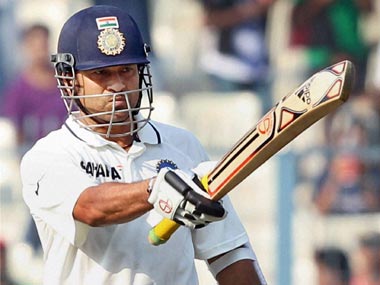
At Eden, Sachin Tendulkar abandoned his pride

December 6, 2012

Tendulkar

The cheers that accompanied Sachin Tendulkar as he made his way to the middle were deafening as always. But what followed next, had most of them sitting with their fingers crossed for the best part of an hour.


It went like this: 2 dots, 1 run, 12 dots, 1 run, 4 dots, Edged four, 9 dots, 1 run, 4 dots, 1 run, 1 run, 5 dots, 1 run.


He just couldn’t get the ball away. Monty Panesar bowled two maidens at him. Steve Finn hit him on the shoulder. The edge of his bat was more prominent than the middle. But he simply didn’t care; he simply didn’t care about how he looked.

He scratched away — in the middle and at the last shreds of pride.


10 runs off 43 balls. 36 dot balls. 1 four.


And for that period, he didn’t look like a world beater. He didn’t look like someone who had 34,000 runs in international cricket. He looked desperate. He looked human. In fact, for what seemed like an inordinate amount of time, England were trying to get him on strike, that’s how insecure he was looking in the middle. A far cry from the days when the opposition would try and get him off strike in a bid to frustrate him. Keep Sachin away from the strike and sooner or later, his momentum will die.


It was a vision: Sachin in chains. But he manfully strained against them, keeping himself alive, giving himself some breathing space. Some might even call it ugly. It was in a way but it also encapsulated his current battle — against age, form and England.


Rahul Dravid on BBC’s Test Match Special couldn’t hide his admiration: “It’s fascinating to see such a legend willing to fight it out.” One couldn’t help but agree.


Then Steven Finn came into the attack. He has pace and height but not quite the control, not today. He erred and Tendulkar got two fours off him. The buzz of the crowd had long since died, now they spoke in hushed whispers. Nobody wanted to jinx him.


18 runs off 49 balls. 40 dot balls. 3 fours.


The next stage was slightly better. A single here, a single there, the odd two, an edged four in between. The impression one got was of a man just trying to stay afloat — sooner or later, help would arrive; sooner or later, he would come good. His belief shone through: If I stay at the wicket long enough, the runs will come.


26 runs off 64 balls. 50 dot balls. 4 fours.


At the other end, Tendulkar had seen Gambhir fall, when the opener attempted to cut a delivery that was too close to the stumps. Kohli, on the other hand, hung his bat outside the off-stump and edged it through to the slips. But Tendulkar had survived.


28 runs off 78 balls. 62 dot balls. 4 fours.


With the arrival of Yuvraj Singh, the tempo of the innings began to change. The left-hander played and missed a few times but his positive intent seemed to spark a little life into Tendulkar as well. Another edge went for four but then the master opened the face of his bat to guide the ball just back of square for four. Two fours in two balls. The crowd cheered wildly and then fell silent again. Nobody wanted to break his concentration.


36 runs off 84 balls. 66 dot balls. 6 fours.


Now, some confidence seemed to flow into Tendulkar’s stride. He was consciously trying to plant his front foot as far forward as possible. He was trying to do it all right. By the time, tea was called, he was just four short of his fifty.
46 runs off 98 balls. 77 dot balls. 8 fours.


But when Tendulkar came out after tea, he wanted to get on with things. It felt that way. A four off the first ball in the final session gave him his first half-century in almost a year — he got his last fifty in Syndey on January 3. He followed it up with another four off the very next ball.


54 runs off 100 balls. 77 dot balls. 10 fours.


But then again he settled into a dour rhythm. This was especially evident against Monty Panesar (he played out a total of 73 dot balls in his whole innings against the left-arm orthodox bowler).


63 runs off 124 balls. 95 dot balls. 11 fours.


At this point, he was pretty much starting to look like he had settled in for the long haul. The bowlers weren’t really troubling him much. The ball was pretty old as well. Anderson was bowling brilliantly and the odd ball would beat the batsmen but that was it.


69 runs off 149 balls. 117 dot balls. 12 fours.


Then came the end. Immediately after the drinks break, Anderson got one to seam away from the batsman. Tendulkar came forward to drive anyway, edged it and Matt Prior took a brilliant one-handed catch to his right. The innings was over. The crowd exhaled but they still wondered: Was he back?


76 runs off 154 balls. 123 dot balls. 13 fours.
Some might point to the runs and wonder why the question even needs to be asked. Others might point to the fours — especially the shot he hit off Panesar’s flighted delivery which was driven between cover and extra-cover. The timing and placement were class. But the real takeaway from this innings was the 123 dot balls he faced.


The dot balls above all showcased a desire to remain relevant in our cricketing conversations from reasons other than retirement. They showed the resolve to get down and dirty; to do the hard yards and even appear ordinary while trying to do it.


This wasn’t a monumental innings. This wasn’t Chennai in 1999 — where he made 136 despite a stiff back. This wasn’t the Sydney off 2004 — where he decided he wouldn’t play off-side shots. This was Kolkata; this was where Tendulkar abandoned his pride.
And this too must count.



Comments

Add new comment

  • Coastaldigest.com reserves the right to delete or block any comments.
  • Coastaldigset.com is not responsible for its readers’ comments.
  • Comments that are abusive, incendiary or irrelevant are strictly prohibited.
  • Please use a genuine email ID and provide your name to avoid reject.
News Network
May 9,2020

May 9: Filipina weightlifting star Hidilyn Diaz noticed live-streamed concerts were collecting money for coronavirus relief and was struck by inspiration: why not raise funds with an online workout?

Since then the Olympic silver-medallist -- and strong contender for her country's first Games gold -- has made enough money to buy food packs for hundreds of hard-hit families in the Philippines.

Diaz has done it all from Malaysia, where she was training to qualify for the now-postponed Tokyo Olympics when much of the world locked down against the virus in March.

"I thought (distribution) would be impossible because I'm not physically present," Diaz, 29, told news agency.

"It's a good thing that I have trusted friends and trusted family members who understand why we need to do a fundraising."

That circle of supporters has handed out the packages, which include vegetables, eggs and rice, to more than 400 families.

The food was bought with donations from about 50 people who joined sessions that lasted up to three hours, and gave them a rare chance to train with an elite athlete.

Diaz rose to fame in 2016 after snagging a surprise silver in the 53 kilogramme category in Rio, becoming the Philippines' first female Olympic medallist and ending the nation's 20-year medal drought at the Games.

Two years later, she won gold at the Asian Games in Indonesia.

However, her quest to qualify for Tokyo is on hold ahead of the Games' rescheduled opening in July 2021.

"I thought all the hard work would soon be over... then it was extended," she said. "But I'm still thankful I can still continue with (the training) I need to do."

Still, the lockdown broke her daily training regimen, keeping her away from weights for 14 days for the first time in her career.

"I felt like I was losing my mind already. I've been carrying the barbell for 18 years and all of a sudden it's gone. Those were the kinds of anxiety that I felt," she said.

But she got access to some equipment, and with her coach's urging, got back to work. She was relieved to find her strength was still there.

Instead of a Tokyo berth, the past months have been about a different kind of accomplishment for Diaz: helping her countrymen get through the coronavirus crisis.

Rosemelyn Francisco's family in Zamboanga City, Diaz's home town, is one of the first to get help from the athlete's initiative, and is deeply grateful.

Her family was not wealthy to begin with, and the pandemic has cost her husband his construction job.

"The food she donated has all everything we need, including eggs," said Francisco, 27.

Comments

Add new comment

  • Coastaldigest.com reserves the right to delete or block any comments.
  • Coastaldigset.com is not responsible for its readers’ comments.
  • Comments that are abusive, incendiary or irrelevant are strictly prohibited.
  • Please use a genuine email ID and provide your name to avoid reject.
News Network
April 2,2020

New Delhi, Apr 2: BJP MP and former cricketer Gautam Gambhir on Thursday said that he will donate his two year's salary to PM-CARES Fund to support the battle against coronavirus pandemic in the country.

"People ask what can their country do for them. The real question is what can you do for your country? I am donating my 2 year's salary to #PMCaresFund. You should come forward too! @narendramodi @JPNadda @BJP4Delhi #IndiaFightsCorona," Gambhir tweeted.

The total number of coronavirus cases in India climbed to 1965 on Thursday after 131 people confirmed positive in the past 12 hours, said the Ministry of Health and Family Welfare.

At present, there are 1764 COVID-19 active cases in the country and 50 people have died due to the lethal infection.

Interestingly, on this day in 2011, India lifted its second World Cup title after a drought of 28 years. Gambhir played a crucial role in the final and anchored the run-chase.

India won its first World Cup in 1983 under the leadership of former all-rounder Kapil Dev. 

Comments

Add new comment

  • Coastaldigest.com reserves the right to delete or block any comments.
  • Coastaldigset.com is not responsible for its readers’ comments.
  • Comments that are abusive, incendiary or irrelevant are strictly prohibited.
  • Please use a genuine email ID and provide your name to avoid reject.
News Network
May 10,2020

New Delhi, May 10: Former Australia captain Ian Chappell has proposed radical changes in the LBW laws, stating that a batsman should be given out leg before as long as the ball is hitting the stumps irrespective of the spot of its landing and impact.

Chappell also said captains should agree on one way of working up the ball which will encourage swing bowling, even as the ICC is considering the use of artificial substances to shine the ball instead of sweat and saliva in post-COVID-19 scenario.

"The new lbw law should simply say: 'Any delivery that strikes the pad without first hitting the bat and, in the umpire's opinion, would go on to hit the stumps is out regardless of whether or not a shot is attempted'," he wrote in a column for ESPNcricinfo.

"Forget where the ball pitches and whether it strikes the pad outside the line or not; if it's going to hit the stumps, it's out."

The 76-year-old said the change in lbw law would attract expected criticism from the batsmen but it would make the game more fair.

"There will be screams of horror - particularly from pampered batsmen - but there are numerous positives this change would bring to the game. Most important is fairness.

"If a bowler is prepared to attack the stumps regularly, the batsman should only be able to protect his wicket with the bat. The pads are there to save the batsman from injury not dismissal.

"It would also force batsmen to seek an attacking method to combat a wristspinner pitching in the rough outside the right-hander's leg stump," said Chappell.

He cited Sachin Tendulkar's example on how he negotiated Shane Warne's round the wicket tactic during the 1997-98 Test series in India.

"Contrast Sachin Tendulkar's aggressive and successful approach to Shane Warne coming round the wicket in Chennai in 1997-98 with a batsman who kicks away deliveries pitching in the rough and turning in toward the stumps. Which would you rather watch?

"The current law encourages "pad play" to balls pitching outside leg while this change would force them to use their bat. The change would reward bowlers who attack the stumps and decrease the need for negative wide deliveries to a packed off-side field," he said.

Chappell said his proposed change to the lbw law would also cut down "frivolous" DRS challenges.

"This change to the lbw law would also simplify umpiring and result in fewer frivolous DRS challenges. Consequently, it would speed up a game that has slowed drastically in recent times.

"It would also make four-day Tests an even more viable proposition as mind-numbing huge first-innings totals would be virtually non-existent."

On the substitute of shining the ball without sweat and saliva, Chappell said international captains should find out a way of working up the ball.

"With ball-tampering always a hot topic, in the past I've suggested that administrators ask international captains to construct a list (i.e. the use of natural substances) detailing the things bowlers feel will help them to swing the ball.

"From this list, the administrators should deem one method to be legal with all others being punishable as illegal," the cricketer-turned-commentator added.

Comments

Add new comment

  • Coastaldigest.com reserves the right to delete or block any comments.
  • Coastaldigset.com is not responsible for its readers’ comments.
  • Comments that are abusive, incendiary or irrelevant are strictly prohibited.
  • Please use a genuine email ID and provide your name to avoid reject.