


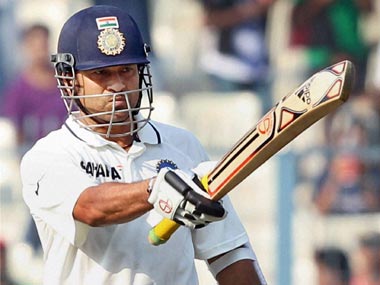
At Eden, Sachin Tendulkar abandoned his pride

December 6, 2012

Tendulkar

The cheers that accompanied Sachin Tendulkar as he made his way to the middle were deafening as always. But what followed next, had most of them sitting with their fingers crossed for the best part of an hour.


It went like this: 2 dots, 1 run, 12 dots, 1 run, 4 dots, Edged four, 9 dots, 1 run, 4 dots, 1 run, 1 run, 5 dots, 1 run.


He just couldn’t get the ball away. Monty Panesar bowled two maidens at him. Steve Finn hit him on the shoulder. The edge of his bat was more prominent than the middle. But he simply didn’t care; he simply didn’t care about how he looked.

He scratched away — in the middle and at the last shreds of pride.


10 runs off 43 balls. 36 dot balls. 1 four.


And for that period, he didn’t look like a world beater. He didn’t look like someone who had 34,000 runs in international cricket. He looked desperate. He looked human. In fact, for what seemed like an inordinate amount of time, England were trying to get him on strike, that’s how insecure he was looking in the middle. A far cry from the days when the opposition would try and get him off strike in a bid to frustrate him. Keep Sachin away from the strike and sooner or later, his momentum will die.


It was a vision: Sachin in chains. But he manfully strained against them, keeping himself alive, giving himself some breathing space. Some might even call it ugly. It was in a way but it also encapsulated his current battle — against age, form and England.


Rahul Dravid on BBC’s Test Match Special couldn’t hide his admiration: “It’s fascinating to see such a legend willing to fight it out.” One couldn’t help but agree.


Then Steven Finn came into the attack. He has pace and height but not quite the control, not today. He erred and Tendulkar got two fours off him. The buzz of the crowd had long since died, now they spoke in hushed whispers. Nobody wanted to jinx him.


18 runs off 49 balls. 40 dot balls. 3 fours.


The next stage was slightly better. A single here, a single there, the odd two, an edged four in between. The impression one got was of a man just trying to stay afloat — sooner or later, help would arrive; sooner or later, he would come good. His belief shone through: If I stay at the wicket long enough, the runs will come.


26 runs off 64 balls. 50 dot balls. 4 fours.


At the other end, Tendulkar had seen Gambhir fall, when the opener attempted to cut a delivery that was too close to the stumps. Kohli, on the other hand, hung his bat outside the off-stump and edged it through to the slips. But Tendulkar had survived.


28 runs off 78 balls. 62 dot balls. 4 fours.


With the arrival of Yuvraj Singh, the tempo of the innings began to change. The left-hander played and missed a few times but his positive intent seemed to spark a little life into Tendulkar as well. Another edge went for four but then the master opened the face of his bat to guide the ball just back of square for four. Two fours in two balls. The crowd cheered wildly and then fell silent again. Nobody wanted to break his concentration.


36 runs off 84 balls. 66 dot balls. 6 fours.


Now, some confidence seemed to flow into Tendulkar’s stride. He was consciously trying to plant his front foot as far forward as possible. He was trying to do it all right. By the time, tea was called, he was just four short of his fifty.
46 runs off 98 balls. 77 dot balls. 8 fours.


But when Tendulkar came out after tea, he wanted to get on with things. It felt that way. A four off the first ball in the final session gave him his first half-century in almost a year — he got his last fifty in Syndey on January 3. He followed it up with another four off the very next ball.


54 runs off 100 balls. 77 dot balls. 10 fours.


But then again he settled into a dour rhythm. This was especially evident against Monty Panesar (he played out a total of 73 dot balls in his whole innings against the left-arm orthodox bowler).


63 runs off 124 balls. 95 dot balls. 11 fours.


At this point, he was pretty much starting to look like he had settled in for the long haul. The bowlers weren’t really troubling him much. The ball was pretty old as well. Anderson was bowling brilliantly and the odd ball would beat the batsmen but that was it.


69 runs off 149 balls. 117 dot balls. 12 fours.


Then came the end. Immediately after the drinks break, Anderson got one to seam away from the batsman. Tendulkar came forward to drive anyway, edged it and Matt Prior took a brilliant one-handed catch to his right. The innings was over. The crowd exhaled but they still wondered: Was he back?


76 runs off 154 balls. 123 dot balls. 13 fours.
Some might point to the runs and wonder why the question even needs to be asked. Others might point to the fours — especially the shot he hit off Panesar’s flighted delivery which was driven between cover and extra-cover. The timing and placement were class. But the real takeaway from this innings was the 123 dot balls he faced.


The dot balls above all showcased a desire to remain relevant in our cricketing conversations from reasons other than retirement. They showed the resolve to get down and dirty; to do the hard yards and even appear ordinary while trying to do it.


This wasn’t a monumental innings. This wasn’t Chennai in 1999 — where he made 136 despite a stiff back. This wasn’t the Sydney off 2004 — where he decided he wouldn’t play off-side shots. This was Kolkata; this was where Tendulkar abandoned his pride.
And this too must count.



Comments

Add new comment

  • Coastaldigest.com reserves the right to delete or block any comments.
  • Coastaldigset.com is not responsible for its readers’ comments.
  • Comments that are abusive, incendiary or irrelevant are strictly prohibited.
  • Please use a genuine email ID and provide your name to avoid reject.
News Network
February 18,2020

Berlin, Feb 18: Sachin Tendulkar being lifted on the shoulders of his teammates after their World Cup triumph at home in 2011 has been voted the Laureus best sporting moment in the last 20 years.

With the backing of Indian cricket fans, Tendulkar got the maximum number of votes to emerge winner on Monday.

Tendulkar, competing in his sixth and last World Cup, finally realised his long-term dream when skipper Mahendra Singh Dhoni smacked Sri Lankan pacer Nuwan Kulasekara out of the park for a winning six.

The charged-up Indian cricketers rushed to the ground and soon they lifted Tendulkar on their shoulders and made a lap of honour, a moment etched in the minds of the fans.

Former Australian skipper Steve Waugh handed the trophy to Tendulkar after tennis legend Boris Becker announced the winner at a glittering ceremony.

“It's incredible. The feeling of winning the world cup was beyond what words can express. How many times you get an event happening where there are no mixed opinions. Very rarely the entire country celebrates,” Tendulkar said after receiving the trophy.

“And this is a reminder of how powerful a sport is and what magic it does to our lives. Even now when I watch that it has stayed with me.”

Becker then asked Tendulkar to share the emotions he felt at that time and the Indian legend put in perspective how important it was for him to hold that trophy.

“My journey started in 1983 when I was 10 years old. India had won the World Cup. I did not understand the significance and just because everybody was celebrating, I also joined the party.

“But somewhere I knew something special has happened to the country and I wanted to experience it one day and that's how my journey began.”

“It was the proudest moment of my life, holding that trophy which I chased for 22 years but I never lost hope. I was merely lifting that trophy on behalf of my countrymen.”

The 46-year-old Tendulkar, the highest run-getter in the cricket world, said holding the Laureus trophy has also given him great honour.

He also shared the impact the revolutionary South African leader Nelson Mandela had on him. He met him when he was just 19 years old.

“His hardship did not affect his leadership. Out of many messages he left, the most important I felt was that sport has got the power to unite everyone.

"Today, sitting in this room with so many athletes, some of them did not have everything but they made the best of everything they had. I thank them for inspiring youngsters to pick a sport of their choice and chase their dreams. This trophy belongs to all of us, it's not just about me.”

In a tweet on Tuesday, Tendulkar dedicated the award to his country, teammates and fans.

"Thank you all for the overwhelming love and support! I dedicate this @LaureusSport award to India, all my teammates, fans and well wishers in India and across the world who have always supported Indian cricket," he tweeted.

Comments

Add new comment

  • Coastaldigest.com reserves the right to delete or block any comments.
  • Coastaldigset.com is not responsible for its readers’ comments.
  • Comments that are abusive, incendiary or irrelevant are strictly prohibited.
  • Please use a genuine email ID and provide your name to avoid reject.
News Network
June 1,2020

Jun 1: Premier India pacer Jasprit Bumrah won't miss the hugs and high-fives as part of a wicket celebration but he will certainly miss applying saliva on the ball and feels an alternative should be provided to maintain the red cherry.

The ICC Cricket Committee, led by former India captain Anil Kumble, recommended a ban on using saliva on the ball as an interim measure to deal with the COVID-19 pandemic. However, the Committee did not allow the use of artificial substances as a substitute move.

The new rule makes life tougher for the bowlers and Bumrah, like many former and current fast bowlers, feels there ought to be an alternative.

"I was not much of a hugger anyway and not a high-five person as well, so that doesn't trouble me a lot. The only thing that interests me is the saliva bit," said Bumrah in a chat with Ian Bishop and Shaun Pollock on ICC's video series 'Inside Out'.

"I don't know what guidelines we'll have to follow when we come back, but I feel there should be an alternative," he added.

Bumrah said not being able to use saliva makes the game more batsman-friendly.

"If the ball is not well maintained, it's difficult for the bowlers. The grounds are getting shorter and shorter, the wickets are becoming flattered and flatter.

"So we need something, some alternative for the bowlers to maintain the ball so that it can do something - maybe reverse in the end or conventional swing."

When former West Indian pacer Bishop pointed out that the conditions have been favorable to the fast bowlers over the last couple of years, Bumrah nodded in agreement.

"In Test match cricket, yes. That is why it's my favorite format because we have something over there. But in one-day cricket and T20 cricket… one-day cricket there are two new balls, so it hardly reverses at the end.

"We played in New Zealand, the ground (boundary) was 50 metres. So even if you are not looking to hit a six, it will go for six. In Test matches I have no problem, I'm very happy with the way things are going."

He finds it amusing that the batsmen keep complaining about the swinging ball.

"Whenever you play, I've heard the batsmen - not in our team, everywhere - complaining the ball is swinging. But the ball is supposed to swing! The ball is supposed to do something! We are not here just to give throwdowns, isn't it? (laughter)

"This is what I tell batsmen all the time. In one-day cricket, when did the ball reverse last, I don't know. Nowadays the new ball doesn't swing a lot as well. So whenever I see batsmen say the ball is swinging or seaming and that is why I got out - the ball is supposed to do that.

"Because it doesn't happen so much in the other formats, it's a new thing for the batsmen when the ball is swinging or seaming," said the 26-year-old.

The Ahmedabad-born pacer finds himself in an unusual position as he has not bowled for over two months due to the lockdown imposed in the wake of the coronavirus outbreak.

When India will play next is not clear yet and Bumrah said he is not sure about how his body will hold up when he returns to action.

"I really don't know how your body reacts when you don't bowl for two months, three months. I'm trying to keep up with training so that as soon as the grounds open up, the body is in decent shape.

"I've been training almost six days a week but I've not bowled for a long period of time so I don't know how the body will react when I bowl the first ball.

"I'm looking at it as a way to renew your own body. We'll never get such a break again, so even if you have a small niggle here and there, you can be a refreshed person when you come back. You can prolong your career," he said.

Bumrah has risen rapidly in international cricket despite experts having reservations about his longevity due to his unorthodox action.

The gritty fast bowler sees similarities in his career graph to Swedish football star Zlatan Ibrahimovic.

"Our personalities are different. But the story I could relate to is that not many people thought he would make it big. There was a similar case with me growing up as well.

"Wherever I went, it was the general feedback from people that 'this guy would not do anything, he would not be a top-rated bowler, he won't be able to play for a long period of time with this kind of action'.

"So, having the self-belief is important and the only validation that is required is your own validation. I saw that in his (Ibrahimovic's) story, so that's the thing I could relate to," added Bumrah.

Comments

Add new comment

  • Coastaldigest.com reserves the right to delete or block any comments.
  • Coastaldigset.com is not responsible for its readers’ comments.
  • Comments that are abusive, incendiary or irrelevant are strictly prohibited.
  • Please use a genuine email ID and provide your name to avoid reject.
Agencies
July 7,2020

Mumbai, Jul 7: Australias second largest city Melbourne is set to go for another round of lockdown — for six weeks — from midnight Wednesday as the coronavirus has reared its ugly head in Victoria. And this has further confirmed that this years T20 World Cup in Australia is practically not possible. Even as the ICC keeps delaying the announcement, BCCI hopes that the official call will now be taken with this latest development.

Despite ICC's Financial and Commercial Affairs Committee (F&CA) chief Ehsan Mani as well as Cricket Australia making it clear time and again that hosting a T20 World Cup in the October-November window is practically impossible, the ICC hasn't made an official announcement and that hasn't impressed the Board of Control for Cricket in India (BCCI).

Speaking to media persons, a BCCI official said that it is only the ICC which has kept speaking about delaying the inevitable — announcing a postponement — even as Cricket Australia chairman Earl Eddings wrote to the international body that it looks highly unlikely that a T20 World Cup can be hosted in these trying times.

"As it is there were so many logistical difficulties and that is perfectly understandable. The Australian government has been addressing the public health issue efficiently and there are regulations in place which are crucial to address the challenges. In that background even Cricket Australia has been practical in their assessment of the situation.

"With this present situation where Melbourne is in lockdown, the ICC really must take the final call of closure on the issue if they have any concept of responsible decision making," the official said.

Not just CA chairman Eddings, but also Mani — who is also the PCB chief — recently told the media that the T20 World Cup cannot be held in a bio-secure environment.

"We have had a lot of discussions and the feeling is it (T20 World Cup) would not be possible this year. ICC has World Cups lined up in 2021 and 2023, so we have a gap year where we can adjust this event. God forbid if some player(s) falls ill or mishap occurs during the tournament, it will have a big impact and create panic in the cricket world and we can't take that risk. Having a bio-bubble environment is feasible for say a bilateral series like Pakistan in England, but it is very difficult when 16 teams are involved," he had said.

Cricket Australia's interim CEO Nick Hockley echoed the sentiments when he said the biggest challenge was to get the players from so many teams into the country.

"Our biggest challenge is getting 15 teams into the country. If I compare it with the prospect of a bilateral tour, you're talking about bringing one team in and then playing individual matches. But the prospect of bringing 15 teams in and having six or seven teams in one city at the same time, it's a much more complex exercise," he had said.

Comments

Add new comment

  • Coastaldigest.com reserves the right to delete or block any comments.
  • Coastaldigset.com is not responsible for its readers’ comments.
  • Comments that are abusive, incendiary or irrelevant are strictly prohibited.
  • Please use a genuine email ID and provide your name to avoid reject.