


Bowling options give Pakistan advantage in second T20

December 28, 2012

dhoni1

Ahmedabad, December 28: Having failed to defend their home turf in the Tests against England and only managing to draw the T20 series, India are now on the brink of losing again, this time against Pakistan in the shortest version.

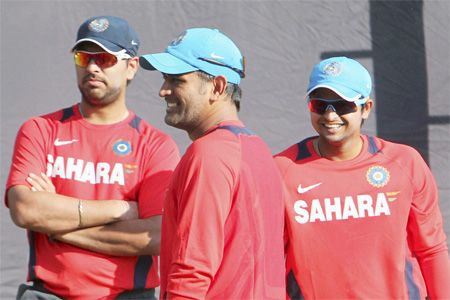
The knives are out and MS Dhoni's men are under pressure heading into the second T20 International here on Friday. Can they pull things back or will the rub of the green again go Pakistan's way, like it did in Bangalore?

With increasing regularity, opposition teams are targeting India's weakest link -- the bowling -- while the batting too hasn't been up to the mark. Some of India's strategies, and their team combination, have come in for criticism.

Against England, the bowlers couldn't defend 177 and against Pakistan in Bangalore, though the match looked close thanks to debutant Bhuvneshwar Kumar's dream spell, the match was always in Pakistan's pocket once India lost nine wickets for 56 runs in their last 10 overs.

So what can one expect from India's second T20 against Pakistan at the Motera? On the face of it, the odds are slightly tilted in Pakistan's favour. Going by current form, India don't have the batting to tame a talented and varied Pakistan bowling attack.

Skipper Mohammad Hafeez was not off the mark when he said: "All our bowlers have proved that they are match winners in international cricket. We have enough experience in our bowling attack. No matter how good the opposition batsmen, we still believe we can make a comeback."

That prowess was on display in Bangalore when Pakistan's bowlers restricted India to 133/9 after the hosts were 77 for no loss by the 11th over.

While India's batsmen have failed to fire in unison, on the bowling front they may have made a mistake by leaving out R Ashwin for the Bangalore game. With the pitch at the Motera generally on the slower side, it's likely that the spinner will be included in the scheme of things this time around. Ashwin's batting too is a plus.

Pakistan, on the other hand, are on a definite high. Skipper Hafeez said: "It's a huge opportunity to wrap up the series here and we all are ready to grab it. Not just the T20, but we are very positive and ready for the entire tour here. We all are very united and we hope to give our best. Morale is very high.

"I am not very disappointed with the failure of the youngsters at the top of the order because everybody can't perform every day," Hafeez added.

"We all know that they are very good players and we have the belief in that they will come good tomorrow. But as a team, the good thing for us was that we came back from difficult situations both while batting and bowling. That's a huge positive for us."

Comments

Add new comment

  • Coastaldigest.com reserves the right to delete or block any comments.
  • Coastaldigset.com is not responsible for its readers’ comments.
  • Comments that are abusive, incendiary or irrelevant are strictly prohibited.
  • Please use a genuine email ID and provide your name to avoid reject.
Agencies
April 2,2020

Lausanne, Apr 2: The postponement of the Tokyo Olympics and the shutdown of the sporting calendar because of the coronavirus pandemic are going to hit international sports federations hard financially.

Many sports that are part of the Games depend heavily on the payouts every four years from the International Olympic Committee (IOC).

"The situation is tense and very gloomy. An assessment will be made, but clearly some posts are under threat," said an official of a major international federation.

The 28 international federations (IF) of the sports that were due to be present at the Tokyo Olympics, would have received substantial sums from the IOC.

However, the postponement of the Games until 2021 could lead to a freeze of their payment.

"We have a lot of IF with substantial reserves, but others work on a different business model, they have income from major events which are suspended, which can be a problem for the cashflow if they don't have enough reserves," said Andrew Ryan, director general of the Association of International Olympic Summer Sports Federations (ASOIF), which is responsible for distributing this money.

The five additions to the Tokyo Games programme - karate, surfing, skateboarding, climbing and baseball/softball - are not eligible.

The Olympic payout totalled 520 million after the Rio Games, four years ago.

"The Olympic money could be less than for Rio 2016," Ryan warned before adding: "My advice is to budget the same as in Rio".

The federations receive money on a sliding scale determined by their audience and size.

The three largest (athletics, swimming and gymnastics) can expect approximately 40 million.

For the second tier, made up of cycling, basketball, volleyball, football and tennis, the sum is 25 million.

For group three, which contains eight sports, including boxing, rowing, judo and table tennis, it is 17 million.

The nine sports in the next level (including sailing, canoing and fencing) receive 12 million.

For the three in the last category (rugby, golf, modern pentathlon) the payout is 7 million.

For the largest associations, such as football's FIFA which has a 1.5 billion nest egg, or basketball body FIBA which has CHF 44.4 million (42 million euros) in reserves, IOC aid represents a small proportion of their income.

For others, it is vital.

"Some IF probably don't have the cashflow to survive one year," said Ryan.

For most federations, the postponement of the Olympic Games has a domino effect, forcing them to reschedule their own money-earning competitions.

"The revenues from these events will eventually come in," said Ryan. "But this impacts the cashflow." World Athletics has already postponed the 2021 World Championships in Eugene, Oregon to 2022.

The International Swimming Federation (FINA) will have to do the same for its World Championships scheduled for next summer in Fukuoka, Japan, when they would probably clash with the Tokyo Games.

"One edition of the World Championships means for us 10 million in revenues," said one sports federation official, speaking on condition of anonymity.

"If this income is postponed, totally or partially, for a year, we will face major problems, especially if the IOC money, originally expected in September, is not paid out."

The Singapore-based International Table Tennis Federation has already taken steps, with "the Executive Committee agreeing to reduce their expenses and senior staff offering to take a salary reduction," said marketing director Matt Pound, but, he added,"further cuts will take place if needed."

- 'Significant loss of revenue' -

The ITTF has suspended all its competitions until June and that is costly.

Kim Andersen, the Danish president of London-based World Sailing, said commercial revenues are not immune.

"The IOC will eventually pay out its aid, but what weighs most heavily is the uncertainty about whether our competitions will be held and whether our sponsors will be maintained," he said.

The IOC is not prepared to go into details of what it plans.

"It is not possible at this stage to assess the overall impact" of the postponement of the Tokyo Olympics, an official told AFP.

"It depends on a number of variables that are currently being studied." According to an official of one federation: "the IOC will discuss on a case-by-case basis, sport by sport".

Another option is for the federations to ask for a share of the public aid set up to deal with the coronavirus crisis, in Switzerland, where 22 ASOIF members are based and also in the United Kingdom, home of World Sailing.

"Can sports federations benefit from federal aid? The answer is yes, in principle," Philippe Leuba, State Councillor of the canton of Vaud, in charge of the economy and sport, told.

Comments

Add new comment

  • Coastaldigest.com reserves the right to delete or block any comments.
  • Coastaldigset.com is not responsible for its readers’ comments.
  • Comments that are abusive, incendiary or irrelevant are strictly prohibited.
  • Please use a genuine email ID and provide your name to avoid reject.
News Network
February 24,2020

Wellington, Feb 24: Indian batsmen's inadequacies in adverse conditions were laid bare as they crashed to an embarrassing 10-wicket defeat against a ruthless New Zealand side that wrapped up the opening Test in just over three days here on Monday.

Starting the day on 144 for four, India were all out for 191 in their second innings. This was only a shade better than their dismal 165 in the first innings, which eventually proved to be decisive.

Trent Boult (4/39 in 22 overs) and Tim Southee (5/61 in 21 overs), the most under-rated new ball pairs in world cricket, showed that when it boils down to playing incisive seam and swing bowling, this batting line-up is still a work in progress.

The required target of nine runs was knocked off by New Zealand without much ado for their 100th Test win.

India's last defeat was against Australia at Perth during the 2018-19 series but the loss at the Basin Reserve would hurt them more because the visitors have not surrendered in such a fashion of late.

There was no resistance from a star-studded line-up and more than intent, the failure was due to poor technique on a track that had something on the third and fourth day as well.

This is a team that plays fast bowling much better than their predecessors, the reason for their success on the bouncy Australian tracks.

But when it comes to facing conventional seam and swing bowling in testing conditions, they are yet to learn the art of saving a Test match.

India had lost the mental battle on the first day itself when they saw the moisture on the wicket.

The toss became a factor and not for one session did they look comfortable. Mayank Agarwal was the only batsman, who felt at home in patches, as New Zealand showed what a Test match strategy is all about.

If the first innings was about mixing back of length deliveries with fuller length balls, the second innings saw the pacers coming from round the wicket and targeting the rib-cage. The line was disconcerting and it stifled them for good.

It affected their mindset and once Ajinkya Rahane and Hanuma Vihari stepped out on the fourth morning, defeat was written all over as both looked ill-equipped to handle such high quality seam bowling.

Rahane (29 off 75 balls) and Vihari (15 off 79 balls) are players who only play long-form cricket at the international level and both are known for their patience.

But little would have the Indian vice-captain apprehended that he would get a delivery from Boult, which he thought would move away after pitching but it held its line and he had no option but to jab at it, and all he got was an edge.

Southee, who bowls a lovely classical outswinger, then bowled an off-cutter from the other end and before Vihari could comprehend, it came back sharply to peg the stumps back.

Within first 20 minutes, the two seasoned practitioners of swing had knocked the stuffing out of India's resistance.

Rishabh Pant (25 off 41 balls) batted only in the manner he can and played one breathtaking shot off Southee, a slog sweep off a 130 kmph-plus delivery to the deep mid-wicket boundary.

But there was too much left to do with too little support from the other end. Bending on one knee, he tried another audacious slog scoop but couldn't clear.

Southee, who had a terrific match, deservingly completed his 10th five-wicket haul and all it took was 16 overs to end the innings and the match.

New Zealand now have 120 points in the World Test championship and India stayed on top with 36 points.

Comments

Add new comment

  • Coastaldigest.com reserves the right to delete or block any comments.
  • Coastaldigset.com is not responsible for its readers’ comments.
  • Comments that are abusive, incendiary or irrelevant are strictly prohibited.
  • Please use a genuine email ID and provide your name to avoid reject.
News Network
February 11,2020

Mt. Maunganui (New Zealand), Feb 11: KL Rahul struck a combative 112 but New Zealand completed a 3-0 whitewash of India by winning the third ODI by five wickets, here on Tuesday.

Rahul helped India recover from a shaky start to post a challenging 296 for 7 but the Kiwis overhauled the target with 17 balls to spare.

This is the first whitewash that India has suffered in an ODI series in more than a decade.

Sent in to bat, India were down 62 for 3 in the 13th over after the dismissals of Mayank Agarwal (1), captain Virat Kohli (9) and Prithvi Shaw (40) but Rahul got a useful ally in in-form Shreyas Iyer (62) to take India to a competitive total.

Rahul, who hit nine fours and two sixes during his 113-ball innings, and Iyer stitched exactly 100 runs from 18.2 overs for the fourth wicket to revive the Indian innings.

After the end of the promising innings of Iyer, Rahul shared another 107 runs for the fifth wicket with Manish Pandey (42).

The Kiwis were off to a confident start in their chase with Martin Guptill (66) and Henry Nicholls (80) and putting on a 106-run stand. However, wrist spinner Yuzvendra Chahal took three wickets to bring India back in the game.

Colin de Grandhomme (58) and Tom Latham (32), though, took their side past the finish line with an unbeaten 80-run partnership.

Brief Scores:

India: 296 for 7 in 50 overs (KL Rahul 112, Shreyas Iyer 62; Hamish Bennett 4/64).

New Zealand: 300 for 5 in 47.1 overs. (H Nicholls 80, M Guptill 66; Y Chahal 3/47).

Comments

Add new comment

  • Coastaldigest.com reserves the right to delete or block any comments.
  • Coastaldigset.com is not responsible for its readers’ comments.
  • Comments that are abusive, incendiary or irrelevant are strictly prohibited.
  • Please use a genuine email ID and provide your name to avoid reject.