


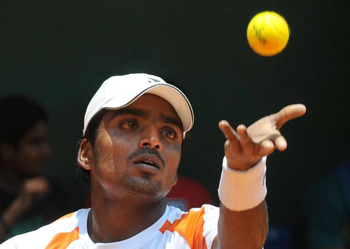
Davis Cup: Korea trample India on day one

February 2, 2013

Ranjeet_Virali_MurugesanNew Delhi, Feb 2: Hope quickly gave way to uncertainty, and uncertainty to reality. India’s Davis Cup campaign, in the absence of its top players, got off to a miserable start with the home side trailing 0-2 against South Korea at the end of the opening day of Asia-Oceania Group ‘I’ tie at the RK Khanna Stadium here on Friday.

Ranjeet Virali Murugesan, the No.1 player for India in the tie, produced a below par performance during his 1-6, 0-6, 1-6 surrender to Min-Hyeok Cho before a cramping Vijayant Malik conceded the match when trailing 4-6, 5-7, 0-3 against Suk-Young Jeong.

Rankings matter little in Davis Cup and one hoped the two debutants would get the adrenaline rushing and raise their game. It had happened in the past but not today.

The drums, the noisy chants and even the fluttering national flags waved by Leander Paes and company at the sidelines could not inspire a change of fortunes. Not even Sania Mirza’ pressence in the stands. Firepower was missing and nerves got prominence.

Ranjeet, after leading 40-15 in the first game, slipped to drop his serve and could never revive his game. He was tight in his movements, struggled to put the ball in play and made a rash of errors. Cho easily wore him down in a few odd rallies with fluent hitting and whenever Ranjeet clambered to the net, he was treated to some rasping passing shots.

Bad struggle

In fact, Cho only grew better with each point, partly due to his Indian counterpart, whose game simply fell apart. So badly did Ranjeet struggle that he could hold his serve only once during the match.

The solitary blemish in the unranked Korean’s game was when he dropped his serve in the fourth game of the first set. But he swiftly recovered to reel off 12 games before Ranjeet held in the fourth game of the final set. It served momentary reprieve. Cho didn’t give away anything afterwards and closed the set and match with a forehand crosscourt winner, dropping only two points on the way.

It put curtains on a painful viewing and shifted focus on 22-year-old Vijayant, who now had the responsibility to put the home team on even keel.

He indeed showed promise with his power-packed strokes. The boy from Panipat fought for each point and stretched Jeong several times in the match. He served with purpose, fearlessly engaged in rallies but his forehand proved to be his undoing. He dropped his serve in the fifth game of the match following two forehand errors and Jeong, quick on feet and solid on serve, sprinted to take the lead.

Egged on, Vijayant carried his attacking game to the second set. A scorching backhand down the line gave him three breakpoints but he couldn’t convert any. Not even the fourth opportunity that came after the two deuces in the game before throwing it all away with a poor backhand.

He dropped his serve in the 11th game to lag 5-7 and immediately asked for a medical timeout. On return, the Korean comfortably served out the set and the match.

Vijayant got broken straightaway in the third set and in the third game fell to the ground grimacing after hitting a backhand return. His exit wrapped up a forgettable day for India, who would look up to their doubles exponent Paes and another debutant Purav Raja to get them their first point in the tie and another day to fight.

Comments

Add new comment

  • Coastaldigest.com reserves the right to delete or block any comments.
  • Coastaldigset.com is not responsible for its readers’ comments.
  • Comments that are abusive, incendiary or irrelevant are strictly prohibited.
  • Please use a genuine email ID and provide your name to avoid reject.
Agencies
February 7,2020

New Delhi, Feb 7: It was on February 7, 1999, that Anil Kumble became just the second bowler in the history of cricket to take all ten wickets in an innings of a Test match.

He achieved the feat against Pakistan at Feroz Shah Kotla Stadium, now known as Arun Jaitley cricket stadium in Delhi during the second Test of the two-match series.

India had set Pakistan a target of 420 runs in the match and the visitors got off to a steady start as openers Shahid Afridi and Saeed Anwar put on 101 runs for the first wicket.

It was then Kumble who came into the attack and wreaked havoc on the Pakistani batting line-up.

The spinner, also known as 'Jumbo' first dismissed Afridi (41) in the 25th over. After the right-handed batter's dismissal, India kept on taking wickets through Kumble and Pakistan was reduced to 128/6 in no time.

Kumble then kept on taking wickets at regular intervals and he got his tenth scalp in the 61st over after dismissing Wasim Akram.

This effort enabled India to register a win by 212 runs, and Kumble became the second bowler after England's Jim Laker to take all ten wickets in a single Test inning.

Kumble finished with the bowling figures of 10-74 from 26.3 overs.

Kumble announced his retirement from international cricket in 2008 and finished with 619 wickets in the longest format of the game.

He has the third-highest number of wickets in Tests, only behind Sri Lanka's Muttiah Muralitharan (800) and Australia's Shane Warne (708).

Comments

Add new comment

  • Coastaldigest.com reserves the right to delete or block any comments.
  • Coastaldigset.com is not responsible for its readers’ comments.
  • Comments that are abusive, incendiary or irrelevant are strictly prohibited.
  • Please use a genuine email ID and provide your name to avoid reject.
News Network
May 30,2020

St John's, May 30: The Cricket West Indies (CWI) on Saturday announced a temporary 50 per cent reduction in salaries and cricket funding across the entire regional cricket system, effective from the start of July due to the ongoing coronavirus pandemic which resulted in the suspension of all the cricketing activities across the globe since March.

"This decision has been necessary in the face of debilitating economic challenges which have resulted from the impact of the COVID-19 pandemic. With no international cricket currently being played anywhere in the world, and with great uncertainty of when regular cricket activity will resume, CWI - like many other international sporting organisations worldwide - is facing a significant loss of income, whilst also being uncertain of the long-term impact of the crisis on our operations," the CWI said in a statement.

During Thursday's teleconference, CWI's Board of Directors received recommendations from the Financial Strategy Advisory Committee (FSAC). The FSAC was formed in April by CWI president Ricky Skerritt, to make recommendations on how CWI could best manage its resources in order to continue its core business over the next few months in view of the changing and uncertain economic environment created by the global pandemic COVID-19. These recommended measures followed close consultation with all stakeholders.

"Cricket is the beating heart of our region for many individuals, communities, and economies. This pandemic is hurting every West Indian and this decision to cut staff and player incomes has been a very difficult one to make; one that will impact so many members of the cricketing family around the Caribbean," Skerritt said.

"This business continuity plan, unfortunately, requires all stakeholders to make a huge sacrifice, but I am confident that it won't be long before CWI will be in a position to ensure that the sport we love can restart and be enjoyed once again by the thousands of cricket fans across the region and diaspora," he added.

CWI has kept staff, players, umpires and coaches on full-pay since the outbreak of COVID-19 and have tried our best to avoid any cuts for as long as possible. CWI hopes that these temporary measures will only be in place for not more than three to six months. These measures will also include a 50 per cent reduction in funding for Territorial Boards, Territorial Board Franchises and WIPA, as well as a 50 per cent cut in all retainers and allowances for Directors and Executive management.

Earlier in the day, CWI gave its approval for a 'bio-secure' Test tour to England.

West Indies were first slated to play three Tests against England in June, but the original starting date of the series was pushed due to the coronavirus pandemic. The England and Wales Cricket Board (ECB) is looking to go ahead with the series against West Indies in July and then the Three Lions will play three Tests against Pakistan.

Comments

Add new comment

  • Coastaldigest.com reserves the right to delete or block any comments.
  • Coastaldigset.com is not responsible for its readers’ comments.
  • Comments that are abusive, incendiary or irrelevant are strictly prohibited.
  • Please use a genuine email ID and provide your name to avoid reject.
News Network
May 10,2020

New Delhi, May 10: Former Australia captain Ian Chappell has proposed radical changes in the LBW laws, stating that a batsman should be given out leg before as long as the ball is hitting the stumps irrespective of the spot of its landing and impact.

Chappell also said captains should agree on one way of working up the ball which will encourage swing bowling, even as the ICC is considering the use of artificial substances to shine the ball instead of sweat and saliva in post-COVID-19 scenario.

"The new lbw law should simply say: 'Any delivery that strikes the pad without first hitting the bat and, in the umpire's opinion, would go on to hit the stumps is out regardless of whether or not a shot is attempted'," he wrote in a column for ESPNcricinfo.

"Forget where the ball pitches and whether it strikes the pad outside the line or not; if it's going to hit the stumps, it's out."

The 76-year-old said the change in lbw law would attract expected criticism from the batsmen but it would make the game more fair.

"There will be screams of horror - particularly from pampered batsmen - but there are numerous positives this change would bring to the game. Most important is fairness.

"If a bowler is prepared to attack the stumps regularly, the batsman should only be able to protect his wicket with the bat. The pads are there to save the batsman from injury not dismissal.

"It would also force batsmen to seek an attacking method to combat a wristspinner pitching in the rough outside the right-hander's leg stump," said Chappell.

He cited Sachin Tendulkar's example on how he negotiated Shane Warne's round the wicket tactic during the 1997-98 Test series in India.

"Contrast Sachin Tendulkar's aggressive and successful approach to Shane Warne coming round the wicket in Chennai in 1997-98 with a batsman who kicks away deliveries pitching in the rough and turning in toward the stumps. Which would you rather watch?

"The current law encourages "pad play" to balls pitching outside leg while this change would force them to use their bat. The change would reward bowlers who attack the stumps and decrease the need for negative wide deliveries to a packed off-side field," he said.

Chappell said his proposed change to the lbw law would also cut down "frivolous" DRS challenges.

"This change to the lbw law would also simplify umpiring and result in fewer frivolous DRS challenges. Consequently, it would speed up a game that has slowed drastically in recent times.

"It would also make four-day Tests an even more viable proposition as mind-numbing huge first-innings totals would be virtually non-existent."

On the substitute of shining the ball without sweat and saliva, Chappell said international captains should find out a way of working up the ball.

"With ball-tampering always a hot topic, in the past I've suggested that administrators ask international captains to construct a list (i.e. the use of natural substances) detailing the things bowlers feel will help them to swing the ball.

"From this list, the administrators should deem one method to be legal with all others being punishable as illegal," the cricketer-turned-commentator added.

Comments

Add new comment

  • Coastaldigest.com reserves the right to delete or block any comments.
  • Coastaldigset.com is not responsible for its readers’ comments.
  • Comments that are abusive, incendiary or irrelevant are strictly prohibited.
  • Please use a genuine email ID and provide your name to avoid reject.