


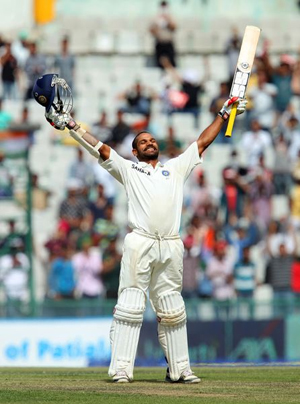
Ind vs Aus: Shikhar Dhawan, Murali Vijay frustrate Australia

March 16, 2013

Shikhar_Dhawan

New Delhi, Mar 16: Debutant Shikhar Dhawan was close to his double ton while Murali Vijay was approaching his second century of the series before the close of the third day play of the third Test with Indian scorecard reading 283/0 against Australia's first innings total of 408 at the PCA stadium in Mohali on Saturday.

Earlier, Dhawan hit a 85-ball hundred, fastest by any cricketer on debut in Test history to give strong reply to the visitors.

Dhawan broke the record of West Indies batsman Dwayne Smith who reached his 100 off 93 balls against South Africa at Newlands, Cape Town in January 2004.

Interestingly, Dhawan raced into the 90s without hitting a single ball in the air. What makes his effort even more praiseworthy is that he maintained a strike-rate of over hundred almost all through his innings. It was a staggering 117.64 when Dhawan got to the three-figure mark.

Earlier, one run was all that separated Starc from becoming the first number nine Australian batsman to notch up a century, as the visitors posted a competitive total.

Ray Lindwall had scored exactly 100 against England at the MCG in 1947 while coming out at number nine.

Though he missed out on the hundred by a whisker, Starc, along with Steven Smith (92), frustrated the Indians for a while, helping Australia add 135 runs in the first session of play before Ravichandran Ashwin trapped last-man Xavier Doherty.

The Indians made three runs in the one over they played before lunch, with Vijay scoring all of them.

But, after the lunch break, the show completely belonged to Dhawan who treated the Australian bowlers with disdain, playing some delightful shots, especially through the heavily populated off-side.

Such was his off-side play that it would have pleased even Sourav Ganguly and former England captain David Gower. The Delhi batsman's timing was impeccable, and his shot-selection faultless.

The Australians, literally, had no answer to counter Dhawan's stroke-play. The way Dhawan dominated the Aussies, it never looked like he was playing in his maiden Test.

In terms of statistics, he hit 19 fours in the first 23 overs, the joint-highest along with West Indian Chris Gayle.

Dhawan reached his 50 off 50 balls, with the help of 12 fours in 72 minutes.

Earlier, Starc was caught behind on 99 by Mahendra Singh Dhoni off Ishant Sharma, which dashed his hopes of becoming the first Australian in 66 years to score a century while batting at number nine.

Another record tumbled on the day as Starc and Smith's 97-run association for the eighth wicket surpassed the previous best of 73 between Shane Watson and Brett Lee for this wicket at this ground. Starc was the more aggressive of the two.

Starc smashed 14 fours and faced 144 balls during his 146-minute stay at the crease. The 23-year-old left-hander from New South Wales was equal to the task whether it was about facing pacers or the spinners.

Making a sort of a lucky comeback to the Test squad after more than two years in wilderness, Smith made it count with a career-best score that included 10 boundaries and a six. He occupied the crease for 235 minutes and faced 185 balls.

A well-deserved century in sight, Smith became a victim of a viciously turning delivery from Pragyan Ojha and an equally good work by India skipper Dhoni, who stumped the batsman in a flash.

India heaved a sigh of relief, but Australia ensured they consolidate their position with another half-century partnership, for the ninth wicket between Starc and Nathan Lyon, with the former firmly in control of the proceedings.

During the course of their innings, both the batsmen had surpassed their previous best Test scores. While Smith's previous best effort -- 77 -- had come against Pakistan at Leeds, Starc's top-score prior to this match was 68 against South Africa in Perth last year.

Not just they added important runs, but did so at a fairly quick rate while keeping the Indian bowlers at bay.

Resuming at 273 for seven, both Smith and Starc were at ease while dealing with the ball, which was 104 overs old at the start of the day's play.

Starc made his intentions clear by pulling Ishant Sharma and then flicked Aswhin for another boundary.

After surviving a close lbw shout by Ishant, Smith got into the act driving him through the off-side for his first authoritative shot of the day. Starc, meanwhile, played Ishant straight over the bowler's head as the ball sped to the fence in one bounce.

The new ball was taken after 108 overs, but it was not the quicker bowlers, but a spinner who gave India the first breakthrough of the day.

Having replaced Aswhin from the pavilion end, Ojha got one to turn and bounce sharply, and Dhoni completed a smart stumping with Smith's back foot on the line.

For India, Ishnat and Ravindra Jadeja finished with three wickets each, while Ashwin and Ojha had two apiece.

Comments

Add new comment

  • Coastaldigest.com reserves the right to delete or block any comments.
  • Coastaldigset.com is not responsible for its readers’ comments.
  • Comments that are abusive, incendiary or irrelevant are strictly prohibited.
  • Please use a genuine email ID and provide your name to avoid reject.
News Network
January 23,2020

Melbourne, Jan 23: Sania Mirza's return to her first Grand Slam after a two-year break was cut short on Thursday when the former world number one was forced to retire midway through her first round match in women's doubles at the Australian Open due to a calf injury.

India's Mirza, who won six Grand Slam doubles titles, took a break from the game after the China Open in October 2017 and gave birth to her son a year later.

The 33-year-old made a winning return to the WTA Tour at this month's Hobart International with Ukrainian Nadiia Kichenok, picking up her 42nd WTA doubles title and the first since winning the women's doubles in Brisbane in 2017.

Mirza said she strained her calf muscle in her right leg during the Hobart final.

"It just got worse in the match. It was bit of a bad strain, but I had a few days off," she told reporters. "So I obviously had to try to do whatever I could to try to get on the court.

"It felt okay when I went on the court, but it was tough to move right. I just felt like I'm gonna tear it or something pretty bad."

Mirza won her first Grand Slam in mixed doubles at the Australian Open in 2009 and also bagged the women's doubles in 2016.

Mirza always believed there was tennis left in her which inspired her comeback, she told Reuters on Sunday.

She had already pulled out of the Australian Open mixed doubles, where she was to partner compatriot Rohan Bopanna.

Mirza and Kichenok were trailing the Chinese pair of Xinyun Han and Lin Zhu 6-2 1-0 on Thursday when the Indian had to call it quits due to the injury.

"As a tennis player you want to compete, it is the Grand Slam. If it's any other tournament, you would probably take a call and be like 'I don't want to risk it'," she said.

Mirza, who is married to former Pakistan cricket captain Shoaib Malik, said she would take two weeks to recover and was hoping to play at next month's Dubai championships.

"When you play a professional sport, injuries are really part of it. And it's something that you have to accept," she said. "Sometimes the timing is really not ideal, it's tough that it happened in a Grand Slam, or just before a Grand Slam."

Comments

Add new comment

  • Coastaldigest.com reserves the right to delete or block any comments.
  • Coastaldigset.com is not responsible for its readers’ comments.
  • Comments that are abusive, incendiary or irrelevant are strictly prohibited.
  • Please use a genuine email ID and provide your name to avoid reject.
Agencies
May 17,2020

Berlin, May 17: Top-flight football in Germany kicked off again on the weekend, becoming the first major sports league in the world to resume play, as parts of Europe took more tentative steps towards normality after the devastation unleashed by the coronavirus pandemic.

With the worldwide death toll past 310,000 and the global economy reeling from the vast damage caused by lockdowns, the reopenings in some of the hardest-hit countries provided much-needed relief from the pandemic.

The French returned to the beach and Italy announced a resumption of European tourism with outbreaks in Europe slowing, but the rising number of fatalities in the United States and Brazil were a grim reminder of the scale of the crisis, with more than 4.6 million infections reported globally.

With governments trying to reopen their economies while avoiding the second wave of infections that could necessitate more lockdowns, Germany's Bundesliga resumed its season on Saturday with games played in vacant, echoing stadiums.

League heavyweights Borussia Dortmund hosted rivals Schalke at the all-but-empty Signal Iduna Park -- which would usually be packed with more than 80,000 raucous fans.

"It's sad that matches are played in empty stadiums, but it's better than nothing," said 45-year-old Borussia Dortmund fan Marco Perz, beer in hand, as he prepared to watch the game on TV.

Dortmund's Erling Braut Haaland became the first player to score a goal after the two-month shutdown and celebrated by dancing alone -- away from his applauding teammates -- in keeping with the strict hygiene guidelines which allowed the league to resume.

The only noise was the cheering and clapping of players and coaches.

League champions Bayern Munich will play Union Berlin in the capital on Sunday, with the resumption in Germany seen as a test case as other top sports competitions try to find ways to resume play without increasing health risks.

"The whole world will be looking at Germany, to see how we get it done," said Bayern boss Hansi Flick.

Prime Minister Giuseppe Conte of Italy, however, said Saturday he needed more guarantees before the government can give the green light for the resumption of its top football league, which is struggling with logistical difficulties as clubs try to arrange training sessions and quarantine facilities.

With the Northern Hemisphere's summer approaching, authorities are moving to help tourism industries salvage something from the wreckage.

Italy, for a long stretch the world's worst-hit country, announced that European Union tourists would be allowed to visit from June 3 and a 14-day mandatory quarantine would be scrapped.

"We're facing a calculated risk in the knowledge that the contagion curve may rise again," Conte said during a televised address.

"We have to accept it otherwise we will never be able to start up again."

In France, the first weekend after the strictest measures were lifted saw many ventures out into the spring sunshine -- and hit the beach.

In the Riviera city of Nice, keen swimmers jumped into the surf at daybreak.

"We were impatient because we swim here all year round," said retiree Gilles, who declined to give his full name.

With the threat of a second wave of infections on their minds, authorities in many countries have asked people not to throng public spaces like beaches as they are made accessible again.

Officials in parts of England on Saturday warned people to stay away from newly reopened beauty spots and avoid overcrowding.

Germany also saw the latest in a growing wave of anti-lockdown protests in many parts of the world, with rallies in major cities bringing together conspiracy theorists, anti-vaccine activists and other extremists.

There were similar protests in France, Switzerland and Poland.

Since emerging in China late last year, the coronavirus has whipped up a catastrophic economic storm, which has left tens of millions unemployed in the United States and many are wondering when a recovery will be possible.

With more than 88,000 deaths and 1.47 million confirmed coronavirus cases, the United States is the worst-hit country on the planet, and the administration of President Donald Trump has faced intense criticism of the way it has handled the crisis.

Former president Barack Obama took a swipe at the response to the pandemic, telling graduates at a virtual commencement ceremony that many leaders today "aren't even pretending to be in charge" -- a remark widely regarded as a rare rebuke of his successor.

Trump is keen to reopen the US economy -- the world's largest -- despite warnings from experts that infections could flare up again if social distancing measures are eased too quickly.

Forty-eight of the 50 US states have now eased lockdown rules to some extent.

Much like Trump and his political allies, Brazil's far-right President Jair Bolsonaro is also keen to end lockdowns, which he claims have unnecessarily damaged the South American nation's economy over a disease he has dismissed as "a little flu".

But the virus has continued its deadly march in Brazil, where the death toll passed 15,000 on Saturday and it became the country with the fourth-largest coronavirus caseload with 230,000 infections.

Comments

Add new comment

  • Coastaldigest.com reserves the right to delete or block any comments.
  • Coastaldigset.com is not responsible for its readers’ comments.
  • Comments that are abusive, incendiary or irrelevant are strictly prohibited.
  • Please use a genuine email ID and provide your name to avoid reject.
News Network
March 19,2020

Geneva, Mar 19: Regional Olympic officials are rallying around the IOC and have backed its stance on opening the Tokyo Games as scheduled, as direct criticism from gold medalist athletes built amid the coronavirus outbreak.

Leaders of continental Olympic groups praised the IOC after a conference call Wednesday to update them on coronavirus issues four months before the opening ceremony in Tokyo on July 24.

"We are living through an unpredictable crisis and as such, it is important that we have one policy, expressed by the IOC, and we follow that policy in unison," the Italy-based European Olympic Committees said.

However, when the International Olympic Committee published an interview with its president, Thomas Bach, after a separate call with athlete representatives, it prompted a four-time Olympic champion to urge postponing the games.

Bach acknowledged that many athletes were concerned about qualifying events being canceled, but noted that there were still four months to go until the games are set to be opened.

"We will keep acting in a responsible way in the interests of the athletes," Bach said.

British rowing great Matthew Pinsent wrote on Twitter that the comments from Bach, his former IOC colleague, were "tone deaf."

"The instinct to keep safe (not to mention obey govt instructions to lock down) is not compatible with athlete training, travel and focus that a looming Olympics demands of athletes, spectators organisers," Pinsent wrote.

Responding to the criticism from Hayley Wickenheiser, a four-time Olympic hockey gold medalist, the IOC said it was "counting on the responsibility and solidarity of the athletes."

Members reinforce faith in IOC

The IOC repeated its steadfast stance after a conference call with sports governing bodies, many of which have not completed qualification events for Tokyo.

"There is no need for any drastic decisions at this stage; and any speculation at this moment would be counter-productive," the IOC said.

That message was repeated after Wednesday's conference call by IOC executive board member Robin Mitchell, the interim leader of the group of national Olympic bodies known as ANOC.

"We share the view that we must be realistic, but not panic," Mitchell said in a statement released by the IOC on behalf of the Oceania Olympic group.

Offering unanimous support for the IOC's efforts to resolve qualification issues, the 41-nation Pan-American group noted challenges facing potential Olympians.

Australian Olympic Committee chief executive Matt Carroll said his organized recognized there was a global health crisis, but equally was assured by the IOC that the games would go ahead.

"We recognize people are suffering -- people are sick, people are losing jobs, businesses are struggling amid enormous community uncertainty. Things are changing everyday and we all must adapt," Carroll said.

"We owe it to our Australian athletes to do everything we can to ensure they will participate with the best opportunity in those Games."

Australia's team delegation leader said the focus now was "moving to the planning of our pre-Games preparation to ensure we get our athletes to the Games healthy, prepared and virus free."

"Clearly that is a major challenge for all National Olympic Committees," he said.

Comments

Add new comment

  • Coastaldigest.com reserves the right to delete or block any comments.
  • Coastaldigset.com is not responsible for its readers’ comments.
  • Comments that are abusive, incendiary or irrelevant are strictly prohibited.
  • Please use a genuine email ID and provide your name to avoid reject.