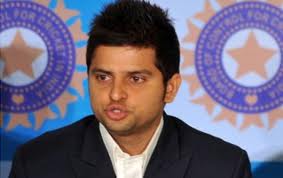
Raina to replace Dhawan

March 20, 2013

Raina_Dhawan

New Delhi, Mar 20: Suresh Raina will replace Shikhar Dhawan, who has been ruled out of the fourth and last Test against Australia, scheduled to held at his home ground Ferozshah Kotla here from March 22-26, owing to a fracture in his left hand. He will be out of action for six weeks.

The All-India Senior Selection Committee initially added Gautam Gambhir and Raina to the squad for the fourth Test.

But Gambhir was diagnosed with jaundice after he went for the blood test earlier in the day and therefore cannot take part in the Delhi Test.

"Gambhir has been diagnosed with jaundice after undergoing a blood test earlier today. The official announcement of the team was delayed, as the Board was waiting for the copy of the report," BCCI secretary Sanjay Jagdale said.

India lead the four-Test series 3-0, having won the first three matches.

The team: MS Dhoni (captain), Murali Vijay, Cheteshwar Pujara, Sachin Tendulkar, Virat Kohli, Ravindra Jadeja, Harbhajan Singh, R Ashwin, Pragyan Ojha, Bhuvneshwar Kumar, Ajinkya Rahane, Ashok Dinda, Suresh Raina, Ishant Sharma.

Comments

Add new comment

  • Coastaldigest.com reserves the right to delete or block any comments.
  • Coastaldigset.com is not responsible for its readers’ comments.
  • Comments that are abusive, incendiary or irrelevant are strictly prohibited.
  • Please use a genuine email ID and provide your name to avoid reject.
News Network
May 25,2020

Karachi, May 25: Pakistan head coach and chief selector Misbah-ul-Haq believes Babar Azam is destined to be a world-class player and is very close to being in the same league as India skipper Virat Kohli and Australia's Steve Smith.

"I don't like comparisons but Babar is currently very close to being in the same class as Virat Kohli, Steve Smith or Joe Root," Misbah said in an interview to Youtube channel, Cricket Baaz.

"He believes in the work ethic that if you want to better Kohli you have to work harder than him at your skills, fitness and game awareness."

The 25-year-old, who was named captain of the Pakistan T20 team ahead of the Australia series in October last year, was recently handed the reins of ODI team as well.

"Making him the T20 captain was a tester. We wanted to see how he will respond to this challenge. All of us agree that he has done a very good job and his biggest plus is that being among the worlds top players he leads by example," Misbah said.

"If you are a performer like Babar then it becomes easier for you to motivate the rest of the team and get things done.

"Even when I was made captain in 2010 my performances were here and there and I was in and out. But captaincy changed my game and mindset and I became a more hard-working and motivated cricketer."

Misbah said Babar always challenges himself and would get better as a captain with experience.

"He is in a zone of his own. He just doesn't want to be in the team. He just doesn't want to play for money. He wants to be the top performer for Pakistan. He is always pitting himself against other top batsmen like Kohli or Smith," he said.

"He loves challenges in the nets and on the field. He has really matured as a player and in time he will get better as a captain with experience."

Babar was the leading run-scorer of the T20I series against Australia last year. He also scored 210 runs, which included a hundred, at 52.50 in the Test series against the same opponents.

In the two-Test home series against Sri Lanka, Babar ended the series with 262 runs with an average of exactly 262.

Misbah feels Babar had changed as a batsman when he got runs in the Tests in Australia.

"Before that he was getting runs in tests but not consistently. In Australia and in the following tests against Sri Lanka and Bangladesh he changed," he said.

Talking about his experience as a head coach, Misbah said: "Having captained, it has helped me a lot. As captain I had to manage everything and also having played under top coaches ... I have seen closely their work ethics and how they managed things.

"It is a learning process. Having remained captain it is a big advantage for coaching because you know the players and their mood swings. You know which player will respond in a given situation,which player is feeling pressure in a scenario.

Misbah said it is not easy juggling between different roles.

"Most important thing as a coach is mentally and psychologically how you handle a group of players," the former skipper said.

"Sometimes captain and coach is different as you have to take tough decisions. Being chief selector makes it it a bit difficult but I had experience of creating and managing teams, I have been building teams since 2003. Till now it is going well."

Misbah feels in Pakistan cricket there were different parameters for judging foreign and local coaches.

"I don't know why it is like this why do we have different eye for locals and foreigners. Maybe we feel they have something special. It looks like every decision by a foreign coach is right. In contrast we tend to be very critical of local coaches no matter what decision they take," he said.


Comments

Add new comment

  • Coastaldigest.com reserves the right to delete or block any comments.
  • Coastaldigset.com is not responsible for its readers’ comments.
  • Comments that are abusive, incendiary or irrelevant are strictly prohibited.
  • Please use a genuine email ID and provide your name to avoid reject.
News Network
July 3,2020

Karachi, Jul 3: There was a sense of insecurity among Pakistan players during the 2019 World Cup, claims former chief selector Inzamam-ul-Haq, who also reckons that the PCB should have given Sarfaraz Ahmed more time as captain instead of removing him abruptly.

Inzamam said captains need to be backed since they get better with time.

"Even in the last World Cup I felt the captain and players were under pressure because they were thinking if we don't do well in the tournament we will be out. That environment was created and this is not good for cricket," Inzamam said.

"Sarfaraz achieved some notable victories for Pakistan and was learning to be a good captain but unfortunately when he had learnt from experience and mistakes he was removed as captain," the former captain told a TV channel.

Inzamam remained chief selector from 2016 till the 2019 World Cup. During his tenure, most of the time Sarfaraz remained captain.

Soon after Inzamam was replaced by head coach Misbah-ul-Haq, the Pakistan Cricket Board removed Sarfaraz as a player and captain from all three formats.

"Sarfaraz won us the Champions Trophy and also made the team number one in T20 cricket. He got us some good wins. He should have been given more time as captain by the board but it acted in haste and didn't give him confidence or patience."

The PCB has now given the Test captaincy to senior batsman, Azhar Ali while young batsman Babar Azam leads the side in the white ball formats.

Inzamam, the most capped player for Pakistan, also said that the captain's own performance can dip as he had to focus a lot on other players.

"But a captain learns all this with time. There is no shortcut to it."

He pointed out that people praise Imran Khan’s leadership qualities and captaincy but he also won the World Cup on his third attempt as captain.

"He won the 1992 World Cup because by that time he had become a seasoned captain and learnt to motivate his players and get them to fight in every match."

Inzamam said giving confidence to new players and youngsters is very important for the selectors. He gave the example of Babar Azam.

"Babar struggled initially in Test cricket but we never had any doubt about his ability so we persisted with him and see today where he is standing in all formats."

He also described Babar and pacer, Shaheen Shah Afridi as and future stars.

"Babar is always compared to Virat Kohli but the latter has played a lot more cricket and if you look at their stats and performances at the stage Babar is now, he has not done badly at all."

Comments

Add new comment

  • Coastaldigest.com reserves the right to delete or block any comments.
  • Coastaldigset.com is not responsible for its readers’ comments.
  • Comments that are abusive, incendiary or irrelevant are strictly prohibited.
  • Please use a genuine email ID and provide your name to avoid reject.
News Network
February 11,2020

Melbourne, Feb 11: Opener David Warner received Allan Border Medal, while all-rounder Ellyse Perry bagged Belinda Clarke medal in the 2020 Australian Cricket Awards on Monday.

Warner secured his third (2016, 2017, 2019) Allan Border Medal and Perry a trio of Belinda Clarke Awards (2016, 2018, 2019) as voted by their peers, umpires and the media across all forms and every game of international cricket in 2019.

Warner dominated the ICC World Cup with 647 runs including a highest score of 166 at an average of 71.88, including three centuries. He then rebounded from a challenging Ashes series to dominate at home in the T20I series against Sri Lanka and Pakistan, the Test series against Pakistan - which included his memorable innings of 335 not out in Adelaide - and the Test series against New Zealand.

Warner (194) outpolled Ashes hero Steve Smith by a single vote for the Allan Border Medal with paceman Pat Cummins, the ICC International Cricketer of the Year, third in the polling with 185 votes.

Perry enjoyed an incredible year with both bat and ball, starting with dominant Ashes performances which included an innings of 116 in the Test in Taunton and 11 wickets in the three ODIs.

Her figures of 7-22 at Canterbury were the best ODI figures by an Australian woman's player. She backed that up against the West Indies by taking 3-17 in the opening ODI and then scoring 112 not out in Antigua before finishing the year with a solid series against Sri Lanka at home. Perry (161) was a comfortable winner of her third Belinda Clarke Award from Alyssa Healy (153) and Jess Jonassen (87) taking second and third place respectively in the voting.

Breakout batsman Marnus Labuschagne's superlative Test summer and Ashes series secured him the Male Test Player of the Year. Having replaced Steve Smith as a concussion substitute in the Lord's Test, Labuschagne went on to make 353 runs at 50.42 in the Ashes.

His outstanding form continued at home with a first-up 185 against Pakistan at the Gabba and a Test high 215 against New Zealand in Sydney. He scored 347 runs at an average of 173.5 against Pakistan and 549 runs at 91.5 against New Zealand. Limited overs captain Aaron Finch (38) capped a stellar year by being voted the Men's One-Day International Player of the Year ahead of Usman Khawaja (33) and Warner (24).

Finch's year included a massive series against Pakistan in the UAE with 451 runs at 112.75, including knocks of 116, 153 not out and 90. He then dominated the World Cup with 507 runs at 50.7, including 153 against Sri Lanka and 100 against England at Lords. Warner (19) continued his magical year in the T20I game to become the Men's T20 International Player of the Year from Glenn Maxwell (16). Kane Richardson and Steve Smith (8) tied for third.

Alyssa Healy claimed top honours as the women's One-Day International Player of the Year with 39 votes ahead of Perry (33) and Jonassen (19). Healy scored a double by also claiming the women's T20 Player of the Year with 18 votes, ahead of Jonassen and Meg Lanning who were tied on 15. It was the second consecutive year that Healy has won the women's ODI and T20 Awards.

West Australian veteran Shaun Marsh was voted Men's Domestic Player of the Year with 1322 runs at 52.88 in all forms of the game, including the highest score of 214, while breakout paceman Wes Agar was named the Bradman Young Cricketer for his 41 wickets at 22.62 in the year.

Molly Strano and Tayla Vlaeminck took the prized Women's Domestic Player of the Year and Betty Wilson Young Cricketer of the Year awards respectively.

Strano took 28 wickets in 22 games while Vlaeminck's 19 wickets for the year reinforced her enormous potential.

Former Hobart Hurricane Corrine Hall was named Community Champion for her work as an Ambassador of the Kindness Factory, grassroots cricket, and upcoming book Victress, which features 35 iconic female athletes and their stories. Each portrait is accompanied by the athlete's story, with a particular focus on how kindness impacted their journey.

The awards for international cricket are based on votes from players, umpires and the media on a 3-2-1 basis from each match. For the domestic awards, the votes are collected from all players.

Comments

Add new comment

  • Coastaldigest.com reserves the right to delete or block any comments.
  • Coastaldigset.com is not responsible for its readers’ comments.
  • Comments that are abusive, incendiary or irrelevant are strictly prohibited.
  • Please use a genuine email ID and provide your name to avoid reject.