


Kings XI keep their slender hopes alive

May 17, 2013

Kings_XI

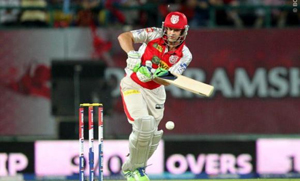
Dharamsala, May 17: Kings XI Pu¬njab eked out a close seven-run win over Delhi Daredevils here on Thursday to keep alive their slim chances of qualifying for the play-offs of the Indian Premier League.

Kings XI first rode on David Miller and captain Adam Gilchrist’s whirlwind knocks to post a challenging 171 for four.

Miller scored an unbeaten 44 off just 24 balls towards the end, while Gilchrist made 42 off 26 balls upfront. Shaun Marsh also played a sedate 44-ball 45-run knock to help Kings XI’s cause.

Defending the total, Sandeep Sharma returned with figures of three for 23 to help Kings XI restrict Daredevils to 164 for seven. Chasing 172 for win, Delhi lost Unmukt Chand, Irfan Pathan and David Warner early with just 12 runs on the board.

While Chand was bowled by Praveen Kumar, Pathan and Warner were picked up by Sandeep in successive balls in the last two deliveries of the fourth over. Pathan edged a swinging delivery to Gilchrist behind the stumps and then a ball later Warner departed without opening his account, caught by Marsh in the slips.

Skipper Mahela Jayawardene (39) and Virender Sehwag (30) shared 49 runs off 40 balls for the fourth wicket before the latter edged one to Gilchrist off Parvinder Awana’s bowling.

Sehwag laced his 22-balls innings with six fours. Jayawardene and Ben Rohrer (49) then added quick 50 runs off 5.3 overs to keep Delhi’s hopes alive.

The ever-climbing asking rate finally took a toll on Jayawardene, who was caught by Manan Vohra to give Sandeep his third wicket of the day. He hit three fours and a six during his 42-ball knock.

But Rohrer kept Delhi in the hunt as, needing 41 off 12 balls, the left-hander picked up 19 runs of the penultimate over off Azhar Mahmood to bring dowm the equation to 22 off the final six deliveries.

But it was not to be as Rohrer was bowled by a quicker one by Piyush Chawla in the first ball of the last over.

New man in Morne Morkel (13) brought Delhi close with some lusty hitting but the visitors eventually fell short.

Earlier sent into bat, Gilchrist got Kings XI off to a blazing start racing the hosts to the 50-run mark in the sixth over.

Gilchrist sent the Delhi bowlers on a leather hunt from the word go. He was particularly severe on Ashish Nehra (2/38) as he clobbered the left-arm pacer to all parts of the ground to pick up 27 runs off the bowlers opening two overs.

Gilchrist was going great guns before perishing while going for one too many big shots, caught by Pathan off his own bowling in the eight over. Her hit five fours and two towering sixes.

Comments

Add new comment

  • Coastaldigest.com reserves the right to delete or block any comments.
  • Coastaldigset.com is not responsible for its readers’ comments.
  • Comments that are abusive, incendiary or irrelevant are strictly prohibited.
  • Please use a genuine email ID and provide your name to avoid reject.
News Network
May 28,2020

New Delhi, May 28: India is not at risk of losing hosting rights for next year's Twenty20 World Cup despite its cricket board's failure to secure a tax exemption for the event, a key BCCI official has told Reuters.

Tax exemptions for International Cricket Council (ICC) events are listed as a requirement in host agreements and the BCCI was supposed to confirm they had secured one by May 18.

ESPNcricinfo, citing correspondence between the two bodies, has reported that the ICC has threatened to shift the tournament away from India over the issue.

However, BCCI treasurer Arun Singh Dhumal told Reuters that would not happen and that negotiations were continuing.

"There is no risk to the tournament," he said by telephone.

"That is a work in progress. We are discussing it with the ICC and we'll resolve it."

The BCCI encountered a similar problem when it hosted the event in 2016 when the government refused to provide a tax exemption, and there has been no change in New Delhi's stance despite the board's appeals.

Failure to secure that exemption in 2016 saw the ICC withhold an equivalent sum from India's share of revenue from the governing body's grants and it appears to be taking an even harder line this time around.

"There are certain timelines within the agreements that we collectively work towards to ensure we can deliver successful world class events and continue to invest in the sport of cricket," an ICC spokesperson told Reuters.

"In addition to this the ICC Board agreed clear timelines for the resolution of the tax issues which we are guided by."

Comments

Add new comment

  • Coastaldigest.com reserves the right to delete or block any comments.
  • Coastaldigset.com is not responsible for its readers’ comments.
  • Comments that are abusive, incendiary or irrelevant are strictly prohibited.
  • Please use a genuine email ID and provide your name to avoid reject.
Agencies
July 8,2020

New Delhi, Jul 8: After a hiatus of 116 days, international cricket will be resuming today as England and West Indies lock horns in a three-match Test series.

Since March, no international cricket has been played due to the coronavirus pandemic. Because of this virus, whole sporting action across the world came to a standstill.

Australia and New Zealand had played the last international cricket match on March 13 behind closed doors, but the remaining two ODIs of this particular series were cancelled due to COVID-19.

India and South Africa's ODI series also met the same fate due to the pandemic.
It was looking as if it will take a while for sports to come back, but slowly and steadily, all different sports have managed to get into gear and provide fans some respite in these turbulent times.

German football league Bundesliga was the first one to come back, and the organisers set the template as to how to go about conducting tournaments behind closed doors, keeping all safety protocols in check.

Soon after, La Liga, Premier League, and Serie A followed and all major football leagues came back on the television screens across the globe. Formula One kickstarted last week with the Austrian Grand Prix and now it is the time for cricket to resume.

The series between England and West Indies will be played behind closed doors and the matches will be played in Southampton and Manchester. This will be the first time in the 143-year long history of Test cricket that the matches will be played without no crowds.

The England-Windies Test series will be held at Hampshire's Ageas Bowl and Lancashire's Emirates Old Trafford, which have been chosen as bio-secure venues. After the series against West Indies, England would also lock horns with Ireland in three ODIs and Pakistan in three ODIs and as many T20Is.

However, the series against West Indies will be followed closely across the world as all other boards would be looking to see as to how cricket series can be scheduled in their own backyard with the current scenario regarding coronavirus.

The dates for three Tests against West Indies are:

First Test: July 8-12 at Ageas Bowl
Second Test: July 16-20 at Emirates Old Trafford
Third Test: July 24-28 at Emirates Old Trafford

Windies side had arrived in the UK in mid-June and the entire camp had to quarantine themselves for 14 days at Manchester.

For the entire tour, the West Indies squad will live, train and play in a 'bio-secure' environment in England as part of the comprehensive medical and operations plans to ensure player and staff safety.

The bio-secure protocols will also restrict movement in and out of the venues.
Both England and West Indies have played intra-squad practice matches to get some cricketing form back.

While England played their practice match in Southampton, Windies played theirs at Manchester.

West Indies will be led by Jason Holder, while Ben Stokes would captain England in the first Test as regular skipper Joe Root has left the bio-secure bubble to attend the birth of his second child.

England squad for the first Test: Ben Stokes (captain), James Anderson, Jofra Archer, Dom Bess, Stuart Broad, Rory Burns, Jos Buttler, Zak Crawley, Joe Denly, Ollie Pope, Dom Sibley, Chris Woakes, Mark Wood.

West Indies squad for the first Test: Jason Holder (captain), Jermaine Blackwood, Nkrumah Bonner, Kraigg Brathwaite, Shamarh Brooks, John Campbell, Roston Chase, Rahkeem Cornwall, Shane Dowrich, Shannon Gabriel, Chemar Holder, Shai Hope, Alzarri Joseph, Raymon Reifer, and Kemar Roach.

As safety precautions against the coronavirus, the International Cricket Council (ICC) has also brought about some changes to the playing conditions. The new guidelines include the ban of saliva to shine the ball and allowing replacement of players displaying symptoms of COVID-19 during a Test match.

Players will not be permitted to use saliva to shine the ball. If a player does apply saliva to the ball, the umpires will manage the situation with some leniency during an initial period of adjustment for the players, but subsequent instances will result in the team receiving a warning.

A team can be issued up to two warnings per innings but repeated use of saliva on the ball will result in a 5-run penalty to the batting side. Whenever saliva is applied to the ball, the umpires will be instructed to clean the ball before play recommences.

Also, the requirement to appoint neutral match officials has been temporarily removed from the playing conditions for all international formats owing to the current logistical challenges with international travel. The ICC will be able to appoint locally based match officials from the ICC Elite Panel of Match Officials and the ICC International Panel of Match Officials.

Moreover, teams will be allowed to replace players displaying symptoms of COVID-19 during a Test match. In line with concussion replacements, the match referee will approve the nearest like-for-like replacement. However, the regulation for COVID-19 replacements will not be applicable in ODIs and T20Is.

The ICC had also confirmed an additional unsuccessful DRS review for each team in each innings of a match, keeping in mind that there may be less experienced umpires on duty at times.

This will increase the number of unsuccessful appeals per innings for each team to three for Tests and two for the white-ball formats.

The first Test between England and West Indies gets underway later today from 3:30 PM IST.

Comments

Add new comment

  • Coastaldigest.com reserves the right to delete or block any comments.
  • Coastaldigset.com is not responsible for its readers’ comments.
  • Comments that are abusive, incendiary or irrelevant are strictly prohibited.
  • Please use a genuine email ID and provide your name to avoid reject.
Agencies
April 2,2020

Lausanne, Apr 2: The postponement of the Tokyo Olympics and the shutdown of the sporting calendar because of the coronavirus pandemic are going to hit international sports federations hard financially.

Many sports that are part of the Games depend heavily on the payouts every four years from the International Olympic Committee (IOC).

"The situation is tense and very gloomy. An assessment will be made, but clearly some posts are under threat," said an official of a major international federation.

The 28 international federations (IF) of the sports that were due to be present at the Tokyo Olympics, would have received substantial sums from the IOC.

However, the postponement of the Games until 2021 could lead to a freeze of their payment.

"We have a lot of IF with substantial reserves, but others work on a different business model, they have income from major events which are suspended, which can be a problem for the cashflow if they don't have enough reserves," said Andrew Ryan, director general of the Association of International Olympic Summer Sports Federations (ASOIF), which is responsible for distributing this money.

The five additions to the Tokyo Games programme - karate, surfing, skateboarding, climbing and baseball/softball - are not eligible.

The Olympic payout totalled 520 million after the Rio Games, four years ago.

"The Olympic money could be less than for Rio 2016," Ryan warned before adding: "My advice is to budget the same as in Rio".

The federations receive money on a sliding scale determined by their audience and size.

The three largest (athletics, swimming and gymnastics) can expect approximately 40 million.

For the second tier, made up of cycling, basketball, volleyball, football and tennis, the sum is 25 million.

For group three, which contains eight sports, including boxing, rowing, judo and table tennis, it is 17 million.

The nine sports in the next level (including sailing, canoing and fencing) receive 12 million.

For the three in the last category (rugby, golf, modern pentathlon) the payout is 7 million.

For the largest associations, such as football's FIFA which has a 1.5 billion nest egg, or basketball body FIBA which has CHF 44.4 million (42 million euros) in reserves, IOC aid represents a small proportion of their income.

For others, it is vital.

"Some IF probably don't have the cashflow to survive one year," said Ryan.

For most federations, the postponement of the Olympic Games has a domino effect, forcing them to reschedule their own money-earning competitions.

"The revenues from these events will eventually come in," said Ryan. "But this impacts the cashflow." World Athletics has already postponed the 2021 World Championships in Eugene, Oregon to 2022.

The International Swimming Federation (FINA) will have to do the same for its World Championships scheduled for next summer in Fukuoka, Japan, when they would probably clash with the Tokyo Games.

"One edition of the World Championships means for us 10 million in revenues," said one sports federation official, speaking on condition of anonymity.

"If this income is postponed, totally or partially, for a year, we will face major problems, especially if the IOC money, originally expected in September, is not paid out."

The Singapore-based International Table Tennis Federation has already taken steps, with "the Executive Committee agreeing to reduce their expenses and senior staff offering to take a salary reduction," said marketing director Matt Pound, but, he added,"further cuts will take place if needed."

- 'Significant loss of revenue' -

The ITTF has suspended all its competitions until June and that is costly.

Kim Andersen, the Danish president of London-based World Sailing, said commercial revenues are not immune.

"The IOC will eventually pay out its aid, but what weighs most heavily is the uncertainty about whether our competitions will be held and whether our sponsors will be maintained," he said.

The IOC is not prepared to go into details of what it plans.

"It is not possible at this stage to assess the overall impact" of the postponement of the Tokyo Olympics, an official told AFP.

"It depends on a number of variables that are currently being studied." According to an official of one federation: "the IOC will discuss on a case-by-case basis, sport by sport".

Another option is for the federations to ask for a share of the public aid set up to deal with the coronavirus crisis, in Switzerland, where 22 ASOIF members are based and also in the United Kingdom, home of World Sailing.

"Can sports federations benefit from federal aid? The answer is yes, in principle," Philippe Leuba, State Councillor of the canton of Vaud, in charge of the economy and sport, told.

Comments

Add new comment

  • Coastaldigest.com reserves the right to delete or block any comments.
  • Coastaldigset.com is not responsible for its readers’ comments.
  • Comments that are abusive, incendiary or irrelevant are strictly prohibited.
  • Please use a genuine email ID and provide your name to avoid reject.